


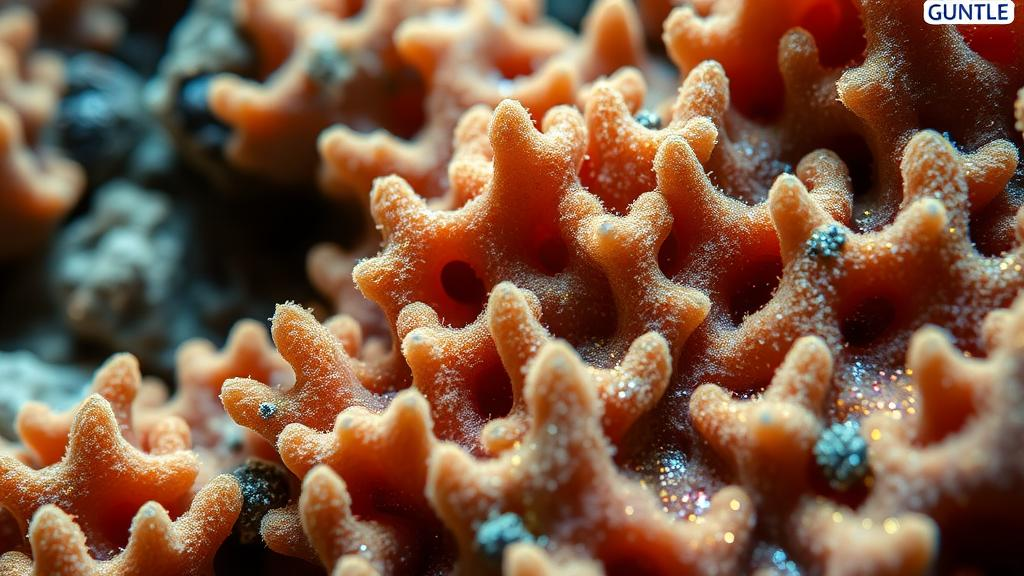
On two of the most isolated islands in the Atlantic Ocean, scientists have found something unexpected glittering beneath the waves. Corals living around the Trindade and Martim Vaz archipelago, a volcanic island group roughly 1,140 kilometers east of the Brazilian coast, have been ingesting microscopic particles of glitter. The discovery, reported in the journal Discover Oceans, marks the first time glitter particles have ever been documented inside coral tissue, and it delivers a sobering message: no marine ecosystem, however remote, is beyond the reach of plastic pollution.
The research team, led by Lucas Gonçalves Queiroz of the University of São Paulo, examined fragments of two reef-building coral species collected in May 2022 from three sampling sites across the archipelago. One species, Mussismilia hispida, is endemic to Brazil, while the other, Montastraea cavernosa, ranges widely across the Atlantic. Both are scleractinian, or stony, corals, the architects of reef structures that shelter roughly a quarter of all marine species on less than one percent of the ocean floor. What the researchers found inside the soft tissues of these animals was startling in both quantity and identity: flat, hexagonal flakes of polyethylene terephthalate, the polymer better known as PET, which forms the reflective core of virtually all commercial glitter.
The numbers are striking. In M. hispida from the Trindade sampling site designated TR2, the team counted an average of 629.63 glitter particles per gram of soft tissue, with a standard deviation of 101.23. M. cavernosa from the same site contained an average of 304.76 particles per gram, while M. cavernosa from Martim Vaz, 48 kilometers away, carried a lower but still significant load of 62.92 particles per gram. The average particle size was just 28.10 micrometers, with a standard deviation of 7.17, meaning these flakes are smaller than the width of a human hair. Notably, the study counted only particles that had been internalized within the coral’s soft tissue; particles adhering to external surfaces were excluded, so the true contamination burden is likely far higher.
Identifying the particles required a two-step chemical digestion process. Coral fragments were first treated with potassium hydroxide at 60 degrees Celsius for 48 hours, then with hydrogen peroxide under the same conditions, dissolving the biological material and liberating any embedded plastics. The resulting suspension was filtered through a 0.6-micrometer fiberglass membrane and examined under a stereomicroscope. To confirm the polymer identity, the team used Raman spectroscopy with a 532-nanometer laser, comparing the spectra of extracted particles against those of new commercial glitter. The extracted particles displayed the same characteristic PET vibrational bands at 632, 859, 1288, 1615, and 1725 inverse centimeters, corresponding to carbon-hydrogen bending, carbon-carbon-oxygen stretching, carbon-oxygen stretching, aromatic ring vibrations, and carbonyl stretching respectively. The match was unambiguous.
Rigorous contamination controls underscore the reliability of the findings. All glassware was rinsed repeatedly with filtered ultrapure water and cleaned with acetone-soaked cotton, reagents were pre-filtered, and all manipulation took place in a fume hood with researchers wearing nitrile gloves and cotton lab coats. A control experiment run without coral samples detected only 5.3 colorless fibers on average, which were excluded because they did not match the hexagonal platelet morphology under investigation. The team also restricted their visual analysis to hexagonal particles, which account for approximately 77.8 percent of global glitter production, to ensure accuracy in identification. One lone star-shaped particle turned up in the samples but was excluded from the counts.
Perhaps the most puzzling aspect of the discovery is the source. The Martim Vaz islets are too small to support human habitation, and Trindade hosts only a small Brazilian Navy facility whose inorganic waste is either shipped to the mainland for recycling or incinerated on site. Since 2018, the archipelago has sat within a marine protected area covering roughly 925,000 square kilometers. Glitter is not used there. The researchers therefore conclude that the particles arrived by sea, most likely carried within the South Atlantic Subtropical Gyre, the vast wind-driven current system that traps floating debris in what has become known as the South Atlantic Garbage Patch, an accumulation zone spanning approximately 0.7 million square kilometers.
The archipelago lies about 500 kilometers north of the garbage patch’s core, and its windward beaches already accumulate stranded plastics carried by the gyre’s counterclockwise rotation. Modeling studies identify South America and Africa as the primary land-based sources of debris in the region, though discarded bottles from Asian shipping now dominate the floating litter found as far away as Tristan da Cunha. Shipping itself is a plausible glitter vector: a recent analysis estimated that up to a quarter of the global cruise fleet discharges untreated sewage directly into the ocean, releasing as much as 100,000 tons of microplastics annually. Wastewater treatment plants on continents, each capable of emitting tens of millions of microplastic particles per day, add to the load that currents eventually sweep into open water.
The physical properties of glitter make it a particularly insidious pollutant. Glitter flakes are typically cut from biaxially oriented PET film coated with aluminum for reflectivity, and variants made of polyvinyl chloride and poly(methyl methacrylate) also exist. All three polymers are denser than seawater, which should cause them to sink, yet turbulence can keep them suspended and transport them across entire ocean basins. As the particles weather, abrasion, ultraviolet radiation, oxidation, and microbial attack degrade the plastic, reducing its molecular mass and density, which increases resuspension and extends the distance particles can travel. The degradation signs observed in the Trindade corals, including rough surfaces, faded color, and irregular edges, suggest the particles had spent varying lengths of time in the environment, hinting that contamination occurred repeatedly rather than in a single event.
Why corals accumulate these particles is a question of growing ecological urgency. Reef structures physically reduce water turbulence, enhancing the retention and deposition of suspended particles, and corals ingest plastics both actively through feeding and passively through mucus production. M. hispida, notably, can shift between autotrophic and heterotrophic feeding multiple times a year in response to environmental stress, and greater reliance on capturing prey may explain its higher glitter burden, though the authors caution this hypothesis remains untested. Laboratory studies have already shown that microplastic ingestion can impair feeding performance and growth in corals, trigger oxidative stress and histological damage, and suppress detoxification and immune capacities. Small particles are especially concerning because they tend to be retained within the digestive system, potentially causing blockages and cumulative exposure, and their size only decreases as degradation proceeds.
The concentrations documented in this remote archipelago exceed those reported for corals near inhabited coastlines, a comparison the authors describe as surprising given that no glitter is used locally. Previous studies in the South China Sea and near Taiwan recorded microplastic loads in corals that were orders of magnitude lower per gram of tissue, though those studies focused on larger particles. The finding suggests that surveys targeting only larger microplastics may dramatically underestimate contamination, and that glitter, a single-use material whose global market was valued at 353 million dollars in 2020 and is projected to reach 526 million dollars by 2026, deserves far more scrutiny. The European Union has already moved to ban the intentional addition of synthetic polymer microparticles, including glitter, in commercial products under Commission Regulation 2023/2055. As the authors conclude, coral reefs act as sinks for microplastic pollution, and with limited pathways for permanent removal, concentrations in these ecosystems will only rise unless primary microplastics are curbed at the source. For the corals of Trindade and Martim Vaz, the sparkle of the party industry has arrived in one of the ocean’s last wild places, and it is not leaving.
Subject of Research: Microplastic glitter contamination in corals of a remote Atlantic archipelago
Article Title: First record of glitter particles in coral reefs from a remote archipelago in the Atlantic Ocean
Article References: Queiroz, L. G., Maricato, G., Gomes, E., Lima, G. V., Ando, R. A., Tavares, M., Pompêo, M., & Rani-Borges, B. (2026). First record of glitter particles in coral reefs from a remote archipelago in the Atlantic Ocean. Discover Oceans, 3(1), Article 11. https://doi.org/10.1007/s44289-026-00127-3
Image Credits: AI Generated
DOI: 10.1007/s44289-026-00127-3
Keywords: microplastics, glitter, coral reefs, Trindade, Martim Vaz, PET, Raman spectroscopy, marine pollution, South Atlantic Subtropical Gyre, Mussismilia hispida, Montastraea cavernosa, ocean currents
Cite Scienmag News
Reese Ellison. (October 4, 2026). Glitter Found Inside Corals on Remote Atlantic Islands in a First for Science. Scienmag. https://scienmag.com/glitter-found-inside-corals-on-remote-atlantic-islands-in-a-first-for-science/
Reese Ellison. "Glitter Found Inside Corals on Remote Atlantic Islands in a First for Science." Scienmag, 4 October 2026, https://scienmag.com/glitter-found-inside-corals-on-remote-atlantic-islands-in-a-first-for-science/. Accessed 4 October 2026.
Reese Ellison. "Glitter Found Inside Corals on Remote Atlantic Islands in a First for Science." Scienmag. October 4, 2026. https://scienmag.com/glitter-found-inside-corals-on-remote-atlantic-islands-in-a-first-for-science/


