

Monday, October 26, 2026
Science
No Result
View All Result
  • Login
  • HOME
  • SCIENCE NEWS
  • CONTACT US
  • HOME
  • SCIENCE NEWS
  • CONTACT US
No Result
View All Result
Scienmag
No Result
View All Result
Home Science News Cancer

RNF152 Tags PD-L1 for Destruction and Curbs Immune Evasion in Kidney Cancer

October 26, 2026
in Cancer
Nathaniel Bowman
By Nathaniel Bowman Scienmag Editorial Profile - Precision Oncology
Reading Time: 3 mins read
0
RNF152 Tags PD-L1 for Destruction and Curbs Immune Evasion in Kidney Cancer

RNF152 Tags PD-L1 for Destruction and Curbs Immune Evasion in Kidney Cancer

65
SHARES
587
VIEWS
Share on FacebookShare on Twitter
ADVERTISEMENT

A study published in Medical Oncology reports that the ubiquitin E3 ligase RING finger protein 152 (RNF152) is expressed at low levels in clear cell renal cell carcinoma (ccRCC) and that higher RNF152 expression correlates with better patient survival, based on bioinformatics analysis of RNA expression profiles from The Cancer Genome Atlas (TCGA). The work, authored by Qiang Wang, Yue-Ru Liu, Xiu-Bo Zhu, Ji-Chao Peng, Shuang Chen and colleagues, set out to define the role of RNF152 in ccRCC and to identify the molecular mechanism behind its effects.

In cell culture experiments, forcing ccRCC cells to overexpress RNF152 inhibited their proliferation and reduced their ability to evade immune attack, while knocking RNF152 down produced the opposite effects. Cytotoxicity assays using co-cultured CD8+ T cells, the immune cells that normally kill tumor cells, showed that RNF152-high tumor cells were more vulnerable to immune-mediated killing, whereas RNF152-depleted cells resisted it.

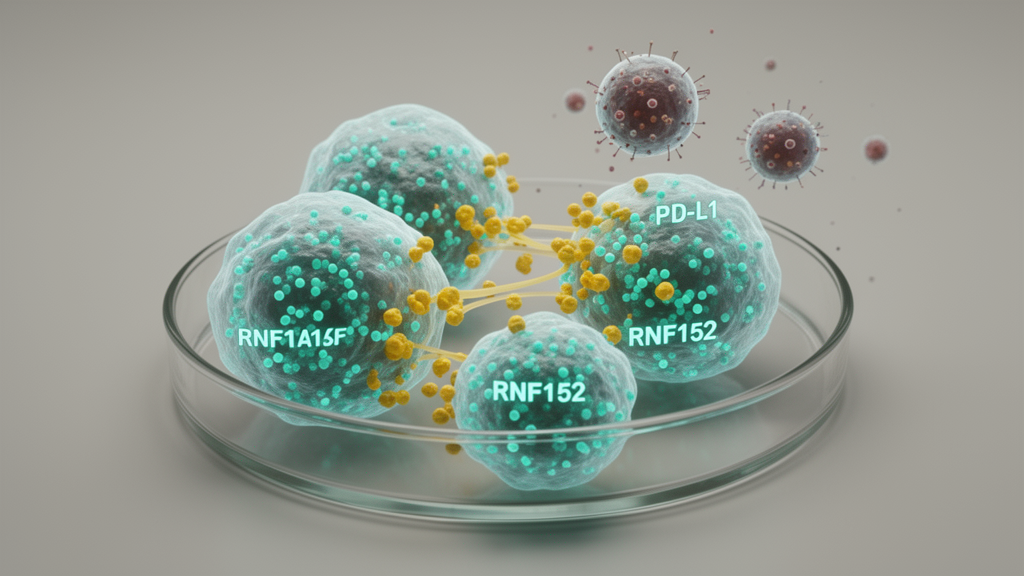
The mechanistic explanation centers on PD-L1. The researchers found that RNF152 promotes the degradation of PD-L1 by facilitating K48-linked polyubiquitination, the molecular mark that directs a protein to the proteasome for disposal. Using site-specific analysis, they identified lysine 64 (K64) on PD-L1 as the ubiquitination site through which RNF152 acts, pinpointing a precise biochemical handle on a key immune checkpoint protein.

Rescue experiments tested the causal chain further. When the researchers overexpressed PD-L1 in cells carrying elevated RNF152, the anti-proliferative and immune-sensitizing effects of RNF152 were counteracted. This indicates that PD-L1 is a functionally relevant substrate of RNF152 rather than an incidental partner, and that the balance between the two proteins helps determine how susceptible ccRCC cells are to CD8+ T cell activity.

To extend the findings beyond cell culture, the team used a tumor-bearing mouse model to evaluate tumor growth and immune evasion in vivo. In mice whose tumors had RNF152 knocked down, treatment with an anti-PD-L1 antibody inhibited tumor growth and reduced immune evasion. The authors suggest that upregulating RNF152 to enhance anti-tumor immunity could hold therapeutic potential, potentially in combination with anti-PD-L1 immunotherapy.

The study’s broader significance lies in connecting two themes in cancer biology: dysregulation of ubiquitination, described in the paper as a driver of tumor progression in various cancers including ccRCC, and the regulation of PD-L1, which the findings place under direct control of a single E3 ligase. By showing that RNF152 can restrain both proliferation and immune escape through targeted PD-L1 degradation, the work defines a regulatory mechanism that had not previously been characterized in this cancer type.

Several caveats temper the enthusiasm. The survival correlation comes from retrospective analysis of TCGA data, which shows association rather than causation. The mechanistic results rest on cell lines, and the in vivo experiments involved genetic knockdown of RNF152 in mice rather than pharmacological modulation of the ligase. Translating the finding into a clinical approach would require ways to restore or mimic RNF152 activity in human tumors, as well as validation in patient cohorts beyond the TCGA dataset.

For now, the study offers a mechanistic blueprint: RNF152 marks PD-L1 at K64 with K48-linked ubiquitin chains, hastening its degradation and thereby limiting immune evasion by ccRCC cells in the models tested. Whether that blueprint can be exploited therapeutically will depend on the next stages of preclinical and clinical testing.

Subject of Research: Role of the E3 ubiquitin ligase RNF152 in regulating PD-L1 degradation and immune evasion in clear cell renal cell carcinoma

Article Title: RNF152 inhibits immune evasion in clear cell renal cell carcinoma by promoting the ubiquitination of PD-L1

Article References: Wang, Q., Liu, Y.-R., Zhu, X.-B., Peng, J.-C., & Chen, S. (2026). RNF152 inhibits immune evasion in clear cell renal cell carcinoma by promoting the ubiquitination of PD-L1. Medical Oncology, 43(11), Article 358. https://doi.org/10.1007/s12032-026-03478-1

Image Credits: AI Generated

DOI: 10.1007/s12032-026-03478-1

Keywords: RNF152, PD-L1, clear cell renal cell carcinoma, ubiquitination, E3 ligase, immune evasion, CD8+ T cells, immunotherapy, TCGA, proteasomal degradation, kidney cancer, tumor immunology

Cite Scienmag News

Nathaniel Bowman. (October 26, 2026). RNF152 Tags PD-L1 for Destruction and Curbs Immune Evasion in Kidney Cancer. Scienmag. https://scienmag.com/rnf152-tags-pd-l1-for-destruction-and-curbs-immune-evasion-in-kidney-cancer/


Nathaniel Bowman. "RNF152 Tags PD-L1 for Destruction and Curbs Immune Evasion in Kidney Cancer." Scienmag, 26 October 2026, https://scienmag.com/rnf152-tags-pd-l1-for-destruction-and-curbs-immune-evasion-in-kidney-cancer/. Accessed 26 October 2026.

Nathaniel Bowman. "RNF152 Tags PD-L1 for Destruction and Curbs Immune Evasion in Kidney Cancer." Scienmag. October 26, 2026. https://scienmag.com/rnf152-tags-pd-l1-for-destruction-and-curbs-immune-evasion-in-kidney-cancer/

Tags: CD8+ T cellsclear cell renal cell carcinomaE3 ligaseimmune checkpoint regulation in ccRCCimmune evasionImmunotherapykidney cancerkidney cancer tumor suppressionPD-L1PD-L1 degradation mechanismsproteasomal degradationproteasomal degradation of immune checkpointsrenal cell carcinoma immune evasionRNF152RNF152 expression and patient survivalRNF152 in immune vulnerability of tumor cellsRNF152 PD-L1 ubiquitinationrole of K48-linked polyubiquitinationTCGAtumor immune response modulationtumor immunologyubiquitin E3 ligase in cancerubiquitinationubiquitination sites on PD-L1
Share26Tweet16
Previous Post

Machine Learning Bias Correction Distorts Warming Signals in Climate Projections

Next Post

Soil Bacterial Abundance Tracks Heavy-Metal Contamination Near Bulgarian Lead-Zinc Smelter

Related Posts

Caregivers of Older Blood Cancer Patients Carry Heavier Cognitive Burden Than Patients
Cancer

Caregivers of Older Blood Cancer Patients Carry Heavier Cognitive Burden Than Patients

October 26, 2026
Mitochondrial transporter SLC25A39 emerges as a metabolic hub and candidate target in cancer
Cancer

Mitochondrial transporter SLC25A39 emerges as a metabolic hub and candidate target in cancer

October 26, 2026
MicroRNA miR-183-3p emerges as candidate regulator of ESR1 in colorectal cancer
Cancer

MicroRNA miR-183-3p emerges as candidate regulator of ESR1 in colorectal cancer

October 26, 2026
Breast Lesion Cancer Risk Depends on Where the Atypia Sits, Study Finds
Cancer

Breast Lesion Cancer Risk Depends on Where the Atypia Sits, Study Finds

October 26, 2026
Blood Protein Panel Flags Early Esophageal Cancer with High Accuracy in Chinese Case-Control Study
Cancer

Blood Protein Panel Flags Early Esophageal Cancer with High Accuracy in Chinese Case-Control Study

October 26, 2026
Fibroblasts May Help Endometrial Tumors Evade Immunity, but the Evidence Is Still Patchy
Cancer

Fibroblasts May Help Endometrial Tumors Evade Immunity, but the Evidence Is Still Patchy

October 26, 2026
Next Post
Soil Bacterial Abundance Tracks Heavy-Metal Contamination Near Bulgarian Lead-Zinc Smelter

Soil Bacterial Abundance Tracks Heavy-Metal Contamination Near Bulgarian Lead-Zinc Smelter

  • Mothers who receive childcare support from maternal grandparents show more optimized

    Mothers who receive childcare support from maternal grandparents show more parental warmth, finds NTU Singapore study

    27656 shares
    Share 11059 Tweet 6912
  • University of Seville Breaks 120-Year-Old Mystery, Revises a Key Einstein Concept

    1061 shares
    Share 424 Tweet 265
  • Bee body mass, pathogens and local climate influence heat tolerance

    682 shares
    Share 273 Tweet 171
  • Researchers record first-ever images and data of a shark experiencing a boat strike

    546 shares
    Share 218 Tweet 137
  • Groundbreaking Clinical Trial Reveals Lubiprostone Enhances Kidney Function

    531 shares
    Share 212 Tweet 133
Science

Embark on a thrilling journey of discovery with Scienmag.com—your ultimate source for cutting-edge breakthroughs. Immerse yourself in a world where curiosity knows no limits and tomorrow’s possibilities become today’s reality!

RECENT NEWS

  • Soil Bacterial Abundance Tracks Heavy-Metal Contamination Near Bulgarian Lead-Zinc Smelter
  • RNF152 Tags PD-L1 for Destruction and Curbs Immune Evasion in Kidney Cancer
  • Machine Learning Bias Correction Distorts Warming Signals in Climate Projections
  • Amino Acid L-Histidine Restores Carbapenem Power Against NDM-Resistant Superbugs

Categories

  • Agriculture
  • Anthropology
  • Archaeology
  • Athmospheric
  • Biology
  • Biotechnology
  • Blog
  • Bussines
  • Cancer
  • Chemistry
  • Climate
  • Earth Science
  • Editorial Policy
  • Marine
  • Mathematics
  • Medicine
  • Pediatry
  • Policy
  • Psychology & Psychiatry
  • Science Education
  • Science News
  • Social Science
  • Space
  • Technology and Engineering

Subscribe to Blog via Email

Enter your email address to subscribe to this blog and receive notifications of new posts by email.

Join 5,151 other subscribers

© 2025 Scienmag - Science Magazine

Welcome Back!

Login to your account below

Forgotten Password?

Retrieve your password

Please enter your username or email address to reset your password.

Log In
No Result
View All Result
  • HOME
  • SCIENCE NEWS
  • CONTACT US

© 2025 Scienmag - Science Magazine

Discover more from Science

Subscribe now to keep reading and get access to the full archive.

Continue reading