


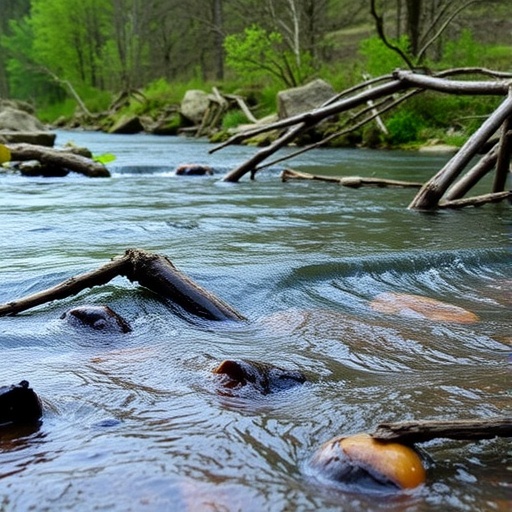
Rising water temperatures in river ecosystems are altering the fundamental ways in which carbon is cycled through these environments, with profound implications for aquatic life and the broader ecological dynamics of freshwater systems. Recent research conducted by a team at Northern Arizona University (NAU) reveals that warming streams accelerate the decomposition of organic material, such as fallen leaves, twigs, and bark, but simultaneously reduce the efficiency with which this carbon is converted into biomass by microbes and aquatic insects. Instead, a larger proportion of carbon is lost to the atmosphere as carbon dioxide (CO₂), thus weakening the energy base supporting river food webs.
This innovative study, published in the journal Ecosphere, employed a tightly controlled experimental framework to isolate the effects of water temperature on carbon cycling processes. The researchers constructed an array of 48 mini stream channels inside a greenhouse environment at The Arboretum at Flagstaff. These artificial streams utilized natural pond water while allowing precise manipulation of temperature variables, thereby closely mimicking real-world river conditions. By maintaining constant light, water chemistry, and flow conditions, the scientists uniquely could attribute observed changes directly to temperature fluctuations.
Central to their experimental design was the use of isotopically labeled leaf litter, marked with a rare carbon isotope, which served as the primary energy and carbon source within the streams. By tracing this “heavy” carbon through the food web—from microbes that initiate decomposition to shredding macroinvertebrates like caddisflies that consume the decomposed material—the researchers quantified how carbon was partitioned among biomass creation, respiration, and release into the aquatic environment as CO₂. This approach provided robust insights into the carbon use efficiency of different organisms under varying thermal regimes.
The findings are striking: as water temperature increased, the rate at which leaf litter decomposed also accelerated. However, this speedier decomposition did not yield increased biomass production proportionally. Instead, a higher fraction of carbon was respired as CO₂. Notably, caddisflies exhibited a nuanced thermal response. At lower temperatures, their activity was constrained; they attained peak carbon conversion efficiency at intermediate temperatures, but at higher temperatures their consumption rates rose without corresponding gains in biomass build-up. These data collectively suggest that warming pushes these ecosystems toward greater carbon loss, diminishing the carbon available to sustain aquatic life.
This decreased carbon use efficiency under warming conditions means that aquatic insects and microbes convert less of the consumed organic matter into growth, thus disrupting the flow of energy through the food web. Because these organisms form the critical link between detrital inputs and higher trophic levels, such as fish, these changes can cascade through the ecosystem. In Southwest U.S. river systems, where these food webs offer vital services ranging from supporting fisheries to maintaining water quality, the implications of this carbon processing shift are considerable.
Michael Zampini, lead author and postdoctoral researcher at NAU, emphasizes that “warming doesn’t simply speed up the biological machinery in streams. Instead, it fundamentally changes the metabolic pathways—more carbon is lost as respiration, and less is retained to build biomass that fuels the food web.” This insight reframes our understanding of how climate change may undermine ecosystem productivity and stability via altered biochemical cycling, beyond the commonly acknowledged temperature effects.
Jane Marks, a professor at NAU’s Department of Biological Sciences and a co-author, highlights the broader ecological significance. “When carbon is less efficiently converted into biomass within stream ecosystems, there is less energy available to support aquatic organisms, which can ripple through food webs, jeopardizing fisheries, dampening water quality, and destabilizing the overall ecosystem functions that human communities rely on,” she explains. Such cascading impacts underscore the urgent need to factor aquatic ecosystem responses into climate resilience planning.
The controlled nature of the study’s stream system represents a pioneering methodological advance. By building a “living laboratory” that faithfully replicates the complex interplay of biological and chemical processes in natural streams—while allowing precise manipulation of temperature—the researchers have opened new pathways for investigating how future warming scenarios might reshape freshwater ecosystems globally. This experimental design also permits future work to include additional variables such as nutrient fluxes or varying hydrological regimes.
The study’s collaborators included experts from multiple institutions, including Professor Steven Thomas from the University of Alabama and NAU colleagues George Koch, Benjamin Koch, Paul Dijkstra, and Victor Leshyk from the Center for Ecosystem Science and Society (Ecoss). Their multidisciplinary expertise enriched the analysis and interpretation of complex ecological dynamics revealed by these experiments. The resulting findings help illuminate the nuanced biological and chemical transformations anticipated in warming riverine ecosystems.
Funded by the U.S. National Science Foundation, this research adds vital knowledge to the growing body of evidence documenting climate change’s disruptive effects on freshwater ecology. It draws attention not only to the accelerated rates of leaf litter decomposition in warmer waters but also to the fundamental shifts in how energy is captured and lost within aquatic food webs. Such mechanistic understanding is critical for predicting and mitigating the vulnerability of freshwater resources under ongoing climate warming.
In summary, the study reveals that rising stream temperatures drive faster decomposition yet reduce carbon retention efficiency in river ecosystems, releasing more CO₂ and limiting biomass growth. These processes threaten the integrity of aquatic food webs, with cascading effects on biodiversity, ecosystem services, and human livelihoods dependent on freshwater systems. As global temperatures climb, understanding and managing these hidden shifts in ecosystem function will be essential for safeguarding the health and sustainability of rivers and their biotic communities.
News Publication Date: 1-Apr-2026
Web References: https://esajournals.onlinelibrary.wiley.com/doi/epdf/10.1002/ecs2.70585
References: Northern Arizona University, Center for Ecosystem Science and Society (Ecoss), National Science Foundation (DEB-1120343).
Cite Scienmag News
Gavin Prescott. (April 17, 2026). Research Reveals How Rising Stream Temperatures Could Disrupt River Food Webs. Scienmag. https://scienmag.com/research-reveals-how-rising-stream-temperatures-could-disrupt-river-food-webs/
Gavin Prescott. "Research Reveals How Rising Stream Temperatures Could Disrupt River Food Webs." Scienmag, 17 April 2026, https://scienmag.com/research-reveals-how-rising-stream-temperatures-could-disrupt-river-food-webs/. Accessed 3 September 2026.
Gavin Prescott. "Research Reveals How Rising Stream Temperatures Could Disrupt River Food Webs." Scienmag. April 17, 2026. https://scienmag.com/research-reveals-how-rising-stream-temperatures-could-disrupt-river-food-webs/


