


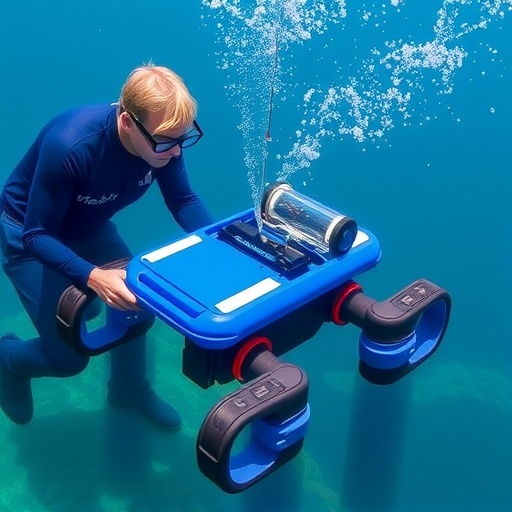
From the tranquil shallow waters of Lake Wahlberg to the vast, salty expanses of the open ocean, a groundbreaking technological initiative led by University of Florida researchers is transforming underwater communication. The team, leveraging expertise from the fields of marine robotics, wireless communication, and magnetoelectric device engineering, has succeeded in developing a compact, power-efficient antenna system capable of dramatically improving robot-to-robot communication beneath the waves. This advancement holds the promise of revolutionizing applications ranging from naval missions and environmental monitoring to the inspection of offshore structures.
At the heart of this innovation lies BlueME, a sophisticated antenna system utilizing magnetoelectric principles tailored specifically for underwater environments. Traditional underwater communication systems often require large antennas or consume substantial power to transmit signals effectively in water—a medium notoriously challenging for electromagnetic waves due to its conductivity and attenuation properties. BlueME circumvents these limitations by operating around its natural resonance frequency, allowing it to efficiently transmit and receive very low-frequency (VLF) and low-frequency (LF) electromagnetic signals underwater while maintaining a remarkably compact form factor.
Efficiency in energy use is critical for underwater autonomous systems, which frequently operate on limited power budgets. Dr. Md Jahidul Islam, one of the lead researchers, articulated the design ethos underpinning BlueME: achieving robust communication performance with power consumption that remains below that of everyday consumer technology, such as standard stereo camera systems. The resulting device operates at about 10 watts at maximum capacity, a feat that represents a remarkable balance between energy efficiency and communication reliability in such a challenging medium.
The genesis of this project is deeply interdisciplinary. Dr. Adam Khalifa, whose primary research focuses on the design of miniature wireless medical microdevices deployable through minimally invasive procedures, found an intriguing parallel between wireless communication inside the human body and underwater environments. Since the human body is constituted largely of lightly salted water, the challenges of efficient wireless power transfer and signal transmission it presents are analogous to those encountered beneath the ocean’s surface. This unique insight fueled the conceptual breakthrough leading to BlueME and its novel application for underwater robotics.
Communication underwater remains an enduring obstacle impeding the advancement of autonomous marine platforms. Today, many underwater robots are limited to sending sparse status updates or must surface regularly to transmit mission-critical data, which significantly curtails their real-time autonomy and collaboration capabilities. The constraints on communication bandwidth and range directly impact the efficiency with which underwater systems can tackle complex tasks that demand coordinated behaviors.
BlueME addresses these challenges by enabling sustained communication over ranges exceeding 700 meters in ocean trials, an achievement surpassing many existing underwater communication platforms. Despite its compact size and low power requirements, the system maintains robust connectivity, empowering operators to receive periodic real-time updates from underwater robots during missions. This capability could allow mission adjustments based on evolving underwater conditions, thus enhancing operational flexibility and effectiveness.
The practical demonstration of BlueME is believed to be among the pioneering uses of compact magnetoelectric antennas for underwater robotic communication. The research team has proactively taken steps to protect this technology through a provisional patent filing and is actively seeking further support to refine the system’s design and expand field-testing with various autonomous underwater vehicles (AUVs). This work lays the foundation for a new paradigm in underwater robotics communication.
Beyond this immediate application, the research team envisions broader implications for BlueME and similar technologies. With sustained development and large-scale deployment, these innovations could catalyze a profound transformation in how swarms of autonomous underwater vehicles collaborate and interact within complex and dynamic marine environments. Such capabilities could dramatically improve the efficiency of naval reconnaissance, environmental data collection, resource monitoring, and the maintenance of underwater infrastructure.
The significance of BlueME extends beyond just hardware innovation; it signals the advent of a new era in underwater robotics. By overcoming the perennial hurdles of limited communication range and high power consumption, this technology enables a level of coordinated autonomy that was previously unattainable. As Dr. Islam notes, while this technology is still in its infancy, it represents “the very early days of a very powerful product” set to revolutionize underwater operations.
This research underscores the potential for cross-disciplinary innovation to solve problems once deemed intractable. By bridging fields as diverse as medical device engineering and marine robotics, the University of Florida team has opened new vistas in underwater communication technology. The synergy of these fields has delivered a solution that not only addresses the technical challenges of underwater electromagnetic propagation but does so with a level of practicality and efficiency conducive to real-world applications.
Future iterations of BlueME promise enhancements in miniaturization, power efficiency, and communication bandwidth, which will broaden the scope and complexity of tasks autonomous marine systems can undertake. Furthermore, the flexible and compact nature of this antenna system facilitates its integration into a wide array of robotic platforms, from small survey drones to larger underwater vehicles used in research, search and rescue, and military operations.
Ultimately, BlueME embodies the critical intersection of theoretical insight, engineering rigor, and practical application. As autonomous underwater systems become increasingly vital to a range of scientific, environmental, and security missions, innovations like BlueME will be central to enabling these technologies to operate collaboratively, efficiently, and intelligently beneath the ocean’s surface.
News Publication Date: 5-May-2026
Web References: https://ieeexplore.ieee.org/document/11506063
References: Published in IEEE Journal of Oceanic Engineering (JOE), DOI: 10.1109/JOE.2026.3675822
Cite Scienmag News
Denise Maddox. (May 29, 2026). Breaking New Ground in Marine Robot Communication: UF Scientists Unveil BlueME. Scienmag. https://scienmag.com/breaking-new-ground-in-marine-robot-communication-uf-scientists-unveil-blueme/
Denise Maddox. "Breaking New Ground in Marine Robot Communication: UF Scientists Unveil BlueME." Scienmag, 29 May 2026, https://scienmag.com/breaking-new-ground-in-marine-robot-communication-uf-scientists-unveil-blueme/. Accessed 3 September 2026.
Denise Maddox. "Breaking New Ground in Marine Robot Communication: UF Scientists Unveil BlueME." Scienmag. May 29, 2026. https://scienmag.com/breaking-new-ground-in-marine-robot-communication-uf-scientists-unveil-blueme/


