


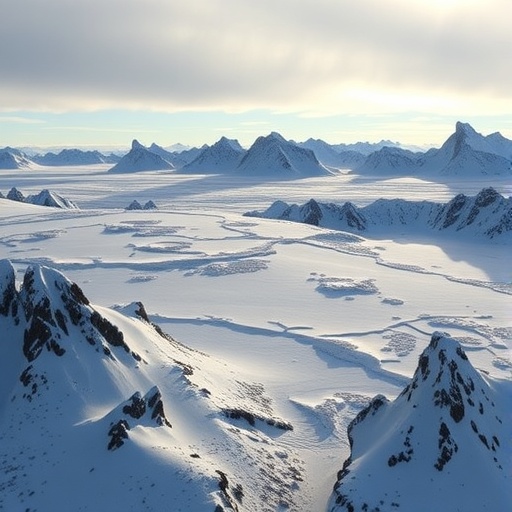
In the high Arctic, the ocean may be sending more than salt into the sky. New balloon measurements above Ny-Ålesund, on the Svalbard archipelago, have detected marine carbohydrates—including sugar-like compounds released by algae and bacteria—at altitudes where clouds form. The finding suggests that organic material from seawater can travel hundreds of metres upward and potentially reach the free troposphere, the region of the atmosphere where air is relatively isolated from the surface and where clouds strongly influence Earth’s climate. As the Arctic Ocean loses sea ice, the expanding areas of open water could provide an increasingly important source of cloud-forming particles, adding another layer to the complex mechanisms behind rapid Arctic warming.
The observations were made during field campaigns in autumn 2021 and spring 2022 near Kongsfjord, close to Ny-Ålesund, the world’s northernmost permanently inhabited settlement. Researchers from the Leibniz Institute for Tropospheric Research, Leipzig University, the University of Cologne, the Alfred Wegener Institute, the Max Planck Institute for Marine Microbiology, the University of Oldenburg and the University of Bremen collected air samples at elevations between 300 and 1,000 metres. To reach those heights, the team used BELUGA, a 12-metre-long tethered helium balloon capable of carrying scientific instruments and sampling equipment into the lower atmosphere. The balloon had previously been used during the MOSAiC expedition, when the research icebreaker Polarstern drifted through the central Arctic for an entire year.
The atmosphere above the Arctic is closely connected to the surface ocean. When waves break and bubbles burst, tiny droplets of seawater are ejected into the air as sea spray aerosol. These particles contain familiar inorganic salts, primarily sodium and chloride, but they also carry a less visible biological cargo. The ocean’s surface film and underlying seawater contain organic compounds produced by marine organisms, including carbohydrates and highly branched polysaccharides. These molecules can be released by phytoplankton, bacteria and other microorganisms, becoming embedded in or attached to sea spray particles. Once airborne, the particles can be transported by winds, altered by chemical reactions and incorporated into clouds.
The new measurements are important because marine carbohydrates had previously been identified mainly in seawater, sea-surface microlayers and air close to the ocean. Researchers had little direct evidence showing how far these compounds could rise through the atmosphere. The team compared samples gathered by BELUGA at different altitudes with samples of seawater and surface film collected in Kongsfjord. This combination allowed the scientists to link atmospheric material with a nearby marine source and to trace the vertical distribution of sea spray constituents. The results indicate that ocean-derived carbohydrates are not confined to the immediate vicinity of the water surface, but can be carried into layers of the lower troposphere relevant to cloud development.
That vertical transport matters because sea spray particles can influence cloud microphysics. Clouds are not simply collections of water droplets; their formation and evolution depend on the particles around which water vapour condenses or freezes. Some aerosol particles act as cloud condensation nuclei, encouraging the formation of liquid droplets. Others can serve as ice-nucleating particles, triggering the formation of ice crystals at temperatures where freezing might otherwise be unlikely. Ice formation changes the size and lifetime of cloud particles, affects precipitation and alters how clouds reflect incoming sunlight and emit heat back toward space.
Marine polysaccharides may be especially significant as ice-nucleating material. Earlier laboratory and field research led by TROPOS found that the ice-nucleating activity of sea spray particles is strongly influenced by the polysaccharides they contain. Model simulations indicated that these compounds are particularly relevant between approximately –20 and –15 degrees Celsius, a temperature range common in clouds over remote ocean regions. In such locations, land-derived ice-nucleating particles may be scarce, leaving marine aerosols with a greater potential influence on cloud ice formation. If these particles reach cloud layers, even in small quantities, they could help determine whether a cloud contains supercooled liquid water, ice crystals or a mixture of both.
The study also points to an unexpected possibility: some of the sugars found in the atmosphere may not have come directly from the sea. Laboratory and field observations suggest that chemical and biological activity inside humid air masses and clouds can transform existing molecules or generate additional carbohydrate-like compounds. In clouds containing abundant water and microorganisms, biological metabolism could contribute to the formation of these substances. The evidence is still preliminary, but it raises the prospect that clouds are not passive atmospheric containers. Instead, they may function as reactive environments in which marine organic matter is modified, recycled or even newly produced as air moves above the ocean.
This possibility adds biological complexity to the Arctic climate system. The region is warming faster than the global average, and its sea ice cover is retreating, particularly during the summer minimum. Open water exposes a larger surface area to wind and wave action, potentially increasing the production of sea spray aerosol. At the same time, a warmer atmosphere can hold more water vapour and may support changes in cloud cover, precipitation and atmospheric chemistry. More marine particles entering the atmosphere could alter the reflectivity, thickness and persistence of Arctic clouds. The direction and magnitude of the overall climate effect will depend on particle composition, altitude, season, cloud temperature and whether the particles promote liquid droplets or ice.
The researchers describe their measurements as a first direct link between marine sugars in the Arctic ocean and their presence at multiple atmospheric heights. However, the observations do not mean that every sea spray particle becomes a powerful climate agent, nor do they establish a single, simple effect on Arctic warming. Atmospheric particles are rapidly diluted, chemically transformed and mixed with material from land, snow and distant regions. The team therefore sees the measurements as a missing piece of a much larger puzzle. Future studies will need to determine how long marine carbohydrates survive in the atmosphere, how efficiently they trigger ice formation under real cloud conditions and how much they contribute to regional radiation and precipitation patterns.
The next major test may come far from Svalbard. The BELUGA team plans to collect comparable observations during Polarstern expeditions associated with Antarctica-Insync in 2028, targeting the Southern Ocean, where sea spray and biological activity are also intense but where equivalent vertically resolved measurements remain scarce. Comparing the Arctic and Antarctic could reveal whether marine carbohydrates are a widespread feature of polar atmospheres or a process strongly shaped by local conditions. For now, the Arctic observations deliver a striking message: the ocean’s influence on climate does not stop at the waterline. Waves, microbes, sugars and salt can rise into the sky, enter clouds and help shape the frozen world’s changing climate.
News Publication Date: 27-May-2026
Web References: https://doi.org/10.5194/acp-26-7235-2026
References: Atmospheric Chemistry and Physics, DOI: 10.5194/acp-26-7235-2026
Cite Scienmag News
Russell Cooper. (August 14, 2026). Ocean-derived sugars rise high into atmosphere, influencing Arctic climate. Scienmag. https://scienmag.com/ocean-derived-sugars-rise-high-into-atmosphere-influencing-arctic-climate/
Russell Cooper. "Ocean-derived sugars rise high into atmosphere, influencing Arctic climate." Scienmag, 14 August 2026, https://scienmag.com/ocean-derived-sugars-rise-high-into-atmosphere-influencing-arctic-climate/. Accessed 3 September 2026.
Russell Cooper. "Ocean-derived sugars rise high into atmosphere, influencing Arctic climate." Scienmag. August 14, 2026. https://scienmag.com/ocean-derived-sugars-rise-high-into-atmosphere-influencing-arctic-climate/


