


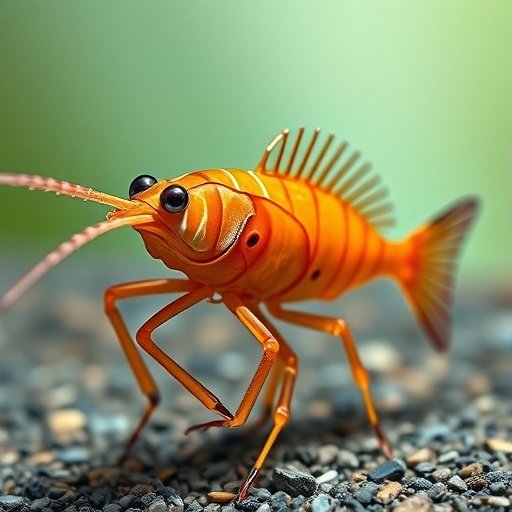
In the deep waters of the northern South China Sea, a remotely operated vehicle’s camera has captured something no scientist had ever documented before: a fish walking backward. The creature, an armored searobin known scientifically as Scalicus engyceros, was filmed using its specialized free pectoral-fin rays to stride across the seafloor in both sideways and backward directions, a mode of locomotion never before observed in any other fish species. The observation, published on July 30 in the journal Ocean-Land-Atmosphere Research, confirms a long-standing speculation about how these unusual fishes use their modified fins and adds a striking new entry to the short list of fishes capable of true walking.
The discovery emerged from a research effort led by scientists at Sun Yat-sen University (SYSU) and the Southern Marine Science and Engineering Guangdong Laboratory in Zhuhai. Using modern deep-sea diving vehicles, including human-occupied vehicles and remotely operated vehicles, the team filmed deep-sea organisms in their natural habitat across three areas of the northern South China Sea. Among the animals they documented were three species of peristediid fishes, commonly called armored searobins: Scalicus engyceros, Paraheminodus murrayi and Peristedion liorhynchus. The footage captured not just still portraits of these animals but extended records of their benthic behaviors, allowing the researchers to describe, for the first time, how the fishes move and forage while alive on the seafloor.
Han Tian, the paper’s primary author and a doctoral researcher in the School of Marine Sciences at Sun Yat-sen University, described the finding as a paradigm-shifting revelation. S. engyceros belongs to a group of fishes characterized by highly specialized free pectoral-fin rays, finger-like appendages that extend from the pectoral fins and make contact with the seafloor. Scientists have long suspected that searobins use these rays to walk, but until now the behavior had not been directly confirmed with in situ footage. The species has even attracted popular attention for its appearance, which combines features of fish and shrimp so strikingly that U.S. local media have dubbed it a “fish-prawn hybrid.”
The walking itself proved more versatile than anyone anticipated. Searobins were first described by the zoologist Albert Günther in 1872, yet in the more than 150 years since, no one had predicted that these fishes could walk both sideways and backward. Locomotion in reverse has never been observed in other fishes, making the armored searobin’s gait a genuine first for the field. The finding illustrates how much basic behavioral information remains locked in the deep sea, inaccessible until organisms can be observed alive in their own environment rather than studied from preserved specimens hauled up in trawls.
The searobin’s body plan reveals a suite of adaptations that appear tailored to life on soft seafloor sediment. Beyond the walking rays, the fish sports outward-extending barbels that Tian compared to a farmer’s rake. While the structure may look awkward for getting around, it serves a foraging function: the barbels allow the searobin to sense and probe potential prey buried in the seafloor sediment, and even to dig into the surface sediment itself in search of food. Meanwhile, the animal’s main pectoral fins have evolved into flat, round plates, which appear to improve balance both during walking and while swimming. When threatened, the fish can deploy its shrimp-like fin rays and tail to make explosive, jerky leaps reminiscent of a startled shrimp, a rapid escape behavior that complements its slower, deliberate walking.
The filmed observations also yielded unexpected insights into the searobin’s sensory world. The fish’s large eyes could not resolve the approaching vehicle itself, indicating that its visual acuity is limited at close range. Yet when the vehicle’s light beam swept near, the animal rolled its eyes toward the light. This response suggests that the searobin’s eyes have retained some sensitivity to light, which, according to the researchers, may reflect a light history during the species’ life cycles. Many deep-sea fishes begin life in shallower, sunlit waters before descending to the abyss, and the eye-rolling behavior hints at vestiges of that developmental or evolutionary past, though the team presents the observation as a suggestion rather than a settled conclusion.
The fact that three different armored searobin species were observed at different locations in the South China Sea raised another question for the team. The distribution of these similar fishes across separate sites suggests, in the researchers’ view, the hypothesis that local specialization forces may be at work, shaping each population’s adaptations to its particular patch of seafloor. Testing that hypothesis will require further observation and comparison, but it points toward a research program that treats deep-sea fishes not as static curiosities but as dynamically evolving lineages responding to the distinct conditions of their habitats.
The methodological significance of the study lies in its approach. Classified as an observational study, the work rests on in situ filming rather than laboratory experimentation or dissection. Advances in deep-sea vehicle technology, including human-occupied vehicles and remotely operated vehicles, have transformed what is possible for deep-sea biology. Where earlier generations of scientists had to infer behavior from the anatomy of dead specimens, today’s researchers can watch living animals interacting with their environment. Tian emphasized that modern diving vehicles allow not only the discovery of new species but also add a new in situ, functional dimension to the study of species that were previously known only from preserved morphology. Observing deep-sea animals alive in their surroundings, the team argues, provides direct insight into adaptation and evolution that museum specimens alone cannot supply.
The broader context makes the finding all the more compelling. The deep ocean is one of the most inhospitable places on Earth, characterized by crushing pressure, perpetual darkness and scarce food, yet many species have managed to survive there, often evolving specialized body structures and behaviors in the process. Armored searobins represent one such evolutionary experiment: a lineage that has repurposed its pectoral fins into a hybrid toolkit serving walking, balance, foraging and escape. The combination of rake-like barbels for probing sediment, plate-like fins for stability, free rays for stepping across the bottom and shrimp-style leaps for emergency escapes suggests a tightly integrated adaptive complex rather than a single isolated trait.
Looking forward, the team intends to push beyond this initial documentation. Tian said the researchers aim to explore the co-evolution of the fish’s unique rake-shaped appendages, its walking locomotion and its deep-sea foraging strategies, with the goal of establishing a new framework for understanding benthic fish adaptive evolution. Such a framework could reshape scientific perceptions of deep-sea biodiversity and illuminate how extreme marine environments drive the emergence of biological structures and behaviors seen nowhere else in the world’s aquatic ecosystems. In the team’s view, these walking fish harbor far more novel behavioral and evolutionary adaptations than previously assumed.
The research was a collaborative effort. Alongside Tian, contributors included Wei Xie, Mingting Li and Kedong Yin, affiliated with the School of Marine Sciences and the Guangdong Provincial Key Laboratory of Marine Resources and Coastal Engineering at Sun Yat-sen University, and with the Southern Marine Science and Engineering Guangdong Laboratory in Zhuhai, China. The paper, titled “Walking Fish,” carries the DOI 10.34133/olar.0172, and the authors reported no conflicts of interest. As with any observational study, the findings describe what the cameras captured in a limited number of encounters and locations; the mechanisms underlying the backward gait, the developmental basis of the fish’s light sensitivity and the role of local specialization remain open questions for future work. Still, the footage marks a milestone: after a century and a half in the scientific record, the armored searobin has finally been seen doing what its anatomy always hinted at, walking, in every direction, across the dark floor of the South China Sea.
Cite Scienmag News
Violet Maxwell. (August 31, 2026). Fish-prawn hybrid observed walking backward for the first time. Scienmag. https://scienmag.com/fish-prawn-hybrid-observed-walking-backward-for-the-first-time/
Violet Maxwell. "Fish-prawn hybrid observed walking backward for the first time." Scienmag, 31 August 2026, https://scienmag.com/fish-prawn-hybrid-observed-walking-backward-for-the-first-time/. Accessed 3 September 2026.
Violet Maxwell. "Fish-prawn hybrid observed walking backward for the first time." Scienmag. August 31, 2026. https://scienmag.com/fish-prawn-hybrid-observed-walking-backward-for-the-first-time/


