


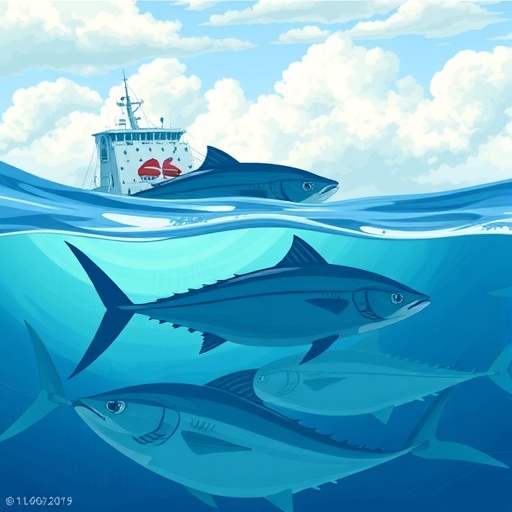
Climate change has moved from the margins to the center of marine fisheries governance, but the precise mechanics of how a global environmental problem becomes an operational concern inside a regional management body have remained poorly documented. A new study published in npj Ocean Sustainability offers one of the most detailed accounts to date of that transformation, using the Western and Central Pacific Fisheries Commission (WCPFC) as a case study of an institution that responded early to climate change. Rather than treating climate governance as a matter of formal policy adoption alone, the research asks how climate change is actually articulated, categorized, and embedded in the day-to-day textual and procedural life of a working fisheries commission.
The study, authored by Yuru He, Yuan Gao, Chunhui Zhang, Yanxuedan Zhang, and Zhengyang Li, takes an unusual methodological route: instead of interviewing officials or analyzing formal resolutions, the team examined the complete record of the commission’s own words. They compiled a climate-specific corpus from all available annual meeting reports of the WCPFC, the regional body responsible for managing tuna fisheries across the Western and Central Pacific Ocean. This is one of the largest and most valuable fisheries domains on the planet: the waters administered by the commission supply a substantial share of the world’s tuna catch, including major purse-seine and longline fisheries for skipjack, yellowfin, and bigeye tuna, and the license fees and export revenues drawn from those fisheries support national budgets and household livelihoods across the Pacific. Because these reports capture what delegates, scientists, and committees actually discuss year after year, they provide a longitudinal window into how an institution’s attention shifts over time, something that snapshots of individual resolutions or interview-based retrospectives cannot easily deliver.
The analytical framework combines two theoretical and technical pillars. On the theoretical side, the authors draw on Field Theory, which treats organizations as arenas of positioned actors, competing framings, and evolving rules rather than as neutral decision machines. This lens matters because a fisheries commission is not simply an administrative unit that receives scientific information and outputs regulations; it is a contested space in which distant-water fishing nations, Pacific island coastal states, industry interests, and observers advance different understandings of what problems exist and who should address them. On the technical side, the authors apply Natural Language Processing to the corpus, running three complementary forms of analysis: discourse analysis to identify how climate change is framed, sentiment analysis to gauge the evaluative tone surrounding climate-related discussion, and content-anchoring analysis to trace which substantive topics and institutional domains climate language becomes attached to. By applying these tools across the full time series of reports, the researchers could track longitudinal shifts in emphasis and tone rather than relying on a snapshot of a single meeting or year.
The central finding is that climate change did not arrive at the WCPFC as a discrete policy input, a ready-made proposal that the commission could accept or reject. Instead, the study finds that climate change was gradually translated into an object of governance through three interlocking processes the authors describe as categorization, proceduralization, and institutional stabilization. Categorization refers to the way climate change was progressively sorted into recognizable institutional categories, becoming something the commission’s existing structures could name, agenda, and discuss without dismantling those structures. Proceduralization describes its incorporation into routines, agendas, and scientific workflows, so that climate considerations became part of how business is done rather than an occasional external concern raised by particular delegations. Institutional stabilization marks the point at which these practices became durable features of the organization rather than provisional responses dependent on the enthusiasm of individual members or the urgency of a given season.
Tracing the language over time, the researchers observed a marked evolution in framing. Early discussions were dominated by a biophysical framing, treating climate change primarily as an environmental phenomenon affecting ocean conditions and fish stocks: warming surface waters, changing currents, and the possibility that tuna distributions might shift. Over the years, however, the texts shifted toward a more integrated configuration in which climate change was linked simultaneously to scientific evidence, institutional mechanisms, and distributional concerns. In practical terms, climate language migrated from descriptions of warming waters and shifting stocks toward discussions of how the commission’s own decision-making structures should respond, and who would bear the costs and benefits of those responses. This is a consequential shift for any international body, because framing determines jurisdiction: as long as climate change remains an environmental variable studied by scientists, it stays within established research channels; once it is framed as a distributive problem, it presses directly against the political core of the organization.
The distributional dimension of this shift is particularly significant for the Pacific region. The study finds that climate-related discourse increasingly foregrounded concerns affecting Small Island Developing States, the Pacific island nations whose economies and food security depend heavily on tuna fisheries and whose capacity to adapt is constrained by size, geography, and resources. For many of these states, fisheries access fees and tuna-related activity constitute an unusually large share of government revenue and a principal source of animal protein, meaning that any redistribution of the resource carries fiscal and nutritional consequences, not merely commercial ones. As climate change became institutionalized within the WCPFC’s texts, the question was no longer only what climate change does to fish, but what climate change means for the countries most exposed to its consequences and least equipped to absorb them. This reframing connects the technical work of fisheries science to questions of equity that have long animated negotiations between distant-water fishing nations and Pacific island states.
Yet the study is careful to document the limits of this institutionalization. The authors find that the process remains uneven. Climate considerations have become increasingly embedded in scientific and procedural domains, where they can be handled through research programs, data collection, stock assessment practices, and agenda-setting routines. But their influence on allocation outcomes, the decisions that determine who gets to catch how much, remains constrained by entrenched decision-making rules. Allocation is among the most politically sensitive functions of any regional fisheries management organization, because existing shares reflect historical effort, negotiated compromise, and economic dependence that members are reluctant to renegotiate. The study suggests that the institutional pathways through which climate knowledge travels, its committees, its scientific processes, its reporting conventions, have not yet reached, or reshaped, this distributive core.
This gap between procedural uptake and distributive effect carries important implications. The authors argue that effective climate adaptation in fisheries governance depends not only on improved knowledge, better science, better models, better data, but also on the institutional conditions under which such knowledge can reshape distributive outcomes. In other words, producing more accurate projections of stock movement under climate change does not automatically translate into quota adjustments, access arrangements, or burden-sharing rules that reflect those projections. If the biology says the fish will move, but the rules say the shares stay fixed, then a widening gap opens between the resource and the governance regime built around it. The bottleneck, on this account, is institutional translation: the work of converting scientific understanding into categories, procedures, and ultimately rules that govern who benefits from a shared resource.
The WCPFC is a revealing site for this argument because it is described in the study as an early institutional responder to climate change among regional fisheries bodies. Its experience therefore offers a preview of challenges that other regional fisheries management organizations are likely to face as climate-driven stock shifts, changing ocean chemistry, and intensifying extreme events force them to confront questions their founding instruments did not anticipate. Many of these bodies were designed around assumptions of stable stock distributions and stable member interests, assumptions that a warming ocean erodes. If even a comparatively responsive commission struggles to move climate considerations from scientific discussion into allocation decisions, the study implies, less prepared bodies may face even steeper translation barriers as those assumptions collapse.
Methodologically, the corpus-based approach demonstrates what large-scale text analysis can reveal about governance that traditional case studies might miss. By treating the full archive of meeting reports as data, the researchers avoided reliance on selective memory or official self-presentation in interviews, and instead measured change in the institution’s own recorded discourse. The combination of Field Theory with computational text analysis also illustrates a broader trend in sustainability research: using quantitative tools to study qualitative institutional dynamics over long time horizons, turning an archive that no single reader could exhaust into a measurable record of institutional change. At the same time, the approach has inherent limits. Meeting reports reflect what is recorded in formal proceedings, and much of the real negotiation in international bodies occurs in informal settings that leave no textual trace. Sentiment and framing detected in documents may also diverge from the positions actors hold privately. The authors’ findings should therefore be read as an account of institutional discourse and its evolution, one that is highly informative about how an organization talks itself into new responsibilities, but not a complete record of its politics.
The broader takeaway is a reframing of what climate governance means for ocean management. The study suggests that the decisive question is not simply whether an institution recognizes climate change, since recognition is now widespread across regional fisheries bodies, but whether that recognition can travel through the institution’s categories, procedures, and rules far enough to alter outcomes that matter, especially the distribution of fishing opportunities. For the WCPFC and the Pacific communities that depend on its decisions, the findings point to a specific frontier: aligning entrenched allocation rules with a changing ocean, so that the countries and fleets affected by shifting stocks are not locked into arrangements designed for a stable past. For governance scholars and practitioners more widely, the research offers a template for measuring institutionalization itself, tracing how an idea moves through the textual life of an organization, and a reminder that adaptation is as much an institutional achievement as a scientific one.
Cite Scienmag News
Sloane Callahan. (August 31, 2026). Making climate governance actionable: a corpus-based analysis of institutionalizing climate change in tuna fisheries governance. Scienmag. https://scienmag.com/making-climate-governance-actionable-a-corpus-based-analysis-of-institutionalizing-climate-change-in-tuna-fisheries-governance/
Sloane Callahan. "Making climate governance actionable: a corpus-based analysis of institutionalizing climate change in tuna fisheries governance." Scienmag, 31 August 2026, https://scienmag.com/making-climate-governance-actionable-a-corpus-based-analysis-of-institutionalizing-climate-change-in-tuna-fisheries-governance/. Accessed 3 September 2026.
Sloane Callahan. "Making climate governance actionable: a corpus-based analysis of institutionalizing climate change in tuna fisheries governance." Scienmag. August 31, 2026. https://scienmag.com/making-climate-governance-actionable-a-corpus-based-analysis-of-institutionalizing-climate-change-in-tuna-fisheries-governance/


