


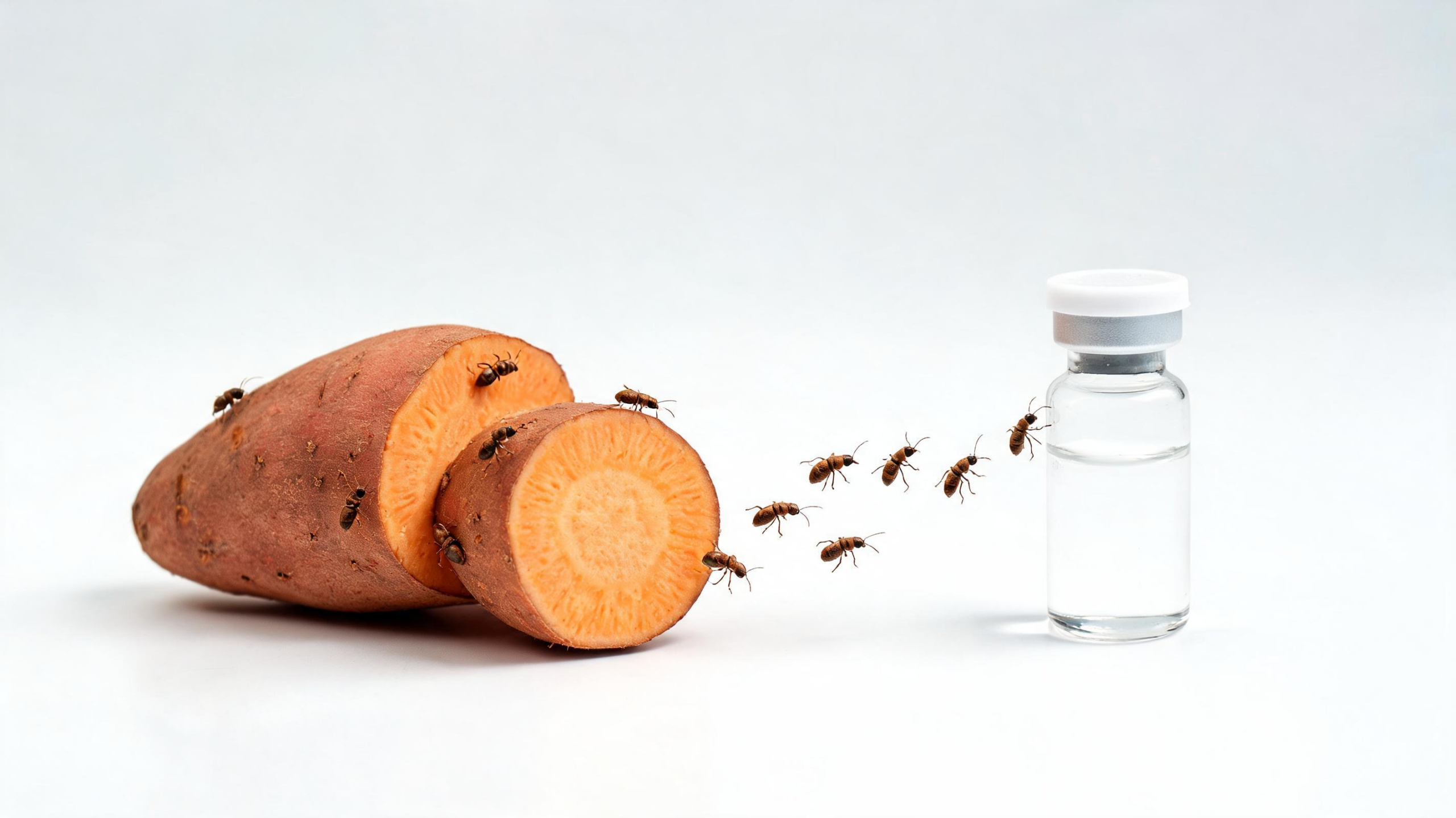
The sweet potato weevil, Cylas formicarius, is arguably the most destructive enemy of one of the world’s most important staple crops, and a new comprehensive review published in the journal Crop Health argues that the key to controlling it may lie not in stronger insecticides but in the insect’s own chemical language. The review, authored by Shuyan He, Chao Li, and Yulin Gao of the Chinese Academy of Agricultural Sciences, synthesizes decades of research on the semiochemicals — the chemical signals and cues — that govern how this beetle finds mates, locates host plants, and avoids competition, and it maps out how those signals can be weaponized for integrated pest management across tropical and subtropical production regions worldwide.
The scale of the problem is staggering. Yield losses caused by C. formicarius commonly range from 60 to 97 percent in heavily infested areas. In China’s Guangdong Province, losses typically run between 5 and 20 percent but can reach 80 percent in bad years. Vietnam has documented farm-level losses of up to 40 percent, Indonesia has recorded losses of 3 to 80 percent across locations and seasons, and the Philippines has seen yields cut in half. Even low levels of infestation can render crops unmarketable, because larval feeding triggers the production of bitter, toxic sesquiterpenes such as ipomeamarone in the storage roots. What makes the weevil so difficult to fight with conventional chemistry is its lifestyle: larvae tunnel cryptically inside roots and vines, hidden from any spray, while adults are predominantly nocturnal, so contact insecticides rarely intercept them at vulnerable moments.
That concealment is precisely why semiochemicals have attracted so much attention. The cornerstone of the chemical approach is the female-produced sex pheromone, first identified in the 1980s from volatiles collected from virgin females and characterized as (Z)-3-dodecen-1-ol (E)-2-butenoate. The compound was a chemical novelty at the time — the first insect pheromone known to contain a butenoate moiety — and later work on feral populations in Cuba confirmed it as the sole active component, with females emitting only about 20 picograms per day. Electroantennogram studies showed that male antennae respond to the synthetic pheromone in a dose-dependent manner while female antennae show no detectable response, underscoring the sex-specific nature of perception. The terminal crotonate functional group proved critical: formate, acetate, propionate, and butyrate analogues all failed to elicit responses, and stereochemical purity matters too, with formulations containing at least 94 percent of the (Z,E)-isomer being highly attractive in the field.
Molecular biology is now revealing how the weevil smells these signals. Researchers have cloned and characterized three odorant-binding protein genes, CforOBP1 through CforOBP3. CforOBP1 is highly expressed in the antennae and legs of both sexes, whereas CforOBP2 and CforOBP3 are predominantly expressed in male antennae. Fluorescence competitive binding assays showed that all three proteins bind strongly to the sex pheromone and to selected host plant volatiles, and RNA interference-mediated knockdown produced partial anosmia, leaving treated weevils with a reduced ability to respond to both pheromone and plant odors. The picture that emerges is a division of labor: CforOBP2 and CforOBP3 are primarily involved in male mating behavior, while CforOBP1 participates broadly in host and mate finding. A parallel set of chemosensory proteins — CforCSP1, CforCSP5, and CforCSP6 — mediates the perception of host volatiles, binding 17 plant compounds including eight host plant volatiles, and their silencing likewise diminishes the insects’ ability to locate host odors such as β-cyclocitral and benzaldehyde.
The plant side of the conversation is equally intricate. Sweet potato plants emit a complex blend of volatile organic compounds whose composition varies among cultivars, tissues, and physiological states. A recent analysis of 40 varieties detected 121 volatile compounds, with aldehydes, furans, and terpenes the most abundant classes; yellow-fleshed varieties showed the strongest aromas, driven by fatty-acid-derived aldehydes, while orange-fleshed types were characterized by apocarotenoids such as β-ionone and geranylacetone. Early behavioral work demonstrated that both sexes are attracted to leaf volatiles, but only females respond to storage root volatiles, and responses differ significantly among cultivars, suggesting genetically determined differences in odor profiles. Subsequent headspace analyses identified 33 compounds from roots and aerial parts, 23 of them terpenes. Three oxygenated monoterpenes — nerol, Z-citral, and methyl geranate — attracted female weevils within a narrow optimal concentration range, while three sesquiterpenes, α-gurjunene, α-humulene, and ylangene, consistently acted as repellents at naturally emitted concentrations, showing that the plant simultaneously broadcasts attractants and deterrents.
One of the most striking recent discoveries concerns chemical warfare within the species itself. Sweet potato roots infested by third-instar weevil larvae emit a distinct volatile profile, and five compounds — linalool, citronellol, nerol, geraniol, and the furanoterpenoid ipomeamarone — elicit consistent antennal responses from adult males and females alike. Behavioral bioassays showed that four monoterpene alcohols significantly repel conspecific adults from feeding and oviposition at ecologically relevant doses, with geraniol the strongest deterrent. The interpretation is that larvae already occupying a root signal their presence through altered plant volatiles, discouraging further colonization and reducing competition for their own offspring. From an applied standpoint, these compounds are promising candidates for repellent or oviposition-deterrent formulations, effectively turning the pest’s own competitive strategy into a push component of a push–pull control scheme.
On the practical front, pheromone-baited traps have already delivered impressive results. In a pioneering mass-trapping study in Okinawa, Japan, ten funnel traps in a 1,200-square-meter field captured more than 65,000 males over 17 months, shifting the population to roughly 80 percent female, reducing female mating rates, and cutting the male population to about one-tenth of its initial density within three months. In Guam, mass trapping with unitraps baited at 100 micrograms reduced root damage to fewer than one feeding hole per root, compared with up to 38 holes in untreated controls, and nearly doubled yields, from around 8 tons per hectare to more than 14. Trap optimization studies have refined the recipe further: bucket-style Pherocon unitraps outperformed ground, funnel-water, and delta traps; light-red traps caught the most weevils; traps placed 50 centimeters above the crop canopy achieved maximum captures; and lures should be replaced roughly every 30 days, although septa remain attractive for up to 98 days. The effective attraction radius was estimated at 60 to 80 meters, informing spacing recommendations for area-wide programs.
Innovation continues on the hardware and integration fronts. In Malaysia, researchers developed a low-cost plastic pole trap from recycled polyethylene terephthalate; traps with four window openings captured 57 to 72 percent more weevils than those with one or two, and a detergent solution outperformed both carbofuran and plain water as the killing agent, with the optimized design outcatching commercial delta, wing, and unitraps by 60 to 78 percent. Intriguingly, trap color did not matter in the Malaysian system, in contrast to Guam, hinting at regional differences in weevil biotypes or ambient light conditions. Green light has been shown to synergize with pheromone, boosting male trap captures up to fivefold, and attract-and-infect approaches — combining pheromone lures with entomopathogenic fungi such as Beauveria bassiana and Metarhizium anisopliae — have proven effective against other pests and warrant testing against the weevil. Chemical markers of host plant resistance, including root-surface hydroxycinnamic acid esters such as octadecyl coumarate and caffeate, and cyclopropane fatty acid esters diagnostic of resistant genotypes, offer breeders concrete selection targets that can be combined with olfactory tactics.
Challenges remain, and the review is candid about them. Mass trapping works best when populations are low and immigration of mated females is minimized; dense canopies can shield males from pheromone plumes flowing above them; and current lures attract only males, motivating efforts to develop bisexual lures by blending pheromone with host plant attractants such as nerol, Z-citral, and methyl geranate. Cost and availability still limit adoption by smallholder farmers, and the possibility of behavioral habituation — a reduced response after repeated exposure, documented in moths and aphids but apparently order-dependent and stimulus-dependent — deserves monitoring, though habituation is typically a reversible phenotypic change rather than permanent resistance. The authors propose a layered framework: monitoring to time interventions, mass trapping to suppress males, larval-induced and sesquiterpene repellents to protect roots from oviposition, resistance chemistry to reduce damage, and multimodal lures combining pheromone, plant volatiles, and visual cues to maximize capture. If that blueprint is validated under real farming conditions, the sweet potato weevil’s own chemistry could become the foundation of a durable, low-insecticide defense for a crop that feeds hundreds of millions of people.
Subject of Research: Semiochemical-based pest management of the sweet potato weevil, Cylas formicarius
Article Title: Advances in semiochemicals of the sweet potato weevil, Cylas formicarius, and its application in pest management
Article References: He, S., Li, C., & Gao, Y. (2026). Advances in semiochemicals of the sweet potato weevil, Cylas formicarius, and its application in pest management. Crop Health, 4(1), Article 24. https://doi.org/10.1007/s44297-026-00087-2
Image Credits: AI Generated
DOI: 10.1007/s44297-026-00087-2
Keywords: sweet potato weevil, Cylas formicarius, semiochemicals, sex pheromone, plant volatiles, integrated pest management, mass trapping, mating disruption, odorant-binding proteins, host plant resistance, push-pull strategy, chemical ecology
Cite Scienmag News
Gavin Prescott. (September 3, 2026). Sweet Potato Weevil Pheromones Offer a Chemical Route to Cleaner Pest Control. Scienmag. https://scienmag.com/sweet-potato-weevil-pheromones-offer-a-chemical-route-to-cleaner-pest-control/
Gavin Prescott. "Sweet Potato Weevil Pheromones Offer a Chemical Route to Cleaner Pest Control." Scienmag, 3 September 2026, https://scienmag.com/sweet-potato-weevil-pheromones-offer-a-chemical-route-to-cleaner-pest-control/. Accessed 4 October 2026.
Gavin Prescott. "Sweet Potato Weevil Pheromones Offer a Chemical Route to Cleaner Pest Control." Scienmag. September 3, 2026. https://scienmag.com/sweet-potato-weevil-pheromones-offer-a-chemical-route-to-cleaner-pest-control/


