

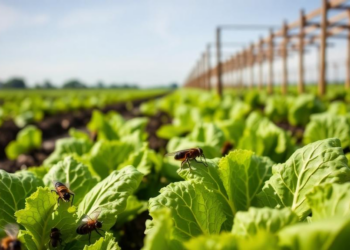
Heavy Pesticide Use Strips Insect Diversity but Boosts Pests in Lettuce Fields
A Chilean field study found that conventionally managed lettuce farms sprayed seven to nine times per cycle supported fewer insect ...
A Chilean field study found that conventionally managed lettuce farms sprayed seven to nine times per cycle supported fewer insect ...

Brazilian researchers used a YOLO-based deep learning model to quantify internal insect injury in sugarcane stalks, showing that continuous injury ...
A comprehensive review finds that bioactive compounds from microalgae, cyanobacteria, and seaweeds can kill insects, nematodes, fungi, bacteria, viruses, and ...
A comparative transcriptomic study of fifteen cotton pest species across four insect orders identifies conserved genes such as vitellogenin and ...
A field and laboratory study in eastern Nepal found neem oil gave the strongest suppression of the leaf-eating caterpillar Artona ...
A two-year nationwide survey of 35 whitefly populations across 18 Chinese agricultural regions reveals escalating resistance to neonicotinoids and newer ...
A comprehensive review in Results in Chemistry details how molecular docking, virtual screening, and ADMET prediction are accelerating the discovery ...
A new review in Crop Health outlines how insect symbiotic microorganisms can be deployed, engineered, or disrupted to control agricultural ...
A new review argues that plant-associated microbes can regulate insect herbivore resistance through three well-supported mechanisms, but inconsistent field performance ...
A new review in the Journal of Nanoparticle Research details how nanoemulsions, nanocarriers, and nano-coatings could overcome the environmental fragility ...

Embark on a thrilling journey of discovery with Scienmag.com—your ultimate source for cutting-edge breakthroughs. Immerse yourself in a world where curiosity knows no limits and tomorrow’s possibilities become today’s reality!