


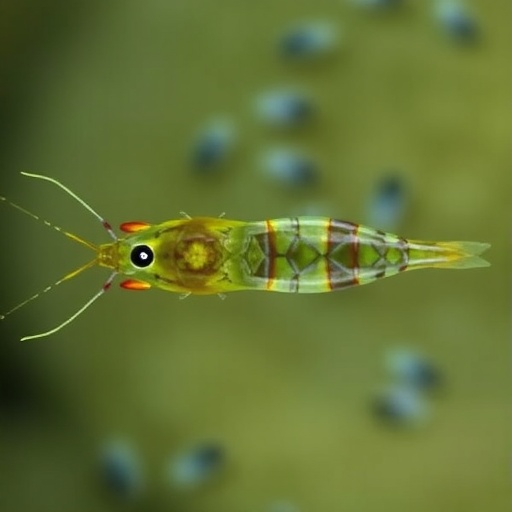
In the darkness beneath Japan’s subtropical Ryukyu Islands, where freshwater moves through rock and seawater penetrates hidden underground passages, researchers have discovered two amphipod species previously unknown to science. The tiny crustaceans, belonging to the genus Bogidiella, live in subterranean aquatic habitats that remain among the least explored ecosystems on Earth. Their discovery on Minamidaito and Ishigaki islands adds to growing evidence that groundwater and anchialine caves—landlocked waters connected to the ocean through underground channels—harbor an unexpectedly rich diversity of specialized animals.
The species, named Bogidiella isajii and Bogidiella painushima, are relatives of the small shrimp-like amphipods found in groundwater, cave streams, narrow waterways, and coastal subterranean systems. Although amphipods are widespread in aquatic environments, members of the family Bogidiellidae are particularly adapted to concealed habitats where sunlight is absent and environmental conditions can change sharply. Hiroshima University Professor Ko Tomikawa and collaborators formally described the two species in a study published in Zootaxa on June 16, 2026. Their work combines detailed anatomical observations with genetic sampling intended to support future studies of the animals’ evolutionary history.
The new species display several characteristics associated with life underground. Their bodies are largely unpigmented, and they lack eyes, features that are common among animals that spend their lives in permanent darkness. Their appendages are elongated, potentially helping them navigate through narrow spaces or detect chemical and physical signals in water. At the same time, their swimming legs, known as pleopods, are reduced compared with those of many surface-dwelling amphipods. These changes are not merely unusual appearances; they represent anatomical patterns that can emerge over evolutionary time as organisms adapt to environments where vision, camouflage, and powerful swimming may be less useful than touch, chemical sensing, and efficient movement through confined spaces.
B. isajii was collected from an anchialine undersea cave on Minamidaito Island. Individuals measure approximately 3.8 to 4.3 millimeters long, placing them close to the size of a sesame seed. The species is named after Yoshitaka Isajii, who discovered the specimens. Its anatomy sets it apart from other members of Bogidiella, particularly in the structure of the pleopods and the tail region. The inner ramus, one of the two branches normally present on each pleopod, is absent. The hardened armature associated with the rami of the first and second pairs of uropods is also missing. Uropods are the paired appendages near the rear of the body and are often important for movement and species identification.
Another distinctive feature of B. isajii is its telson, the terminal structure at the end of the abdomen. In many crustaceans, the telson contributes to a fan-like tail, although in these small amphipods it is more accurately described as a flap. In the new species, the telson appears wider than long, a shape that differs from those documented in related species. Taxonomists frequently use the telson because its outline, setae, spines, and other structural details can remain consistent within a species while differing clearly between closely related forms. In subterranean crustaceans, where many species share similar body sizes and colorless bodies, such small anatomical distinctions are especially valuable.
The second species, B. painushima, was found in freshwater flowing through a cave on Ishigaki Island, in Okinawa. It is smaller than B. isajii, with specimens ranging from approximately 1.4 to 3.2 millimeters long. Its name comes from “Painu-shima,” an Okinawan expression meaning “southern island.” At first glance, the species resembles other members of the genus, but close examination revealed differences in the head, antennae, telson, and gnathopods. Gnathopods are specialized appendages used in feeding, grooming, and handling objects, and their form can provide important clues about both species identity and ecological adaptation.
Among the defining traits of B. painushima are the shape of its antennal sinus and the size of the gland cone on the second segment at the base of the second antenna. The antennal sinus is a recessed region of the head where the antenna is attached, while the gland cone is a small projection associated with the antenna. The species also has a distinct pattern of armature on the telson, referring to the spines, setae, and other hardened structures that reinforce or decorate the appendage. Differences in the gnathopods further separate it from related amphipods. For animals only a few millimeters long, these features require careful microscopy and detailed comparison with specimens from other locations.
The discovery is significant because the Ryukyu Islands contain a mosaic of freshwater, marine, brackish, and groundwater environments distributed across isolated islands. Anchialine systems can be especially complex: their waters may be fresh near land, increasingly saline at depth, or influenced by tides through hidden connections to the sea. Such conditions create a series of ecological zones in which isolated populations can diverge over generations. A cave stream on Ishigaki and an undersea cave on Minamidaito may appear similar from the outside because both are dark and difficult to access, yet their chemistry, salinity, water flow, and geological histories can be very different. These contrasts may help explain why closely related subterranean animals evolve distinct forms on separate islands.
“Groundwater has long been used in human life as a source of drinking water and for agricultural purposes, but in recent years, the conservation of the groundwater environment has become a major challenge,” Tomikawa, the study’s corresponding author, said. Groundwater is often treated as an invisible resource rather than a living ecosystem, but the new findings show that underground waters support organisms with narrow environmental requirements and unique evolutionary histories. Pollution, excessive extraction, changes in recharge caused by land development, and physical alteration of caves can threaten these animals before scientists have even documented them. Because many subterranean species occupy small ranges, damage to a single aquifer or cave system could affect an entire species.
The researchers collected genetic samples from the two amphipods to establish a foundation for future work on their relationships and origins. Genetic data may reveal whether the species descended from ancient lineages that became isolated as islands formed and sea levels changed, or whether their ancestors dispersed through groundwater and coastal connections more recently. Tomikawa and his team plan broader surveys of groundwater and anchialine habitats across the region, where additional undiscovered species may be waiting in narrow cracks, submerged passages, and cave streams. By combining DNA analysis with anatomy, geology, and water chemistry, scientists hope to reconstruct how life colonized subterranean environments and identify the habitats most in need of protection. The two new species are therefore more than additions to a catalog: they are evidence that some of the planet’s most important biological discoveries may still be living in water hidden beneath our feet.
Web References: https://mapress.com/zt/article/view/zootaxa.5831.3.5; https://dx.doi.org/10.11646/zootaxa.5831.3.5
References: Zootaxa, DOI: 10.11646/zootaxa.5831.3.5
Cite Scienmag News
Gavin Prescott. (August 17, 2026). Two New Eyeless Shrimp-Like Species Discovered in Japan’s Groundwater. Scienmag. https://scienmag.com/two-new-eyeless-shrimp-like-species-discovered-in-japans-groundwater/
Gavin Prescott. "Two New Eyeless Shrimp-Like Species Discovered in Japan’s Groundwater." Scienmag, 17 August 2026, https://scienmag.com/two-new-eyeless-shrimp-like-species-discovered-in-japans-groundwater/. Accessed 3 September 2026.
Gavin Prescott. "Two New Eyeless Shrimp-Like Species Discovered in Japan’s Groundwater." Scienmag. August 17, 2026. https://scienmag.com/two-new-eyeless-shrimp-like-species-discovered-in-japans-groundwater/


