


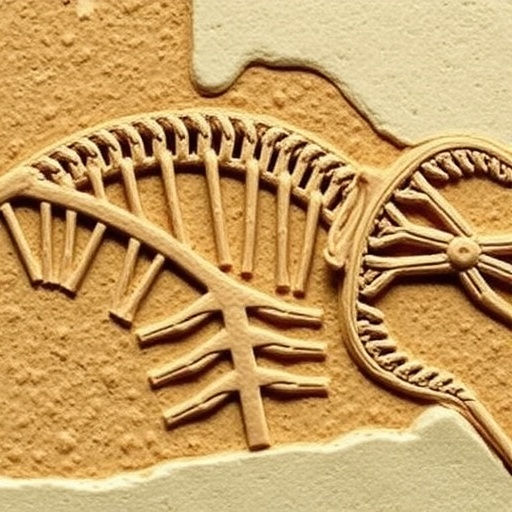
In a groundbreaking paleontological discovery set to redefine our understanding of the late Cambrian period, researchers have unveiled a newly identified fossil arthropod dating back some 500 million years. This remarkable find challenges long-held assumptions about the so-called “Furongian gap,” a period previously thought to represent a significant decline in biodiversity between approximately 497 and 485 million years ago. The fossil, meticulously studied by an international collaborative team led by Flinders University and Germany’s Karlsruhe Institute of Technology, sheds new light on the complexity of ancient ecosystems during this enigmatic interval of Earth’s history.
The “Furongian gap” has mystified paleontologists for decades, as fossil evidence from this era appeared to show a stark contrast in the diversity of life compared to both the preceding Cambrian explosion and subsequent Ordovician radiation. Some hypothesized that this apparent drop in biodiversity resulted from major environmental stressors, including drastic shifts in ocean chemistry, climatic cooling events, or episodes of ecological instability. However, a fresh perspective introduced by this new research posits that previous fossil scarcity might be a consequence of geological and taphonomic biases—meaning researchers may have simply been looking in the wrong sedimentary contexts for well-preserved, soft-bodied organisms.
At the heart of this revisionist view is Magnicornaspis garwoodi, a newly described arthropod species whose morphology points to a lineage closely related to the ancestors of modern-day spiders and scorpions. This specimen exhibits a unique combination of broad cephalic shields, clearly segmented exoskeletal regions, and prominent defensive spines, features characteristic of corcoraniid arthropods—an obscure and poorly understood group from the Cambrian-Ordovician transition. Its discovery within the black shale deposits of the Rivière-du-Loup Formation in Québec unveils an unexpectedly rich fossil archive hidden within deep marine slope environments.
What sets this discovery apart is not merely the age or the taxonomic novelty of the specimen, but also the exceptional preservation quality and the geological provenance. The Rivière-du-Loup Formation’s relatively deep marine setting has long been neglected in favor of more extensively studied shallower deposits, resulting in substantial gaps in the fossil record. By employing modern analytical methods, including advanced imaging techniques and sedimentological analyses, the researchers have been able to unlock critical insights from what was once considered a poor fossiliferous environment.
The retrieval of the fossil itself from the Smithsonian Institution’s vast collections underscores a crucial point about paleontology: transformative findings often arise not just from new field expeditions, but from revisiting existing museum archives. Originally collected during a 1962 geological survey near Québec, this specimen lay dormant for decades until scrutinized using today’s cutting-edge technologies. This reevaluation is part of a broader renaissance in the field, where reexamination of legacy collections is uncovering overlooked biodiversity and reshaping evolutionary narratives.
Integral to the research team’s success was the interdisciplinary collaboration among paleontologists, taxonomists, and paleoartists. Flinders University’s Thomas Turner played a pivotal role in reconstructing the organism’s appearance, bridging the gap between raw scientific data and accessible visual communication. Such artistic reconstructions not only aid in scientific interpretation but also help engage the public and scholarly communities, igniting enthusiasm for ancient life’s intricate forms and evolutionary pathways.
This new data significantly feeds into the growing body of evidence that late Cambrian ecosystems, rather than collapsing into simplistic or depauperate communities, maintained a rich tapestry of life with sophisticated ecological structures. With multiple Furongian fossil sites now coming to light, the narrative of biodiversity decline is increasingly replaced by one of continuity and complexity, demonstrating resilience amid shifting environmental conditions.
Moreover, this research carries profound evolutionary implications. By identifying morphological traits linking Magnicornaspis garwoodi to chelicerates—an arthropod subphylum comprising spiders, scorpions, and their kin—the fossil offers a rare glimpse into the early diversification of major arthropod lineages. Understanding the anatomical innovations and ecological roles of these ancient forms provides crucial context for the emergence of the highly successful and diverse arthropod clade dominating terrestrial and marine ecosystems today.
The study also highlights the critical importance of black shale deposits as repositories of exquisitely preserved soft-bodied fauna, which are otherwise absent or poorly represented in typical fossil-bearing strata. These findings encourage a methodological shift toward exploring under-investigated lithologies and sedimentary environments, which may harbor similarly transformative fossils, thus broadening the scope of paleobiological research.
As Dr. Russell Bicknell of Flinders University emphasizes, the discovery underscores how adopting innovative techniques alongside an open-minded approach to sedimentological contexts can dismantle existing paradigms. It challenges the paleontological community to reconsider biases and gaps that have long skewed evolutionary and ecological interpretations of the ancient biosphere.
Equally, Dr. Julien Kimmig’s insights from Karlsruhe Institute of Technology advocate for a more nuanced understanding that the perceived biodiversity “crisis” during the Furongian may be an artifact of historical research focus and sampling limitations. This recalibration of diversity patterns holds significant ramifications for reconstructing not only biological but also geochemical and paleoenvironmental frameworks of the Cambrian-Ordovician transition.
In conclusion, the unveiling of Magnicornaspis garwoodi from the Furongian strata in Canada is more than the description of a new fossil species; it is a testament to the evolving nature of paleontological inquiry. By integrating old collections with new technology and interdisciplinary expertise, scientists continue to unravel the complexities of Earth’s ancient past, providing fresh perspectives on how life’s diverse forms emerged and persevered through deep time.
Cite Scienmag News
Violet Maxwell. (May 28, 2026). Rediscovered Fossil Sheds New Light on Animal Evolution. Scienmag. https://scienmag.com/rediscovered-fossil-sheds-new-light-on-animal-evolution/
Violet Maxwell. "Rediscovered Fossil Sheds New Light on Animal Evolution." Scienmag, 28 May 2026, https://scienmag.com/rediscovered-fossil-sheds-new-light-on-animal-evolution/. Accessed 4 September 2026.
Violet Maxwell. "Rediscovered Fossil Sheds New Light on Animal Evolution." Scienmag. May 28, 2026. https://scienmag.com/rediscovered-fossil-sheds-new-light-on-animal-evolution/


