


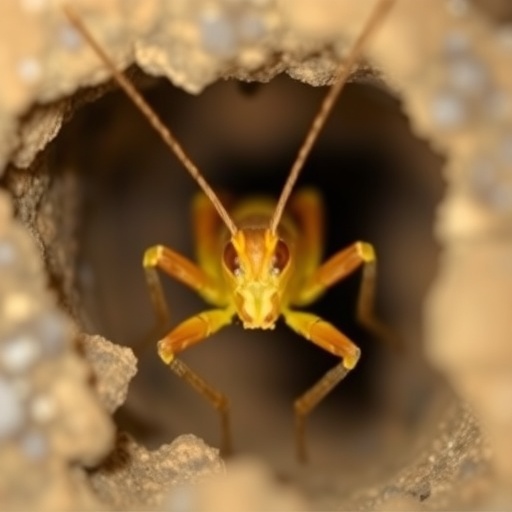
In the realm of scientific exploration, even the most scrutinized regions of the world can yield surprising discoveries, shaking up our understanding of biodiversity and evolutionary adaptation. A remarkable example of this emerged recently from the tiny Greek island of Kastellorizo, nestled in the eastern Mediterranean. Despite extensive studies over the years, researchers have uncovered a previously unknown cave cricket species thriving not in a natural cavern but within a man-made tunnel system. This discovery, derived from meticulous morphological and molecular investigations, unveils not only a new species but also compelling insights into subterranean life’s resilience and the underappreciated ecological value of artificial underground habitats.
The newly identified cricket has been named Dolichopoda balrogi sp. nov., a nod to J.R.R. Tolkien’s legendary Balrog, an enigmatic fire-demon dwelling deep beneath ancient mountains. This evocative naming captures the essence of the insect’s elusive existence within dark, man-made tunnels on Mount Vigla, a site crafted by human excavation on an island largely devoid of natural cave systems. Dolichopoda balrogi’s discovery in such an environment highlights the unforeseen sanctuaries that human infrastructure can unexpectedly provide for specialized fauna adapted to subterranean darkness and humidity.
Belonging to the genus Dolichopoda, this cricket exemplifies the evolutionary niche specialization characteristic of cave-dwelling Orthoptera. These crickets are specialized to live in constant darkness, high humidity, and restricted spaces—conditions typical in caves and similar underground habitats across southern Europe and the Mediterranean basin. Their life strategies include heightened tactile senses, wing reduction, and pigmentation loss, traits evolved over millennia to optimize survival in isolated environments. Notably, these crickets serve as models for studying speciation, as geographically separated populations often diverge into genetically distinct species, making them invaluable for evolutionary biology research.
The population of Dolichopoda balrogi was found exclusively in an artificial tunnel on Kastellorizo, an island covering merely nine square kilometers yet acting as a biogeographic hotspot due to its position at the crossroads of Europe and Asia. The artificial tunnel, originally excavated for historical or infrastructural purposes, turned out to be a haven for this unnoticed cricket species, indicating how anthropogenic landscapes can influence and sometimes facilitate the survival and evolution of niche organisms. Detailed morphological assessments, including body segmentation, leg morphology, and sensory organ adaptations, were corroborated by molecular analyses employing genetic markers to confirm its distinct lineage within Rhaphidophoridae.
The discovery process was serendipitous yet rigorous, involving thorough sampling protocols and comparative analyses against known Dolichopoda species. Advancements in molecular techniques—such as DNA barcoding and mitochondrial gene sequencing—were instrumental in establishing the new species’ uniqueness beyond morphological traits, which can sometimes be subtle or convergent among cave fauna. This approach affirms the necessity of integrating genetic data with classical taxonomy to characterize cryptic biodiversity accurately, particularly in poorly studied or extreme habitats.
Dolichopoda balrogi’s adaptation to living in the dark, tight confines of tunnels reflects a remarkable example of subterranean specialization. Its physiological and behavioral traits, including reduced eyesight compensated by enhanced mechanoreceptors and altered metabolism to cope with nutrient-scarce environments, demonstrate evolutionary responses to continuous darkness and isolation. The cricket’s existence in a man-made tunnel further suggests flexibility in habitat use, challenging traditional definitions of natural habitat and underscoring the ecological complexity of anthropogenic ecosystems.
This profound discovery also carries vital conservation implications. Cave-adapted organisms like Dolichopoda species often exhibit limited distributions and extreme habitat specificity, rendering them vulnerable to environmental disturbances. The isolated nature of underground populations can lead to low genetic diversity and specialized ecological requirements, factors that increase susceptibility to habitat degradation. As a species apparently confined to a single tunnel system, Dolichopoda balrogi illustrates the fragility of subterranean biodiversity hotspots and the urgent need for targeted conservation measures.
Moreover, this finding opens a broader dialogue on how human-induced changes—historically viewed largely as destructive—can inadvertently foster new ecological niches. The case of Dolichopoda balrogi exemplifies how tunnels, mines, and other underground infrastructures might serve as refugia amid habitat loss elsewhere, providing stable microclimates that protect specialized fauna from climatic and anthropogenic pressures on the surface. This challenges conservationists and ecologists to reconsider strategies for preserving subterranean biodiversity, incorporating artificial underground habitats into environmental management frameworks.
The island of Kastellorizo itself emerges from this study as an underestimated reservoir of biodiversity. Its strategic location between continents contributes to its role as a unique evolutionary arena where species from different geographical origins can intermingle or evolve independently. The discovery hints at numerous other cryptic or undiscovered species possibly inhabiting its rugged terrain, caves, and anthropogenic structures, emphasizing the importance of continued and nuanced biological surveys in Mediterranean insular ecosystems.
Scientific interest in this discovery is further heightened by the cultural resonance of its name. Drawing from Tolkien’s lore, “balrogi” metaphorically connects the cricket’s hidden, shadowy existence to the mythical Balrog revealed only after the Dwarves delved too deep underground. This creative link underscores the intertwining of scientific discovery with storytelling, helping communicate the wonder and narrative behind biodiversity research to a broader public. Such engagement is crucial in raising awareness and appreciation of subterranean biodiversity, which often remains invisible and underappreciated in conservation dialogues.
The discovery, published in the Journal of Orthoptera Research, represents a milestone for cave biology and biogeography. It exemplifies how cutting-edge taxonomic research combined with local fieldwork can continue to unravel the complexity of life in extreme habitats. As molecular and morphological tools become more sophisticated and accessible, the pace of uncovering similar hidden species, especially in less explored or human-altered environments, is expected to accelerate, bringing new insights into evolutionary processes and ecosystem dynamics.
Overall, the case of Dolichopoda balrogi sp. nov. is a clarion call for the scientific community and policy makers alike to broaden the scope of biodiversity exploration and protection. It highlights that the frontiers of discovery are not confined to distant, pristine wilds but are often close to human settlements in overlooked or unconventional places. Understanding and valuing this hidden diversity is key for sustaining our planet’s biological heritage amid escalating environmental challenges.
News Publication Date: 27-May-2026
Web References:
– Journal of Orthoptera Research: https://jor.pensoft.net/article/187943/
– DOI: http://dx.doi.org/10.3897/jor.35.187943
Cite Scienmag News
Gavin Prescott. (May 28, 2026). Scientists Uncover New Cave Cricket Species in Kastellorizo, Greece—Nicknamed the “Balrog” of the Tunnels. Scienmag. https://scienmag.com/scientists-uncover-new-cave-cricket-species-in-kastellorizo-greece-nicknamed-the-balrog-of-the-tunnels/
Gavin Prescott. "Scientists Uncover New Cave Cricket Species in Kastellorizo, Greece—Nicknamed the “Balrog” of the Tunnels." Scienmag, 28 May 2026, https://scienmag.com/scientists-uncover-new-cave-cricket-species-in-kastellorizo-greece-nicknamed-the-balrog-of-the-tunnels/. Accessed 5 September 2026.
Gavin Prescott. "Scientists Uncover New Cave Cricket Species in Kastellorizo, Greece—Nicknamed the “Balrog” of the Tunnels." Scienmag. May 28, 2026. https://scienmag.com/scientists-uncover-new-cave-cricket-species-in-kastellorizo-greece-nicknamed-the-balrog-of-the-tunnels/


