


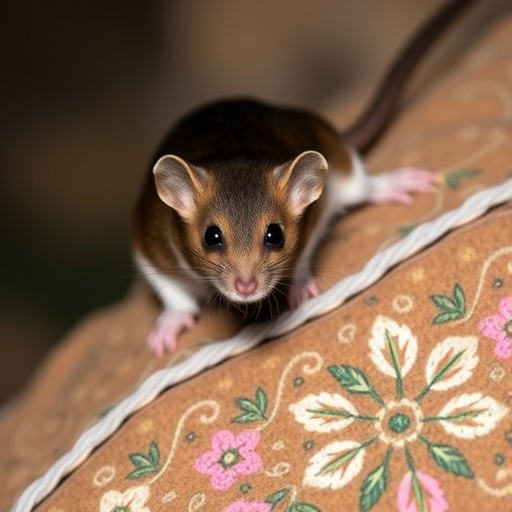
In a groundbreaking study poised to redefine conservation genetics and climate adaptation strategies, researchers have unveiled compelling evidence that North America’s most endangered rodent, the Pacific pocket mouse, is actively undergoing genetic shifts in response to environmental changes. Published in Science Advances, this research utilizes cutting-edge genomic analyses to trace adaptive alleles linked to temperature and moisture variations, uncovering vital clues about the species’ capacity to survive amidst accelerating climate change.
The Pacific pocket mouse (Perognathus longimembris pacificus), once presumed extinct until its dramatic rediscovery in 1994, inhabits a critically fragmented coastal ecosystem in Southern California. This diminutive mammal’s survival hinges not only on habitat preservation but also on its ability to genetically adapt to rising thermal stressors and fluctuating moisture regimes. The research team employed whole-genome sequencing on specimens archived over the last century, providing a temporal dimension to evolutionary dynamics rarely achievable in endangered species studies.
Through meticulous scanning of the genome, scientists identified fourteen candidate genes intimately involved in physiological pathways associated with temperature regulation and water balance. These genes function in concert within complex regulatory networks, mediating cellular responses crucial for thermotolerance and hydration maintenance. Their allelic frequencies were subsequently monitored in populations reintroduced into the wild from captive breeding programs, revealing statistically significant shifts concordant with new environmental pressures.
This dynamic genomic landscape evidences ongoing evolutionary adaptation rather than static genetic stagnation, a notion previously doubted due to the limited genetic pool typical of endangered species. The observed allele frequency changes reflect natural selection’s subtle yet potent imprint, whereby beneficial variants increase prevalence, enhancing resilience to climate-induced habitat alterations. Such findings underscore the importance of integrating genetic monitoring into conservation protocols to gauge adaptive potential accurately.
Importantly, the longitudinal aspect of this study allowed dissection of historical baselines, providing insights into how past environmental perturbations shaped genetic architecture. Comparing historical and contemporary genomes illuminated a trajectory of genetic variation loss intertwined with bottleneck events and anthropogenic habitat fragmentation. Despite these challenges, pockets of adaptive genetic diversity persist, offering hope that evolutionary mechanisms can be harnessed for species recovery.
Technical advancements in high-throughput sequencing and bioinformatics were pivotal in decoding these nuanced genetic changes. The research team applied genome-wide association studies (GWAS) and environmental association analyses (EAA) to correlate specific single nucleotide polymorphisms (SNPs) with climatic variables. These integrative approaches unveiled genotype-environment interactions, reinforcing the causal links between genotype shifts and ecological adaptation.
From an ecological standpoint, this research highlights the intricate interplay between genetics and environment in shaping species’ fate under climate stress. The Pacific pocket mouse exemplifies a model system wherein microevolutionary processes operate on ecological timescales, emphasizing the necessity of evolutionary-informed conservation strategies. Active management facilitating gene flow and safeguarding habitat heterogeneity could bolster adaptive responses, mitigating extinction risks.
The implications transcend this single species, offering a conceptual framework applicable to myriad endangered taxa confronting rapid climate change. Conservation programs worldwide stand to benefit from incorporating genomic surveillance to identify climate-adaptive alleles and monitor their trajectories post-reintroduction. Such precision management could enable the design of assisted gene flow or selective breeding initiatives personalized to ecological contexts.
Furthermore, the study raises awareness about the limitations posed by reduced genetic diversity in endangered populations. Without sufficient allelic variation, adaptive potential diminishes, impeding evolutionary rescue. Hence, the findings advocate for preemptive conservation efforts that maintain or enhance genetic heterogeneity before populations become critically inbred or extinct.
In the context of ongoing climate crises, the study’s demonstration of genomic adaptability instills a cautiously optimistic perspective. The evolutionary capacity of species, albeit constrained, persists and can be strategically augmented through science-based interventions. As global temperatures rise and precipitation patterns shift, understanding and leveraging such adaptive dynamics will prove crucial in biodiversity conservation.
This pioneering research paves the way for an era where genomic tools become integral to wildlife management, shifting paradigms from static preservation to dynamic adaptation facilitation. Through fostering collaboration between geneticists, ecologists, and conservation practitioners, the promise of sustaining endangered species in a warming world grows tangible.
In sum, the resilient genetic pulse detected in Pacific pocket mice populations reflects the tenacity of life to endure amidst adversity. While many species may lack such genetic plasticity, the elucidation of adaptive genetic markers offers a beacon guiding future efforts to conserve not only this tiny coastal rodent but also the countless organisms imperiled by humanity’s changing climate.
News Publication Date: 17-Apr-2026.
Web References: Embargoed manuscript and visuals available at https://sandiegozoo.box.com/s/xloa8kho8nu3c4zg1arpp4azvdkhokfw
Cite Scienmag News
Juliet Wilcox. (April 17, 2026). New Study Reveals Climate Adaptation in One of the World’s Rarest Mice. Scienmag. https://scienmag.com/new-study-reveals-climate-adaptation-in-one-of-the-worlds-rarest-mice/
Juliet Wilcox. "New Study Reveals Climate Adaptation in One of the World’s Rarest Mice." Scienmag, 17 April 2026, https://scienmag.com/new-study-reveals-climate-adaptation-in-one-of-the-worlds-rarest-mice/. Accessed 5 September 2026.
Juliet Wilcox. "New Study Reveals Climate Adaptation in One of the World’s Rarest Mice." Scienmag. April 17, 2026. https://scienmag.com/new-study-reveals-climate-adaptation-in-one-of-the-worlds-rarest-mice/


