


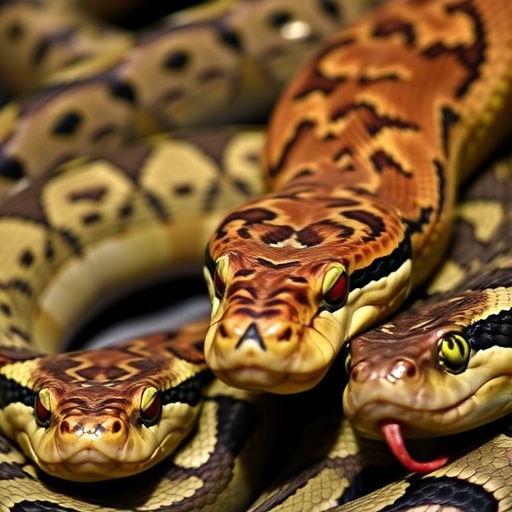
In the fragile ecosystems of island habitats, the interplay of invasive species and extreme weather events often precipitates profound and lasting impacts on native biodiversity. A recent longitudinal study, conducted between 2017 and 2024 on North Key Largo in Florida, provides a keystone insight into how these forces collectively jeopardize endangered endemic rodent populations. Published in the 2026 edition of Biological Diversity, this research delineates the opposing population trajectories of two imperiled subspecies—the Key Largo woodrat (Neotoma floridana smalli) and the Key Largo cotton mouse (Peromyscus gossypinus allapaticola)—in the perilous aftermath of Hurricane Irma and the regional incursion of invasive Burmese pythons (Python bivittatus).
The Key Largo archipelago is a remnant of an ancient terrestrial environment, housing unique fauna that have evolved in isolation, with highly specialized ecological roles and limited adaptive capacity to rapid environmental change. Yet, this biological refuge faces increasingly dire threats as global climatic volatility intensifies storm magnitude and frequency, while concurrently facilitating the establishment of insidious invasive predators. Burmese pythons, large constrictor snakes native to Southeast Asia, have become a dominant predator within these subtropical islands following introduction through the exotic pet trade, exerting substantial predation pressure on native vertebrates.
Researchers employed an intensive live-trapping framework, operationalized through the deployment of 49 Sherman traps across 10 spatially defined grids, sampled over four seasonal sessions spanning from spring 2017 to spring 2024. This consistent methodology enabled the quantification of population densities, detection probabilities, and individual movement within and among grids by leveraging spatially explicit capture-recapture (SECR) models. These sophisticated statistical tools integrate spatial factors with traditional capture-recapture data to yield unbiased density estimates, crucial in small, fragmented habitats where spatial heterogeneity is pronounced.
Analysis unveiled a profound collapse in Key Largo woodrat populations. Initial densities measured at 3.59 individuals per hectare in 2017 plummeted to 0.61 individuals per hectare by 2024. This contraction was paralleled by a shrinkage in occupied habitat from ten captured grids to a mere four, indicative of severe fragmentation and local extirpations. The woodrat’s decline is attributed to compound stressors: acute habitat degradation following Hurricane Irma, which wrought substantial canopy defoliation, altered microhabitats, and diminished resource availability, paired with an escalated predation footprint from burgeoning python populations. Their slow reproductive rates and relatively large body sizes render woodrats disproportionately vulnerable to these pressures.
Conversely, the Key Largo cotton mouse exhibited an intriguing demographic resilience. Starting with a baseline density of 1.57 individuals per hectare in 2017, cotton mouse populations surged to an apex density of 5.35 individuals per hectare in 2022. Although a subsequent decline to 2.70 individuals per hectare was recorded by 2024, their broader ecological niche, higher fecundity, and quicker life history traits seemingly buffered against the synergistic threats of invasive predation and storm-induced habitat perturbation. This inverse population trajectory between the two rodent subspecies underscores species-specific responses dictated by life-history strategies and ecological plasticity.
The study further postulates that hurricanes, by altering landscape permeability and precipitating dispersal events, may act as inadvertent vectors facilitating the expansion of invasive Burmese pythons across island habitats that were previously inaccessible. Hurricane-induced vegetation damage and flooding might create corridors conducive to python movement or generate prey scarcity that drives predator mobility, exacerbating predation pressure on native fauna. This phenomenon underscores the multifactorial nature of biological invasions under climate change scenarios where natural disturbances interplay with anthropogenic influences.
Beyond predator-prey dynamics, the ecological consequences extend to the attrition of ecosystem engineers. Woodrats are noted for their role in seed caching and habitat modification, behaviors critical for forest regeneration and nutrient cycling. Their decline portends cascading effects that may destabilize island ecological networks and diminish biodiversity. Contrastingly, the cotton mouse, while more adaptable, may alter competitive dynamics, potentially influencing community assemblages if unchecked population growth ensues.
This emergent evidence signifies a pressing conservation imperative: the deployment of targeted invasive species management actions, particularly focused on Burmese python control via removal programs, must be integrated with active habitat restoration initiatives. Recovery of native vegetation and microhabitat structures post-hurricane are paramount to reestablishing refugia conducive to woodrat persistence. Moreover, ongoing population monitoring employing robust spatially explicit methodologies is essential to detect further changes and interpret the efficacy of intervention strategies.
Importantly, this research exemplifies the necessity of approaching conservation in island ecosystems through a multifaceted lens that acknowledges climate-induced natural disturbance regimes in tandem with ongoing biological invasions. It augments our understanding of how these complex and compounded stressors dynamically reshape native species survival probabilities and spatial distributions over time.
The study adheres rigorously to ethical standards, with all trapping and handling protocols sanctioned by relevant institutional and governmental agencies, ensuring minimal animal distress and compliance with established wildlife recovery and research permits. The authors declare no conflicts of interest, which underscores the scientific integrity underpinning these findings.
Authors of the study hail primarily from the School of Forestry and Horticulture at Southern Illinois University, Carbondale, with specialized expertise in conservation biology, invasive species ecology, and disturbance ecology in the Florida Keys. Their collaborative work offers a valuable contribution to global biodiversity conservation efforts, particularly in the face of accelerating global environmental change.
Ultimately, the insights derived from this study offer both a cautionary tale and a roadmap for biodiversity conservation on islands worldwide. The synergistic impacts of invasive species and climate-mediated disturbances threaten to erode the unique biotic heritage of island ecosystems, but coordinated science-based interventions provide hope for sustaining endemic species amid unprecedented ecological challenges.
News Publication Date: May 29, 2026
Web References: http://dx.doi.org/10.1002/bod2.70027
References:
Sayers, Shauna M., Brent S. Pease, Brandon W. McDonald, Isabella R. Collamati, Jeremy D. Dixon, and Michael V. Cove. 2026. “Density Estimates of Endangered Endemic Rodents Suggest Broader Impacts of Invasive Burmese Pythons Following a Category 4 Hurricane in the Florida Keys,” Biological Diversity: 1–11.
Cite Scienmag News
Margaret Porter. (May 29, 2026). Invasive Pythons and Hurricanes Trigger Opposing Population Changes in Florida’s Native Rodents. Scienmag. https://scienmag.com/invasive-pythons-and-hurricanes-trigger-opposing-population-changes-in-floridas-native-rodents/
Margaret Porter. "Invasive Pythons and Hurricanes Trigger Opposing Population Changes in Florida’s Native Rodents." Scienmag, 29 May 2026, https://scienmag.com/invasive-pythons-and-hurricanes-trigger-opposing-population-changes-in-floridas-native-rodents/. Accessed 4 September 2026.
Margaret Porter. "Invasive Pythons and Hurricanes Trigger Opposing Population Changes in Florida’s Native Rodents." Scienmag. May 29, 2026. https://scienmag.com/invasive-pythons-and-hurricanes-trigger-opposing-population-changes-in-floridas-native-rodents/


