


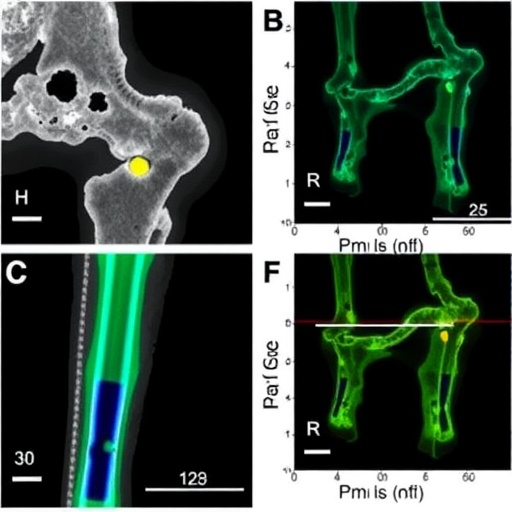
In a groundbreaking advancement poised to transform regenerative medicine, researchers have unveiled a novel decoupling strategy that enhances spatiotemporal regulation and biomechanical transmission in sandwiched scaffolds designed for osteochondral regeneration. Published recently in Nature Communications, this pioneering study offers a sophisticated approach to repairing complex osteochondral defects by addressing the intricate interplay between biological cues and mechanical forces within engineered tissue constructs. The innovation centers on the strategic structuring of a sandwiched scaffold model, providing a new horizon in targeted tissue engineering and functional restoration of damaged cartilage and subchondral bone.
Osteochondral defects, involving the degradation of both cartilage and underlying bone, have long presented a formidable clinical challenge due to the distinct biological and mechanical requirements of each tissue layer. Traditional treatments often fail to restore the native architecture and function, leading to progressive degeneration and osteoarthritis. Central to this new research is the concept of decoupling two fundamental aspects: the spatiotemporal delivery of biochemical signals and the transmission of biomechanical forces, parameters critical for orchestrating cellular behaviors essential for successful tissue regeneration.
The sandwiched scaffold developed by Liu and colleagues innovatively integrates two distinct layers, each designed to individually cater to the unique needs of cartilage and subchondral bone regeneration. By isolating and independently optimizing biochemical and mechanical stimuli within each compartment, the scaffold precisely guides cell differentiation, proliferation, and matrix synthesis in a controlled and predictable manner. This methodological separation enables synchronized regeneration, minimizing detrimental cross-interference often observed in traditional composite grafts.
At the heart of this decoupling strategy lies a sophisticated biomaterial design that mimics the native extracellular matrix environment of the osteochondral unit. The upper cartilage-mimicking layer incorporates a hydrogel matrix laden with growth factors and fine-tuned porosity to facilitate chondrogenic differentiation and nutrient diffusion. Conversely, the bottom layer incorporates a stiffer, mineralized scaffold that mimics subchondral bone’s biomechanical properties and promotes osteogenesis through embedded osteoinductive agents. This architectural compartmentalization accomplishes an elegant balance—providing localized mechanical support while ensuring sustained biochemical signaling.
Mechanotransduction, the process by which cells convert mechanical stimuli into biochemical responses, is a pivotal factor in tissue maturation and functional integration in vivo. The research team innovatively incorporated dynamic mechanical loading into their experimental design to replicate physiological conditions experienced by articular cartilage. This biomechanical stimulation was transmitted through the sandwiched scaffold, reinforcing cellular activities that drive matrix deposition and structural organization, crucial for regenerating a resilient osteochondral interface capable of withstanding daily mechanical stresses.
Temporal control of bioactive factor release is another critical advantage of the proposed decoupling system. Through the utilization of advanced delivery vehicles embedded within each layer, growth factors such as transforming growth factor-beta (TGF-β) and bone morphogenetic protein-2 (BMP-2) are released in phase with each tissue’s developmental timeline. This careful orchestration prevents premature or mistimed differentiation events that could compromise structural coherence or functional outcomes. The controlled release system achieves sustained, localized signaling over extended periods, harmonizing with cellular turnover and matrix remodeling processes.
The experimental validation of the sandwiched scaffold included comprehensive in vitro and in vivo assessments that underscore the clinical promise of this technology. In culture, stem cells seeded within the respective layers exhibited marked differentiation trajectories consistent with cartilage and bone phenotypes under combined biochemical and mechanical cues. When implanted into animal models with induced osteochondral defects, the scaffold facilitated robust tissue integration, regeneration of native-like cartilage surface, and restoration of subchondral bone integrity. Histological and biomechanical analyses confirmed the scaffold’s efficacy in reconstructing a functional osteochondral unit.
Beyond biological regeneration, this system also addresses a long-standing challenge—the mechanical compatibility between regenerated tissues and host structures. The tailored stiffness gradient within the scaffold minimizes delamination risks and supports stress distribution, thereby averting failure modes commonly encountered in hybrid tissue interfaces. This feature is indispensable for long-term survivability and the restoration of joint functionality, making the technology highly applicable to load-bearing joints such as the knee and ankle.
Further technological highlights include the use of biofabrication techniques enabling precise spatial layering and material crosslinking, which confer robustness while preserving cellular viability and function. This level of architectural control positions the scaffold prototype at the forefront of personalized regenerative implants, where patient-specific geometries and injury profiles can be accommodated through additive manufacturing and tailored biomaterial blends.
The implications of this research extend far beyond osteochondral repair, signaling a shift in regenerative engineering paradigms towards the decoupling of multiplexed signals in complex tissue systems. Future applications could involve integrating additional layers or modules to address composite tissues such as the osteotendinous junction or vascularized bone, broadening the scaffold’s utility and impact. The ability to independently navigate spatial and temporal parameters of regeneration while maintaining mechanical fidelity could redefine scaffold design principles across biomedical fields.
Contributing to the broader understanding of tissue biomechanics, this study exemplifies how an interdisciplinary fusion of material science, cellular biology, and mechanical engineering can yield platforms that recapitulate the multifaceted nature of human tissues. The exploration and application of biomechanical transmission alongside biochemical regulation illuminate pathways to new therapies that are both biologically sophisticated and mechanically pragmatic, elevating the standards of reparative medicine.
In summary, this innovative decoupling strategy for sandwiched scaffolds marks a critical advancement in osteochondral regeneration by honing in on the precise control over spatial, temporal, and mechanical factors driving tissue repair. Liu and colleagues’ approach leverages biomimicry, mechanobiology, and controlled bioactive delivery to engineer a functional, durable osteochondral interface, thereby setting a new benchmark for regenerative scaffolding systems. The promising data and conceptual breakthroughs evidenced herein promise future translation from bench to bedside, potentially revolutionizing treatments for joint diseases and improving millions of patients worldwide.
As the field of regenerative medicine continues to evolve, this study exemplifies the direction of future tissue engineering strategies: dynamic, multidimensional, and finely tunable biomaterials that empower cells to self-organize and restore complex tissues with functional fidelity. Unlocking the regeneration of osteochondral units through decoupling biochemical and biomechanical parameters is a milestone that may spur the next generation of bioengineered therapeutics, bringing closer the goal of fully functional joint restoration and improved quality of life for affected individuals.
Cite Scienmag News
Ophelia Keating. (April 17, 2026). Decoupling Strategy Enhances Osteochondral Scaffold Function. Scienmag. https://scienmag.com/decoupling-strategy-enhances-osteochondral-scaffold-function/
Ophelia Keating. "Decoupling Strategy Enhances Osteochondral Scaffold Function." Scienmag, 17 April 2026, https://scienmag.com/decoupling-strategy-enhances-osteochondral-scaffold-function/. Accessed 4 September 2026.
Ophelia Keating. "Decoupling Strategy Enhances Osteochondral Scaffold Function." Scienmag. April 17, 2026. https://scienmag.com/decoupling-strategy-enhances-osteochondral-scaffold-function/


