


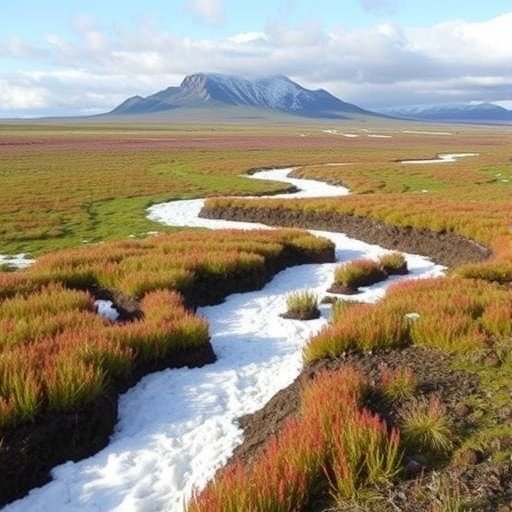
As the planet continues to warm at an unprecedented pace, the question of how agriculture might adapt to shifting climatic zones has become increasingly urgent. New research is shedding light on a previously underappreciated limit to the northward expansion of agricultural land: the vast northern permafrost soils. Scientists are rigorously examining how these frozen grounds represent a formidable barrier that constrains the northward migration of climatically feasible agricultural frontiers, even under future warming scenarios. This insight challenges earlier assumptions that arable land will freely expand into northern regions as temperatures rise.
The study, recently published in Communications Earth & Environment, reveals nuanced interactions between permafrost thawing dynamics and agricultural viability. Although models predict significant warming across Arctic and sub-Arctic regions, the presence of persistent permafrost soils imposes critical physical and biogeochemical constraints on soil development, moisture availability, and nutrient cycling—parameters essential to successful crop production. The northern soils do not simply become fertile lands overnight as ice recedes; rather, a complex set of limiting factors emerge, reshaping our understanding of future agricultural potentials.
Permafrost, by definition, refers to ground that remains at or below 0°C for at least two consecutive years. These frozen soils cover vast tracts of land across the high northern latitudes, storing immense quantities of organic carbon and water locked in ice. As global temperatures rise, thawing permafrost initiates profound transformations in soil structure, hydrology, and chemistry. While some thawed areas might transition into viable cropland over extended timescales, many experience waterlogging, land subsidence, and destabilization, which undermine agricultural productivity. This phenomenon effectively draws a hard line for northward agricultural expansion.
Xu, Xiao, Jägermeyr, and colleagues utilized dynamic ecosystem and climate modeling to unravel these complex feedbacks. Their analyses incorporated permafrost distribution data, soil thermal properties, hydrological responses, and crop growth models under various greenhouse gas emission scenarios projected through the mid- and late 21st century. This integrative approach allowed them to spatially delineate the climatically feasible frontiers for agriculture considering both temperature increases and the ecological realities imposed by frozen soils.
One of the pivotal findings is that while regional warming trends may reduce cold-related limitations for crop growth, the degradation of permafrost simultaneously creates new environmental challenges. For example, the thaw-induced alteration of soil moisture regimes often leads to excessive surface wetness or drainage problems, hindering traditional farming practices. Furthermore, nutrient mobilization from organic matter releases greenhouse gases but does not necessarily translate into increased soil fertility usable for agriculture within relevant timeframes.
The researchers emphasize that previous projections that relied solely on temperature thresholds for crop viability tended to overestimate the expansion potential of agricultural frontiers in the Northern Hemisphere. The presence of permafrost introduces non-linear constraints that fundamentally confine the spatial extent where cultivation can sustainably occur. This has profound implications for global food security strategies and agricultural land management policies, especially as northern countries weigh potential benefits and risks of expanding farming activities.
A striking implication of this study is its challenge to the commonly held expectation that warming will universally increase arable land area. While some temperate and subtropical zones may witness improved agricultural yields, permafrost soils at high latitudes provide a natural constraint limiting the northward compensation for losses in other regions due to drought or heat stress. The net balance of agricultural land and productivity under climate change is thus far more complex and regionally heterogeneous than previously recognized.
The permafrost boundary acts as an ecological and physical threshold that modulates hydrological pathways, soil stability, and vegetation succession, all of which influence agronomic potential. Even where thaw occurs, processes such as thermokarst—localized land collapse due to ice melt—pose challenges for mechanized farming. Restoration or preparation of such soil surfaces for crop production would require extensive intervention, technology, and investment, further complicating feasibility.
Another dimension highlighted by the study is the temporal lag between climatic warming and actual land usability for agriculture. Soil formation from permafrost substrates is a slow process, dependent on soil organic matter decomposition, microbial activity, and weathering—all of which can take decades to centuries to stabilize into fertile ground. Hence, even under scenarios of continuous warming, the agricultural frontiers pinned by permafrost edges do not shift rapidly, dampening the potential for quick adaptation via geographic expansion.
The findings call for integrated land-use planning that incorporates permafrost dynamics into predictions of future agricultural landscapes. Policymakers must consider that regions with thawing permafrost may not yield the easy gains in crop land once anticipated. Instead, these areas demand careful assessment of soil quality, water dynamics, and ecosystem responses before agricultural development initiatives proceed.
Moreover, this research underscores the tightly-knit feedback loops between climate change, land systems, and biogeochemical cycles. Thawing permafrost is a significant source of carbon dioxide and methane emissions, further accelerating global warming and complicating mitigation efforts. The double-edged impact—both limiting agricultural expansion and contributing to greenhouse gas fluxes—illustrates the systemic nature of climate change challenges that transcend simplistic solutions.
The study also highlights the importance of multidisciplinary collaboration, combining climatology, soil science, ecology, and agronomy to achieve accurate forecasts. The complexity of permafrost landscapes demands such integrative approaches to avoid misunderstandings that could misguide investment decisions or environmental policies. Advanced remote sensing technologies and in situ monitoring play crucial roles in refining permafrost mapping and dynamic assessment.
In conclusion, the research challenges optimistic narratives about the adaptability of global agriculture to climate change solely through spatial expansion into northern territories. It situates northern permafrost not just as a passive backdrop but as an active environmental boundary that profoundly shapes the future geography of farming. The earth’s frozen soils, long viewed as inert, emerge as critical gatekeepers in determining where agriculture can unfold sustainably in a warming world.
As societies worldwide strategize to enhance food production amidst climatic uncertainties, recognizing the limitations imposed by permafrost landscapes is essential. Future agricultural planning must balance technological innovation with ecological realities to forge resilient food systems. The study by Xu and colleagues thus provides a valuable scientific foundation for informed decision-making at the nexus of climate, land, and food security.
This new body of knowledge invites further research into adaptive farming techniques suitable for cold-regions and the potential role of ecological restoration alongside food production efforts. Understanding the interplay between thawing soils and crop viability will be crucial for managing risks and harnessing any available opportunities while safeguarding fragile northern ecosystems.
In summary, northern permafrost is far from a simple frontier awaiting cultivation with the progression of global warming. Instead, it marks a dynamic and challenging ecological threshold that limits the northward shift of climatically feasible agricultural frontiers. This paradigm shift in understanding reframes how we envision the future of agriculture under climate change and underscores the need for holistic and scientifically informed approaches moving forward.
Xu, S., Xiao, C., Jägermeyr, J. et al. Northern permafrost represents a limit on the northward shift of climatically feasible agricultural frontiers under future warming.
Commun Earth Environ (2026). https://doi.org/10.1038/s43247-026-03702-w
Cite Scienmag News
Violet Maxwell. (May 30, 2026). Northern Permafrost Limits Future Agricultural Expansion North. Scienmag. https://scienmag.com/northern-permafrost-limits-future-agricultural-expansion-north/
Violet Maxwell. "Northern Permafrost Limits Future Agricultural Expansion North." Scienmag, 30 May 2026, https://scienmag.com/northern-permafrost-limits-future-agricultural-expansion-north/. Accessed 3 September 2026.
Violet Maxwell. "Northern Permafrost Limits Future Agricultural Expansion North." Scienmag. May 30, 2026. https://scienmag.com/northern-permafrost-limits-future-agricultural-expansion-north/


