


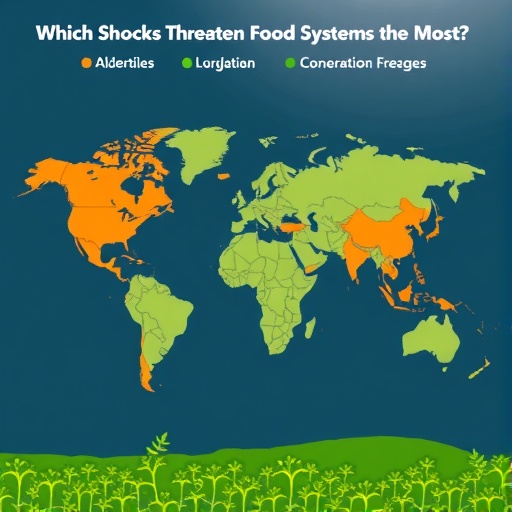
In recent times, the stability of global food systems has been exposed to extraordinary pressures, epitomized by disruptive events such as the closure of critical maritime chokepoints like the Strait of Hormuz and geopolitical tensions exemplified by the Russian invasion of Ukraine. These shocks have triggered cascading effects through agricultural commodity markets, instigating significant price hikes and amplifying food insecurity worldwide. As nations grapple with these multifaceted threats, the urgency to develop robust strategies that enhance resilience against future food crises has never been more pronounced. However, emerging insights from a pioneering study led by researchers at the University of Oxford challenge prevailing paradigms centered predominantly on boosting domestic food production as the principal avenue for food security.
The research underscores a critical conceptual shift: vulnerability to global shocks does not merely hinge on self-sufficiency or localized production metrics. Instead, it pivots on a country’s embeddedness within intricate global trade networks, its diversity of supply chains, and capacity to absorb exogenous disturbances through strategic reserves and flexible logistics. This nuanced understanding reveals that nations emphasizing inward-looking policies risk overlooking systemic vulnerabilities that arise from interdependencies in energy, fertilizer supply, and international agricultural commodity flows. Modern agriculture’s dependency on fossil fuels and agrochemicals for cultivation, harvesting, and transportation interlinks food security intricately with global energy markets. Hence, ruptures in energy or fertilizer supply chains can precipitate rapid global ripple effects, outstripping the localized impacts of direct trade barriers or export restrictions.
Utilizing an advanced global trade resilience model encompassing 177 countries and analyzing four staple crops—wheat, maize, rice, and soybean—the researchers simulated an array of compound shock scenarios. These included the synergistic effects of climate-induced poor harvests colliding with geopolitical conflicts, trade embargoes, and abrupt spikes in energy and fertilizer prices. The simulation outcomes revealed a sobering reality: in the most acute compound scenarios, nearly all countries worldwide simultaneously suffered food security losses, albeit with heterogeneous severity reflecting varying degrees of exposure and adaptive capacity. Countries heavily reliant on a concentrated set of grain exporters and maintaining scant stockpiles found themselves disproportionately susceptible to severe price shocks, sometimes witnessing domestic food price inflation in excess of 100%.
Conversely, nations equipped with diversified import portfolios and strategic grain reserves exhibited markedly enhanced resilience. Their ability to pivot among alternate suppliers and buffer demand through existing reserves allowed them to moderate the transmission of global shocks to local markets more effectively. These findings has profound implications for policy formulation that transcends simplistic self-sufficiency metrics. It calls for a systemic appreciation of global interdependencies, advocating for diversified sourcing strategies and enhancing storage infrastructure as vital components of resilience strategies.
Jasper Verschuur, the study’s lead researcher and a Research Associate at Oxford’s Environmental Change Institute, encapsulates this strategic pivot by emphasizing that no nation can insulate itself entirely from the convoluted global food system shocks. The complexity and interconnectedness inherent in modern food supply chains mean that climate variability, geopolitical conflict, or energy price volatility in one region can swiftly propagate through trade routes, affecting food availability and affordability across distant markets. The pursuit of complete production self-reliance is neither universally feasible nor inherently protective, particularly given the exacerbating influence of local climatic variability on agricultural yields.
Professor Jim Hall, Director of the Oxford Martin Systemic Resilience Initiative, further contextualizes this systemic fragility by highlighting the multiplicative risks posed by compound shocks. Traditional analytic approaches fail to account fully for the synergistic amplification that occurs when climatic adversity coincides with geopolitical instability and market perturbations. His reflections foreground the importance of “stress-testing” global food systems using integrated models capable of capturing multi-dimensional risk vectors simultaneously. Such cutting-edge modelling facilitates the identification of structural weaknesses and informs targeted interventions to bolster systemic robustness.
Moreover, the study reveals that while extreme weather events and harvest failures elevate global food prices moderately—on the order of 10 to 15 percent—severe compound shocks can cause domestic food prices in vulnerable regions to escalate dramatically, sometimes doubling or tripling. This asymmetry exposes the uneven distribution of risks and underscores the socio-economic fragility of net food-importing nations with limited fiscal and logistical capacity to absorb shocks, often culminating in acute food insecurity and political unrest.
In dissecting the transmission mechanisms of food supply shocks, the research illuminates the outsized role of energy and fertilizer markets. Agricultural production’s reliance on fossil fuel-powered machinery and petrochemical-derived fertilizers means that increases in these input costs rapidly feed through to crop production expenses and final food prices. Unlike export restrictions, which tend to have localized or regional effects, energy and fertilizer price surges propagate globally, simultaneously impacting producers worldwide and thus amplifying systemic vulnerabilities.
This comprehensive analysis provides a vital empirical and theoretical foundation for rethinking international food security strategies. Rather than prioritizing nationalistic, isolationist policies, governments would benefit from engaging in cooperative international frameworks that enhance transparency, diversify supply chains, and promote the establishment of strategic grain reserves. Such systemic approaches can mitigate the impact of shocks and enhance adaptive capacity, ultimately reducing societal vulnerability.
The methodological innovations underpinning this study are noteworthy. The modelling platform integrates climatic data, trade flows, geopolitical disruptions, and energy market dynamics to simulate plausible extreme scenarios rather than precise forecasts. While it does not capture phenomena such as speculative trading or panic-driven purchasing, which can exacerbate crises, the model nevertheless offers a rigorous baseline to understand systemic resilience and pinpoint critical pressure points in global food networks.
These insights bear particular relevance for high-income countries like the United Kingdom, where political discourse has recently emphasized domestic food self-sufficiency in response to heightened global uncertainty. The Oxford research cautions against viewing self-sufficiency as a panacea, instead advocating a multifaceted resilience framework balancing domestic production with diversified imports and robust emergency reserves.
As global agricultural production faces intensified climate variability, evolving geopolitical tensions, and unpredictable energy markets, the imperative to cultivate resilient food systems becomes increasingly urgent. This study supplies policymakers, researchers, and stakeholders with actionable evidence to navigate these complexities, underscoring resilience as a dynamic property that harmonizes production, trade, storage, and policy responsiveness within a highly interconnected global system.
Together, these findings illuminate a path toward food system sustainability and security that leverages international cooperation, scientific modelling, and strategic planning. In an era marked by uncertainty and volatility, developing capacity to anticipate, absorb, and adapt to compound shocks is fundamental to safeguarding the food security of populations worldwide.
News Publication Date:
Not explicitly stated in the source material.
Web References:
http://dx.doi.org/10.1371/journal.pclm.0000825
References:
Published in PLOS Climate
Cite Scienmag News
Alan Morgan. (May 28, 2026). Which Shocks Threaten Global Food Systems the Most? Scienmag. https://scienmag.com/which-shocks-threaten-global-food-systems-the-most/
Alan Morgan. "Which Shocks Threaten Global Food Systems the Most?" Scienmag, 28 May 2026, https://scienmag.com/which-shocks-threaten-global-food-systems-the-most/. Accessed 3 September 2026.
Alan Morgan. "Which Shocks Threaten Global Food Systems the Most?" Scienmag. May 28, 2026. https://scienmag.com/which-shocks-threaten-global-food-systems-the-most/


