


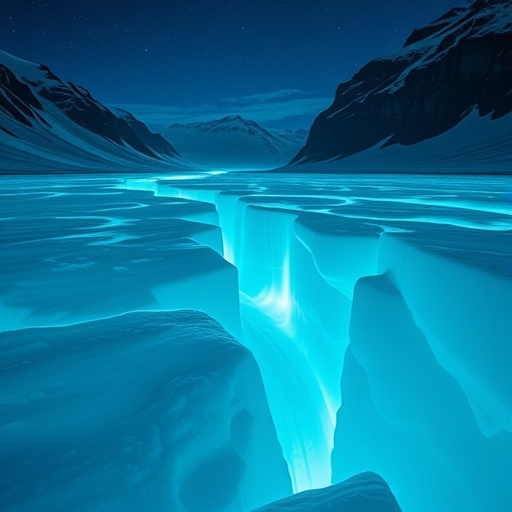
Glaciers may look solid and immovable from a distance, but much of their most important structural damage is hidden beneath the surface. A new study by researchers at ETH Zurich shows that a single fibre-optic cable can map fractures deep inside a glacier with a level of detail that would require hundreds of conventional seismometers. The technique, tested on Switzerland’s Gorner Glacier, revealed that more than eight percent of the ice at the measurement site was occupied by hidden crevasses containing air or water. The discovery suggests that glaciers may be far more internally fractured than surface observations indicate, potentially changing how scientists assess the risk of sudden collapses, rapid ice flow and major calving events.
The need for better information has become increasingly urgent as glacier failures produce deadly consequences across the Alps. In September 2023, part of the Marmolada Glacier in Italy’s Dolomites collapsed, killing seven mountaineers. In May 2025, the collapse of the Birch Glacier above Blatten in Switzerland focused global attention on the instability of mountain ice. Such events are influenced not only by visible cracks and ice cliffs, but also by fractures concealed within the glacier. These internal weaknesses can allow meltwater to penetrate deeper into the ice, reduce its strength, increase its movement and help trigger a larger collapse.
Scientists have traditionally investigated these hidden processes using seismic monitoring. When a crevasse opens, the sudden release of stress generates a tiny earthquake, or microearthquake, inside the ice. Seismometers can detect the resulting waves and estimate where the fracture occurred. However, a conventional seismic network provides only a limited number of observation points. Installing enough instruments to produce a detailed three-dimensional picture is expensive and technically difficult, particularly on a glacier covered with deep crevasses, unstable snow bridges and rapidly changing terrain. The instruments must also be positioned carefully and protected from harsh weather, shifting ice and the danger faced by field teams.
The ETH Zurich team, led by Assistant Professor Thomas Hudson of the Environmental and Exploration Geophysics Group, used distributed fibre-optic sensing to overcome those limitations. Instead of deploying hundreds of separate sensors, the researchers placed a single fibre-optic cable across the surface of the Gorner Glacier in Valais, Switzerland. Connected to an instrument known as an interrogator, the cable acted as a continuous seismic sensor. The system sent laser light through the fibre and analysed tiny changes in the light scattered back from imperfections within the glass. Because the cable could register disturbances along its entire length, it effectively transformed a simple line of fibre into a dense array of measuring points.
The physics behind the method is subtle but powerful. When seismic waves from a microearthquake travel through the glacier, they cause minute strains in the cable. Those strains alter the way light propagates through the glass and change the pattern of light returning to the interrogator. By measuring these changes at many locations, the researchers can determine when and where a seismic disturbance occurred. Repeated signals reveal the positions of fractures, while the character and travel time of the waves provide information about the material surrounding them. In this way, the cable works somewhat like an ultrasound probe, except that it uses naturally occurring seismic energy to image the interior of a massive body of ice.
The resulting data set is extraordinarily large and complex. Every section of the cable can produce measurements at high temporal and spatial resolution, creating far more information than a small collection of individual seismometers. To interpret it, the researchers used computational methods and an algorithm capable of identifying seismic signals and reconstructing the structure of the ice below the cable. The analysis allowed them to investigate the glacier to a depth of approximately 25 metres. Rather than simply locating large cracks visible from the surface, the method detected a broad network of internal fractures, including crevasses that could not be identified from aerial images or direct field inspection.
The results surprised the researchers. At the measurement site, hidden crevasses accounted for more than eight percent of the glacier’s ice volume. The remaining 92 percent was comparatively undisturbed ice, but the fractured portion was large enough to have important consequences for the glacier’s mechanical behaviour. Some crevasses contained air, while others contained water. That distinction matters because water can exert pressure on the surrounding ice and travel downward through fracture networks. When meltwater reaches the glacier bed, it can act as a lubricant between the ice and the ground, potentially increasing the glacier’s speed and altering the stresses that control further cracking.
The study also challenges the intuitive assumption that the most visibly fractured glaciers are necessarily the most dangerous. Large surface crevasses are important, but they are only part of the picture. A glacier may appear relatively smooth from the air while containing extensive damage below its surface. Conversely, some visible cracks may represent relatively localized features rather than a complete weakening of the ice mass. By measuring the internal fracture network directly, fibre-optic seismology could give scientists a more reliable way to distinguish superficial changes from structural damage that threatens the stability of a glacier front, slope or icefall.
The researchers believe the technique could eventually become a valuable tool for monitoring unstable glaciers and improving warnings of calving or collapse. A cable can be installed more economically than a large network of individual instruments, and its continuous sensing capability offers far greater spatial coverage. The same approach could be tested on other Alpine glaciers and on the enormous ice sheets of Greenland and Antarctica. Those applications are especially significant because fractures influence how rapidly polar ice flows toward the ocean. By combining measurements from inside the ice with satellite observations of the surface, scientists may be able to track how crevasses develop through time, understand how surface cracks connect with deeper fractures and improve projections of future sea-level rise. The ETH Zurich study therefore presents more than a new way to observe glaciers: it offers a glimpse into the hidden architecture of a changing cryosphere and a potential early-warning system for some of the planet’s most consequential ice failures.
News Publication Date: 23-Jul-2026
Web References: https://doi.org/10.1126/sciadv.aef1107
References: Hudson T, Walter F, Noe S et al. “Quantifying subsurface fracture damage in glaciers using fiber-optic seismology.” Science Advances, 2026, 12: eaef1107. DOI: 10.1126/sciadv.aef1107
Cite Scienmag News
Russell Cooper. (August 18, 2026). Fiber-Optic Sensing Uncovers Hidden Crevasses Beneath Glacial Ice. Scienmag. https://scienmag.com/fiber-optic-sensing-uncovers-hidden-crevasses-beneath-glacial-ice/
Russell Cooper. "Fiber-Optic Sensing Uncovers Hidden Crevasses Beneath Glacial Ice." Scienmag, 18 August 2026, https://scienmag.com/fiber-optic-sensing-uncovers-hidden-crevasses-beneath-glacial-ice/. Accessed 3 September 2026.
Russell Cooper. "Fiber-Optic Sensing Uncovers Hidden Crevasses Beneath Glacial Ice." Scienmag. August 18, 2026. https://scienmag.com/fiber-optic-sensing-uncovers-hidden-crevasses-beneath-glacial-ice/


