


Bread scientists in Belgium have uncovered new evidence that the secret to a perfectly airy loaf may lie less in how much gas yeast produces and more in which yeast is doing the producing. A team at KU Leuven, led by Sara Vandenbosch and Christophe Courtin, has shown that different industrial strains of the baker’s yeast Saccharomyces cerevisiae can dramatically alter the stability of gas cells inside bread dough during baking, ultimately shaping the fine, honeycomb-like structure of the bread crumb. The study, published in the open-access journal Food Chemistry: X, offers some of the clearest evidence yet that yeast strain selection influences not just how fast dough rises before baking, but how well it holds on to its gas at the very moment of maximum expansion in the oven.
The phenomenon at the heart of the research is oven rise: the sudden, dramatic swelling of bread dough in the first minutes of baking that transforms a dense fermenting mass into a light, springing loaf. Four processes fuel this expansion. Yeast temporarily boosts its carbon dioxide production as temperatures climb, dissolved carbon dioxide comes out of solution, gas already trapped in expanding cells grows larger, and water and ethanol evaporate. Yet despite these shared physical forces, previous work by the same team on fifteen industrial yeast strains revealed striking variation in oven rise between strains, even though they produced essentially identical amounts of carbon dioxide. Crucially, the strains differed in how long they stayed alive at baking temperatures, and viability tracked oven rise performance almost perfectly. The puzzle was what exactly the strains were doing inside the dough matrix to produce such different results.
To solve it, the researchers selected five S. cerevisiae strains with distinct industrial histories: a standard baker’s yeast as reference, a thermotolerant Kveik brewing strain, a wine strain, a cachaça distillery strain, and a vinegar strain. Fermentation was carefully standardised so every dough produced exactly 400 millilitres of carbon dioxide before entering the oven, isolating the strains’ other effects from any differences in total gas production. This required fermentation times ranging from 77 to 93 minutes depending on the strain. The doughs were then baked in an electrical resistance oven, a device in which the dough itself acts as the electrical resistor, heated by a proportional-integral-derivative controller programmed to mimic the temperature profile of a conventional rotary oven. This setup allowed the team to sample dough mid-bake, tracking temperature-dependent changes with unusual precision.
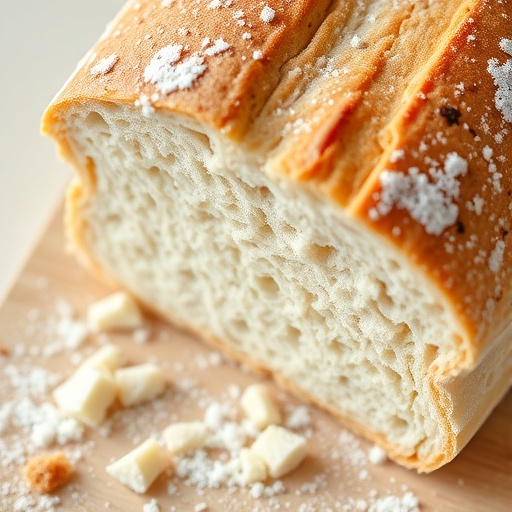
The first revelation came from the bread itself. Slices of conventionally baked loaves were scanned and analysed with image-processing software to count and measure the gas cells in the crumb. The baker’s yeast reference produced roughly 289 gas cells per square centimetre of crumb, while the wine strain Sc4 produced significantly more, around 424 per square centimetre. Across all strains, the number of gas cells correlated negatively with average cell size and positively with oven rise, with correlation coefficients around 0.87 and 0.78 respectively. In other words, the best-rising strains did not simply inflate their dough more; they preserved a finer, more numerous population of gas cells. The worst-performing strains left behind fewer, larger cells, a hallmark of coarsening, the process by which destabilised gas cells coalesce into a coarse, irregular crumb. This suggests the yeast strains were directly modulating gas retention in the dough matrix.
Where might that modulation come from? The researchers turned to yeast metabolites, the chemical by-products of fermentation that yeast excretes into the dough. Ethanol, glycerol, acetic acid and succinic acid are all known to interact with gluten, the protein network that gives dough its viscoelastic strength. Ethanol, for instance, dissolves gliadin proteins and reduces dough extensibility, while organic acids lower pH and alter protein chain interactions, and glycerol competes with gluten and starch for water. Using ion-exclusion high-performance liquid chromatography on samples pulled from the dough every three minutes during baking, the team tracked all four metabolites through the baking process, correcting for the dough’s changing moisture content.
The results were subtle but statistically robust. Ethanol concentrations differed between strains at the start of baking, a surprising finding given that carbon dioxide and ethanol are stoichiometrically linked through alcoholic fermentation, and that every dough had been standardised to the same carbon dioxide endpoint. Even after equal sugar consumption, strain-dependent differences in ethanol production persisted, and models showed the strains continued producing ethanol at different rates during the first twelve minutes of baking, before heat killed the cells. Glycerol, acetic acid and succinic acid concentrations also varied significantly between strains, reflecting strain-specific stress responses and central metabolism rather than any coupling to carbon dioxide. Yet these differences were small, far below the concentrations known to measurably stiffen dough, and the timing of structural setting, marked by the onset of bulk carbon dioxide release at around eleven minutes of baking, was identical across strains.
That timing consistency is itself informative. Structural setting in baking occurs when starch gelatinisation and gluten polymerisation lock the foam-like dough into the open sponge structure of finished bread. The researchers measured carbon dioxide escaping from sealed doughs with an infrared detector, distinguishing an early linear phase of release, caused by localised gas cell rupture, from a later exponential surge as the structure opens wholesale. The onset of that surge did not shift with yeast strain, meaning no strain could delay gluten polymerisation and prolong oven rise. But the rates told a different story. The vinegar strain Sc5 released carbon dioxide three to six times faster than the others during the early phase, evidence that it actively destabilises the dough’s gas-holding capacity rather than merely failing to protect it.
The final line of evidence came from protein chemistry. Using size-exclusion high-performance liquid chromatography under both non-reducing and reducing conditions, the team measured the SDS-extractability of gluten proteins through baking, a proxy for how extensively the gluten network polymerises. Total extractable protein plateaued early, then plunged after about twelve minutes, when dough temperatures reached roughly 77 degrees Celsius, falling to under half its starting value by the end of baking. Strikingly, the yeast strain had a significant effect on the gliadin fraction specifically: doughs made with the wine strain Sc4 showed consistently lower gliadin extractability, about four percent less, than those made with the reference baker’s yeast. Lower extractability can reflect more extensive covalent incorporation of gliadins into the gluten network, hinting at a more interconnected, deformation-resistant matrix, precisely what a strain needs to hold gas cells apart during the violent extension of oven rise.
The authors are careful to note that correlations here do not establish causation. Baking is a brutal environment for mechanistic analysis, combining a complex dough matrix with rapidly changing temperatures, and the metabolite differences observed were too small to shift the timing of structure setting. But the study proposes two candidate mechanisms. First, living yeast may continuously reshape the gluten network through the metabolites it secretes, with strain-specific profiles tilting the balance toward stabilisation or destabilisation. Second, and more provocatively, dying yeast cells may rupture during the critical window of gluten polymerisation and dump intracellular compounds, notably the antioxidant glutathione, into the dough. Glutathione is known to disrupt disulfide bond formation and weaken gluten, and previous work from the same group showed that the worst strain’s viability collapsed to under six percent between 59 and 77 degrees Celsius, while the best strain still retained over forty percent. Early cell death, on this hypothesis, could actively sabotage the setting structure from within.
The implications ripple outward from the bakery bench. Yeast manufacturers currently select strains primarily on fermentation speed and tolerance, treating carbon dioxide output as the measure of merit. This study shows that functionality extends well beyond gas production: the strain baked into a loaf influences crumb fineness, gas cell density and oven rise even when fermentation is perfectly standardised. For whole-wheat breads, where dense crumbs and poor consumer acceptance are persistent problems, strain selection could become a genuine engineering variable. The KU Leuven team also flags what comes next: methods for tracking yeast viability inside dough and quantifying released glutathione remain crude, because gluten itself reshuffles its free thiol groups during baking, confounding current assays. Untangling whether metabolites, cell death, or both, govern strain-dependent gas retention will require new tools, but the payoff is a more mechanistic, and potentially predictive, understanding of how a microscopic choice of microbe sculpts the crumb on every slice.
Cite Scienmag News
Bethany Barker. (September 3, 2026). Yeast strains differ in dough gas cell stability and bread crumb structure. Scienmag. https://scienmag.com/yeast-strains-differ-in-dough-gas-cell-stability-and-bread-crumb-structure/
Bethany Barker. "Yeast strains differ in dough gas cell stability and bread crumb structure." Scienmag, 3 September 2026, https://scienmag.com/yeast-strains-differ-in-dough-gas-cell-stability-and-bread-crumb-structure/. Accessed 10 September 2026.
Bethany Barker. "Yeast strains differ in dough gas cell stability and bread crumb structure." Scienmag. September 3, 2026. https://scienmag.com/yeast-strains-differ-in-dough-gas-cell-stability-and-bread-crumb-structure/


