


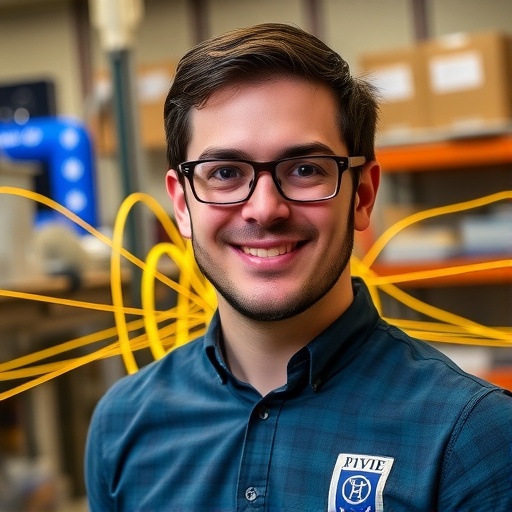
Quantum computers promise to reshape computation, communication, and information science, yet the field remains haunted by a stubborn problem: the quantum states that make these machines so powerful are extraordinarily fragile, collapsing at the slightest disturbance from their surroundings. Now, a physicist at West Virginia University has received one of the most competitive awards in American science to tackle that problem from an unexpected direction — by designing entirely new materials that do not yet exist, using computers to predict which of them can protect delicate quantum states before anyone ever attempts to build them in a laboratory.
Subhasish Mandal, an assistant professor in the WVU Eberly College of Arts and Sciences Department of Physics and Astronomy, has been awarded a Faculty Early Career Development Program award from the U.S. National Science Foundation. The CAREER award, widely regarded as the foundation’s most prestigious honor for early-career faculty, recognizes researchers who demonstrate the potential to serve as academic role models while integrating research and education. For Mandal, the support will fuel an ambitious computational program aimed at understanding how the inner workings of exotic materials give rise to stable quantum behavior — and at building the free software tools that could allow scientists everywhere to accelerate the search for the materials that future quantum technologies will demand.
The core challenge that Mandal’s project addresses lies in the fundamental difference between ordinary and quantum information. Classical computers process information in bits, which exist strictly as either a 0 or a 1. Quantum computers, by contrast, exploit quantum states that can exist in many configurations simultaneously, a property that allows certain calculations to be performed at speeds unreachable by any classical machine. But that same quantum superposition is exquisitely sensitive. Stray electromagnetic fields, thermal fluctuations, or even the tiniest atomic imperfections in the material hosting the quantum state can destroy it, a process known as decoherence. Most quantum devices today operate only inside carefully controlled laboratory environments, shielded at cryogenic temperatures and isolated from external noise. For quantum technology to become practical and scalable, researchers need materials that can maintain quantum behavior in far less forgiving conditions.
“One of the biggest challenges in quantum technology is finding materials that can maintain their quantum behavior outside carefully controlled laboratory environments,” Mandal explained. “To overcome that challenge, we need to understand both how electrons interact with one another and how they interact with the natural vibrations of atoms in a material. Together, these combined interactions can dramatically reshape a material’s quantum properties and, if properly controlled, may help us design better materials for future quantum technologies.”
That dual interaction — electrons with electrons, and electrons with atomic vibrations — sits at the heart of the project. In any solid material, atoms are never perfectly still. They vibrate around their equilibrium positions, producing quantized lattice vibrations known as phonons. When electrons moving through the crystal scatter off these phonons, the resulting electron-phonon coupling can profoundly alter the material’s electronic structure. In some circumstances it enables superconductivity, the remarkable phenomenon in which electrical current flows with zero resistance and no energy loss. In others, it degrades the coherence of quantum states and undermines the very properties a quantum device depends upon. Understanding and controlling these interactions, Mandal argues, may hold the key to engineering materials whose quantum behavior is not merely preserved but actively stabilized by their internal structure.
The materials at the center of the research are not simple bulk crystals. Mandal’s team will focus on specially engineered substances assembled by stacking different two-dimensional layers one atomic plane at a time — a technique that has become one of the most powerful strategies in modern materials science. The approach is often compared to combining ingredients in a recipe: individually, the constituent layers may be rather ordinary, but stacked together in precise sequences, they can produce quantum properties that neither material exhibits on its own. Twisted or stacked layers of graphene, transition-metal dichalcogenides, and other layered compounds have already revealed superconductivity, magnetism, and topological phenomena invisible in the parent materials. By computing how electrons and phonons behave in these engineered stacks, Mandal’s group hopes to establish design principles for combining layers in ways that produce robust, technologically useful quantum phases.
To carry out this work, the project will rely on advanced computational methods and large-scale simulations capable of capturing the intertwined dance of electrons and atomic vibrations. These first-principles calculations, grounded in quantum mechanics rather than empirical fitting, allow researchers to predict whether a candidate material will exhibit special properties such as superconductivity before it is synthesized. A second major thread of the research concerns topological quantum states — exotic electronic phases whose defining characteristics are protected by the global structure of the material’s quantum wavefunction rather than by local details. This built-in protection means topological states can resist certain types of disturbances that would destroy ordinary quantum states. Many physicists believe that marrying superconductivity with topological quantum states could yield the basic building blocks of fault-tolerant quantum computers, whose information would be encoded in ways intrinsically immune to many sources of error. Identifying real materials that combine both ingredients is one of the field’s most sought-after goals, and computational screening offers a way to narrow an effectively infinite search space down to the most promising candidates.
Beyond the science itself, a central aim of the project is to democratize access to the computational machinery of quantum materials discovery. Mandal will develop free, openly available software that other researchers can use to hunt for new quantum materials, lowering the technical and financial barriers that often restrict advanced simulations to well-funded laboratories. The practical payoff could be substantial. “Instead of making every quantum material possible in a laboratory to see which perform well, researchers could first use the software to run simulations to identify the most promising options,” Mandal said. “Then scientists could focus their laboratory experiments on materials most likely to have useful quantum properties.” In a field where synthesizing and characterizing a single new compound can take months and considerable resources, the ability to computationally pre-screen candidates promises to compress discovery timelines and redirect experimental effort toward the materials most likely to succeed.
The award also carries a substantial educational and workforce mission, reflecting the CAREER program’s emphasis on integrating research with teaching. Mandal will create accessible educational materials explaining quantum science and technology to broad audiences, organize immersive summer workshops at WVU, and provide hands-on research opportunities for high school, undergraduate, and graduate students. Participants will learn computational skills that are increasingly indispensable not only in academic research but also in advanced manufacturing, high-performance computing, and the rapidly expanding quantum industry. “As quantum technologies move from the laboratory toward real-world applications, there is a growing need for a workforce that understands both the science and the tools behind them,” Mandal said. “This project allows us to train students at multiple levels and help prepare them for careers in one of the fastest growing areas of science and technology.” The training component holds particular significance for West Virginia, where building a skilled technology workforce is viewed as central to the state’s future economic development. Maura McLaughlin, chair of the Department of Physics and Astronomy and Eberly Distinguished Professor of Physics and Astronomy, praised the project as work “at the cutting edge of an extraordinarily innovative field,” noting that it will open new opportunities for West Virginia students while helping build talent critical to the state’s growth.
Mandal joined the WVU Department of Physics and Astronomy in 2022, and the CAREER award arrives on the heels of a remarkable stretch of recognition. In December 2025, his work on quantum materials was highlighted by the journal Nature Communications, and earlier in 2026 he received the Cottrell Scholar Award from the Research Corporation for Science Advancement. His Computational Quantum Materials Group receives support from an array of agencies and foundations, including the U.S. Department of Energy, the National Science Foundation, the U.S. Department of Defense, and the Research Corporation for Science Advancement — a breadth of backing that reflects the strategic importance of quantum materials research across the federal science enterprise.
Looking further ahead, Mandal frames the project as a step toward a fundamentally predictive paradigm for materials discovery. “The long-term goal is to create a way to predict which materials could be useful for quantum technology before they are ever made in a laboratory,” he said. “If we can find materials or a combination of materials that naturally support quantum states, we can help to build the foundation for new quantum technologies that could benefit society for decades to come.” If that vision is realized, the quantum computers and sensors of the future may rest not on materials discovered by accident, but on substances designed atom by atom, their quantum properties calculated and guaranteed long before the first crystal is grown.
News Publication Date: 10-Sep-2026
Web References: Not provided
Keywords
quantum materials, NSF CAREER award, quantum computing, electron-phonon coupling, superconductivity, topological quantum states, computational materials design, atomically layered materials, West Virginia University, quantum decoherence, high-performance simulation, quantum workforce training
Cite Scienmag News
Katie Riggs. (September 10, 2026). WVU physicist wins NSF CAREER award to advance quantum materials research. Scienmag. https://scienmag.com/wvu-physicist-wins-nsf-career-award-to-advance-quantum-materials-research/
Katie Riggs. "WVU physicist wins NSF CAREER award to advance quantum materials research." Scienmag, 10 September 2026, https://scienmag.com/wvu-physicist-wins-nsf-career-award-to-advance-quantum-materials-research/. Accessed 10 September 2026.
Katie Riggs. "WVU physicist wins NSF CAREER award to advance quantum materials research." Scienmag. September 10, 2026. https://scienmag.com/wvu-physicist-wins-nsf-career-award-to-advance-quantum-materials-research/


