


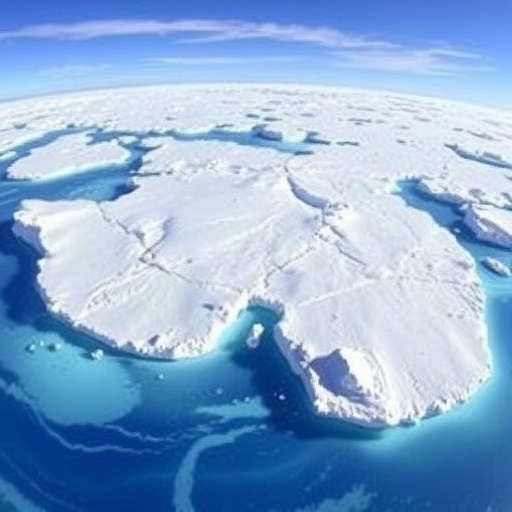
For more than two decades, Antarctica has been shrinking before our satellites’ eyes, shedding an average of roughly 140 billion tons of ice each year and quietly nudging global sea levels upward. Then, between 2021 and 2023, the frozen continent confounded expectations: it gained weight. According to a new study published in the journal Nature on August 19, the Antarctic Ice Sheet added a net 695 billion tons of mass during that window — the largest ice-sheet mass gain ever recorded by the GRACE gravity satellites. The trigger, researchers say, was neither a pause in global warming nor any change in Antarctica itself. It was a distant, invisible hand: a sustained warming of a vast pool of tropical ocean water that behaved like a remote “regulator,” dialing up snowstorms over East Antarctica from thousands of kilometers away. And it happened, remarkably, while global temperatures kept climbing — a coincidence that begged for a physical explanation.
The finding matters because the Antarctic Ice Sheet remains one of the largest sources of uncertainty in projections of future sea-level rise. Over the past two decades it lost ice at an average rate of approximately 140.5 billion tons per year — a slow drain with planetary consequences. Against that backdrop, the 2021–2023 gain of about 695 billion tons stands out as a glaring anomaly in the satellite record, an interruption of the decline so large that it demanded both an explanation and a rigorous attribution. A three-year gain of that magnitude is not statistical noise; it is a signal that demands a mechanism. Sea-level planners, coastal engineers and insurers all depend on getting the Antarctic mass budget right, and attribution is the heart of the matter: knowing that Antarctica gained mass is one thing; knowing why determines whether the gain is a mere curiosity or a genuine clue about how the ice sheet responds to the climate system around it.
To trace the event back to its source, a research team led by the Institute of Oceanology of the Chinese Academy of Sciences (IOCAS) stitched together three independent lines of evidence. Gravity-satellite observations weighed the ice sheet and located the gain. Ice cores, drilled from the ice sheet’s interior, preserve a layered archive of past snow accumulation and confirmed that the added mass arrived as genuine snowfall rather than as some instrumental artifact. Atmospheric circulation model simulations, meanwhile, allowed the scientists to replay the event like a virtual laboratory experiment, switching ingredients on and off to test what mattered. Only when all three perspectives agree can researchers be confident they have found the true culprit. Here they did: the satellites established when and where the mass appeared, the cores anchored the snowfall history, and the models exposed, step by step, the atmospheric machinery that delivered the white deluge.
That machinery, it turns out, begins in the tropics. The study centers on the “tropical warm pool” — the immense expanse of persistently warm ocean where the tropical western Pacific meets the eastern Indian Ocean, a region that hosts some of the most vigorous convective storms on the planet. Because the warm pool sits atop some of the highest sea-surface temperatures on Earth, even modest changes there can reshape atmospheric circulation across entire hemispheres. During 2021–2023, the pool underwent sustained warming. Warm sea surfaces fuel towering thunderstorm complexes, and the anomalous heat released into the atmosphere above the warm pool disturbed the upper-level winds, launching a Rossby wave train toward the high southern latitudes. Rossby waves are planetary-scale undulations in the upper-level flow: like ripples traveling along a taut rope, they transport energy across thousands of kilometers, rearranging pressure and wind patterns far from where they were born — a classic teleconnection in which one region’s ocean imprints itself on another region’s sky.
As the wave train arrived over the Southern Hemisphere’s middle and high latitudes, feedbacks between transient weather systems — the eddies — and the background atmospheric flow amplified and sustained the disturbance rather than letting it dissipate, a process atmospheric scientists describe as eddy–mean flow interaction. The result was a pronounced north–south dipole: a center of lower-than-normal pressure south of Australia, paired with higher-than-normal pressure along the East Antarctic coast. This pressure couplet did far more than reshuffle isobars. Because air circulates counter-clockwise around low-pressure systems and clockwise around high-pressure systems in the Southern Hemisphere, the pairing opened a coherent corridor for moisture, steering damp air from the midlatitude Indian Ocean directly toward the East Antarctic coast and strengthening the atmospheric rivers — narrow, filamentary ribbons of concentrated water vapor that can move moisture across oceans in days. Once established, the dipole did not flicker with day-to-day weather; the eddy feedbacks locked it in place, letting it redirect moisture for months on end.
The delivery mechanism left clear fingerprints. Water-vapor tracking simulations — in which researchers tag moisture according to its region of origin and follow its journey through the model atmosphere — showed that, under the dipole’s influence, moist air from the midlatitude Indian Ocean was swept toward East Antarctica in exceptional volumes. Atmospheric rivers are the same phenomenon that unleashes torrential rain on west-facing coastlines around the world; here, their cargo arrived as snow. More atmospheric rivers reached the continent than otherwise would have, and the snowfall fell persistently over the Queen Mary Land–Wilkes Land region. Snowfall is the only meaningful way Antarctica gains mass, so when the supply line is enhanced, the entire continental budget responds. There, snow piled upon snow through months of sustained storminess, accumulating faster than the ice sheet could lose mass through surface melt, calving and ice outflow. On the balance sheet, the deposits outran the losses, producing the largest mass-gain event the GRACE satellites have ever observed.
Crucially, the team’s atmospheric circulation model experiments confirmed that warming of the tropical warm pool was the direct driver of both the circulation anomalies and the snowfall response. When the researchers quantified how much of the extraordinary snowfall could be chalked up to anthropogenic forcing — including the extra water vapor that a warming atmosphere naturally holds, roughly 7 percent more per degree of warming — the answer was strikingly modest: the increase in regional snowfall attributable to human-caused climate change amounted to only about 9 percent of the observed snowfall anomaly. In other words, this was not simply a case of global warming making it snow harder over Antarctica. It was a natural, tropically born teleconnection doing nearly all of the heavy lifting — a vivid reminder that multiyear swings in the ice sheet’s mass can be governed by sea-surface temperatures half a hemisphere away.
Perhaps the most consequential implication concerns the longer rhythm of the ice sheet. Further observations and simulations showed that similar sustained warmings of the tropical warm pool occur roughly once every decade, which means the pool behaves like a remote regulator that periodically dials snowfall — and with it, ice mass — up or down over East Antarctica on multiyear timescales. The same mechanism documented for 2021–2023 has likely been operating, largely unnoticed, for decades. “We found a previously underrecognized ‘tropical warm pool–East Antarctic Ice Sheet’ teleconnection pathway,” said Wang Yunhe of IOCAS, the study’s first author. “Our research provides a theoretical basis for understanding Antarctic ice-sheet mass changes and conducting future research on the East Antarctic climate.” For scientists, that decadal periodicity is tantalizing: it suggests the warm pool’s temperature could, in principle, be folded into multiyear outlooks of Antarctic snowfall, giving ice-sheet modelers a tropical early-warning signal they have never had before.
None of this, the researchers stress, signals a reprieve for the frozen continent. The 2021–2023 gain was a temporary slowdown, not a reversal, of the long-term decline. The West Antarctic Ice Sheet — widely regarded as the most vulnerable portion of the entire system — continued to lose ice throughout the period, undermined largely by warm ocean waters gnawing at the undersides of its floating ice shelves. In East Antarctica itself, several major outlet glaciers face the same menace: warm intrusions of ocean water drive basal melting of the ice shelves that buttress the glaciers behind them, and the loss of that restraint allows the grounded ice to flow seaward ever faster. The stability of these glaciers is a first-order question for any sea-level projection. One prodigious snowfall episode, however spectacular, cannot offset those losses indefinitely. The regulator can buy time; it cannot change the destination.
For scientists trying to project how far the oceans will rise this century, the study delivers a double message. First, the tropics and the polar south are more tightly coupled than many ice-sheet frameworks assume: the newly identified north–south dipole over East Antarctica is a key conduit linking tropical sea-surface temperatures to the continent’s mass balance, and building that linkage into models could help shrink one of the largest error bars in sea-level science. Second, natural decadal variability can temporarily mask — or exaggerate — the human-driven trend, which means a few heavy-snow years must never be mistaken for recovery. The 695-billion-ton question now is whether such tropical nudges can be anticipated far enough in advance to be woven into the next generation of sea-level projections. Antarctica’s long-term trajectory still points downward. But for two remarkable years, a warm patch of tropical ocean, working through planetary waves and rivers of sky-borne moisture, quietly bent the curve of the world’s largest ice sheet.
Cite Scienmag News
Russell Cooper. (August 29, 2026). Warmer tropical waters briefly slow Antarctic ice melt. Scienmag. https://scienmag.com/warmer-tropical-waters-briefly-slow-antarctic-ice-melt/
Russell Cooper. "Warmer tropical waters briefly slow Antarctic ice melt." Scienmag, 29 August 2026, https://scienmag.com/warmer-tropical-waters-briefly-slow-antarctic-ice-melt/. Accessed 3 September 2026.
Russell Cooper. "Warmer tropical waters briefly slow Antarctic ice melt." Scienmag. August 29, 2026. https://scienmag.com/warmer-tropical-waters-briefly-slow-antarctic-ice-melt/


