


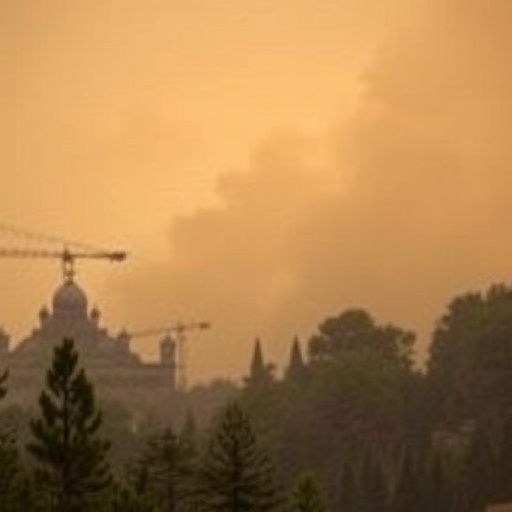
Wildfire smoke is usually treated as a problem that remains in the atmosphere: a drifting mixture of fine particles, gases and toxic compounds that can damage lungs, obscure sunlight and degrade air quality hundreds or even thousands of miles from a fire. But a new study shows that smoke has another, less visible pathway into the environment. When rain falls through a smoke plume, it can wash wildfire-derived material from the atmosphere and deliver concentrated pulses of nitrogen, phosphorus and potassium to soils, lakes and forests across the United States. These elements are essential nutrients, but their sudden arrival may alter ecosystems in ways that are not yet fully understood. As climate change contributes to longer fire seasons and more frequent large wildfires, smoke-rain events could become a growing ecological force.
The study, led by researchers at the University of Utah, Utah State University and the Cary Institute of Ecosystem Studies, is the first large-scale analysis to examine how wildfire smoke is transferred to ecosystems through rainfall across hundreds of monitoring locations and multiple years. The researchers combined satellite-based observations of smoke with precipitation and rain-chemistry data from the National Atmospheric Deposition Program, a long-running scientific network established in the 1970s to monitor substances carried from the atmosphere to Earth’s surface. Their analysis covered 250 sites distributed across 16 climate regions in 2014, 2020 and 2022, allowing the team to compare years with different patterns of wildfire activity and atmospheric smoke.
The process is known as wet deposition. As a wildfire burns vegetation, soil organic matter and, in some cases, human-built materials, combustion releases gases and microscopic particles into the air. The particles may contain minerals, carbon-rich compounds and nutrients bound to ash or other smoke constituents. When a rainstorm moves through a smoke plume, droplets collide with airborne particles and absorb soluble gases. The resulting water carries dissolved and suspended material downward, depositing it on land and in water bodies. Because nutrients in the rainwater can already be dissolved, they may be immediately accessible to plants, algae, bacteria and other organisms, unlike nutrients locked inside larger particles or solid organic matter that must first be chemically broken down.
The researchers found that the frequency of days when smoke and rain occurred together rose sharply over the study period. Monitoring sites averaged approximately four smoke-rain days in 2014 and six in 2020, but the average reached about 22 days in 2022. The distribution was not uniform. The Upper Midwest was the leading regional hotspot in all three years, while the second-most affected region shifted from the Northern Rockies in 2014 to the Southwest in 2020 and the Ohio Valley in 2022. This variation reflects the complicated relationship between fire, atmospheric circulation and precipitation. Smoke can travel across enormous distances, but it is only deposited through rainfall when a storm intersects the plume or when atmospheric conditions bring smoke and clouds together.
The most striking result was not simply the increase in smoke-rain days, but the amount of nutrient material delivered during them. In 2022, a year marked by substantial smoke exposure, these events represented only about 5 percent of the days in the year but accounted for roughly 20 to 30 percent of the annual rain-deposited nitrogen, phosphorus and potassium measured at the study sites. In other words, a relatively small number of rainy days produced an outsized share of the atmospheric nutrient input. This disproportionate contribution suggests that conventional estimates of nutrient deposition may overlook a major episodic source if wildfire smoke is not considered. It also shows why short-lived atmospheric events can have effects that are much larger than their frequency would suggest.
Nitrogen, phosphorus and potassium are commonly described as the primary nutrients supporting biological productivity. Nitrogen is required for proteins, enzymes and chlorophyll; phosphorus is central to DNA, cell membranes and energy transfer; and potassium helps regulate water balance, enzyme activity and cellular function. Yet more nutrients do not automatically mean healthier ecosystems. Nutrient availability is often tightly balanced, and an abrupt pulse can favor some organisms over others. In lakes and reservoirs, added nitrogen and phosphorus can stimulate algae and alter aquatic food webs. Under certain conditions, excessive nutrient inputs may contribute to algal blooms, oxygen depletion and changes in water quality. In nutrient-poor mountain soils, by contrast, a brief input could temporarily support plant growth or microbial activity without producing the same consequences.
The ecological response may also depend on the chemical form of the deposited material, the intensity and duration of the rainfall, the type of ecosystem and the history of other nutrient sources. Agricultural fertilizer, wastewater, industrial emissions and fossil-fuel combustion already deliver nitrogen and phosphorus to many landscapes. Wildfire-derived nutrients may therefore reinforce existing enrichment in one region while providing a rare resource in another. Forests could experience both beneficial and harmful effects. Earlier research has linked smoke deposition with stimulated tree growth in some settings, while also suggesting possible reductions in survival. The new study does not demonstrate that wildfire smoke acts as a universal fertilizer; instead, it establishes that fire emissions can be a substantial source of nutrients and other chemically active material reaching ecosystems through precipitation.
The findings also highlight the limits of viewing wildfire smoke solely through the lens of human exposure. Smoke plumes contain fine particulate matter, carbon monoxide, volatile organic compounds and other pollutants that can affect respiratory and cardiovascular health. At the same time, those plumes are part of a larger atmospheric transport system. Their chemical contents can be transformed by sunlight, oxidants, clouds and water before being deposited on the ground. Rainfall can remove particles from the air, improving local air quality after a storm, but the same cleansing process transfers atmospheric material into soils, streams and lakes. Understanding this exchange requires scientists to connect fire behavior with atmospheric chemistry, cloud physics, precipitation patterns and ecosystem biology.
The study’s authors caution that their analysis identifies where smoke and rain coincided but does not yet trace every deposit to a particular fire. Their next objective is to link individual smoke plumes to their sources and determine how fire characteristics influence the chemistry of rainfall. A fire burning through conifer forest may release a different nutrient mixture from one consuming grassland, peat, agricultural residue or structures at the wildland-urban interface. Burn temperature, fuel moisture, soil type and the duration of combustion could all affect the size and composition of emitted particles. Source tracing may also reveal whether smoke from different kinds of fires produces distinct chemical signatures and whether those signatures lead to different ecological effects after deposition.
As wildfire activity and the number of smoky days increase, the atmosphere may become a more important conveyor of nutrients across national and regional boundaries. The researchers say that tracking this process will be essential for understanding how fire reshapes ecosystems long after flames have disappeared. Rain falling through smoke may influence plant growth, lake productivity, microbial communities, soil chemistry and the movement of nutrients through watersheds. The new results put a measurable scale on that hidden connection: in a high-smoke year, just a few rain events can deliver a surprisingly large fraction of the nutrients deposited from the atmosphere. What appears to be a passing weather event may therefore leave a lasting chemical fingerprint on ecosystems, turning wildfire smoke from a temporary air-quality hazard into a recurring driver of environmental change.
News Publication Date:
25-Aug-2026
Web References:
https://onlinelibrary.wiley.com/doi/10.1111/gcb.71050
References:
Ponette-González et al., “Smoke-affected rain fertilizes terrestrial and aquatic ecosystems,” Global Change Biology, 25 August 2026. DOI: 10.1111/gcb.71050.
Cite Scienmag News
Russell Cooper. (August 25, 2026). Rain May Turn Wildfire Smoke Pollution Into Fertilizer. Scienmag. https://scienmag.com/rain-may-turn-wildfire-smoke-pollution-into-fertilizer/
Russell Cooper. "Rain May Turn Wildfire Smoke Pollution Into Fertilizer." Scienmag, 25 August 2026, https://scienmag.com/rain-may-turn-wildfire-smoke-pollution-into-fertilizer/. Accessed 3 September 2026.
Russell Cooper. "Rain May Turn Wildfire Smoke Pollution Into Fertilizer." Scienmag. August 25, 2026. https://scienmag.com/rain-may-turn-wildfire-smoke-pollution-into-fertilizer/


