


None
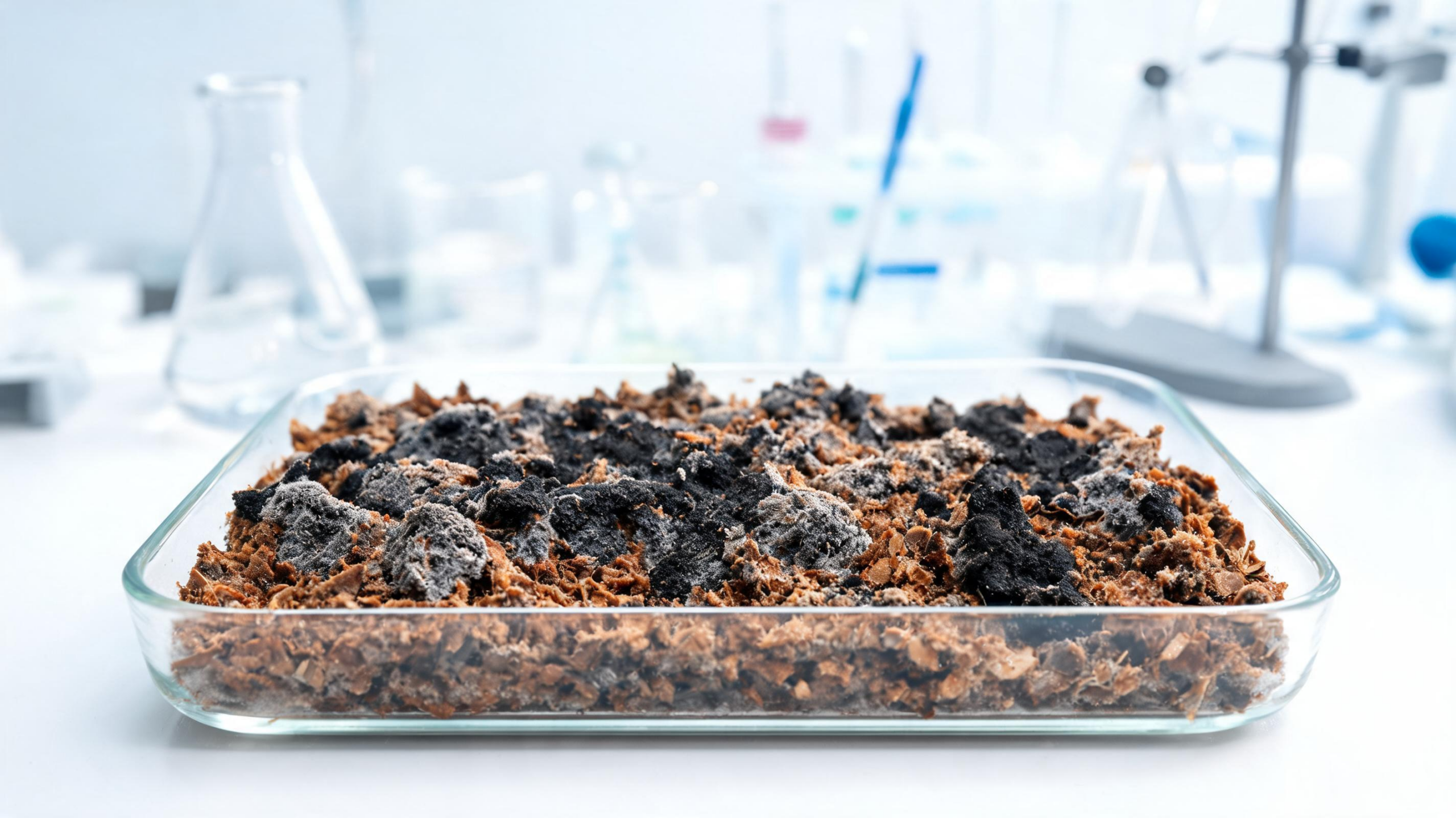
The choice of palm kernel cake as a fermentation substrate deserves closer examination in light of the broader economics of industrial enzyme manufacturing. Cellulase production at commercial scale has historically been dominated by a small number of multinational suppliers, and the cost of the carbon source can account for a substantial fraction of total production expenses. When enzyme producers in importing countries must ship finished enzyme preparations or refined substrates across long distances, the final price paid by downstream users in West Africa rises considerably. By demonstrating that a locally abundant by-product can support meaningful cellulase titers, the study addresses a structural problem rather than merely a technical one. Palm kernel cake is generated in large volumes wherever palm kernel oil is pressed, and in the Ashanti Region of Ghana it is often available at little more than the cost of transport. Converting this material into enzyme-rich fermented biomass would allow small and medium enterprises to produce crude enzyme preparations for local applications such as textile processing, food clarification, or the saccharification of agricultural residues for bioethanol, without the burden of import duties and cold-chain logistics.
The temporal profile reported in the study also illustrates a well-known feature of fungal physiology in solid-state culture. Enzyme secretion by filamentous fungi typically follows a pattern in which activity rises during the early exponential growth phase, peaks as the fungus encounters nutrient limitation or accumulates metabolic by-products, and then declines as proteolysis, substrate depletion, or product inhibition erode the accumulated enzyme pool. The observed rise from 4.68 units per milliliter on day two to 11.96 units per milliliter on day four, followed by a gradual decline to roughly 8.5 to 8.9 units per milliliter by days eight and ten, is consistent with this classical pattern. The rapid early increase suggests that the fungus germinated quickly on the moistened cake and that the cellulose fraction of the substrate was sufficiently accessible to induce cellulase synthesis. Induction of cellulase genes in Aspergillus species is generally triggered by the presence of cellulose or soluble cellulose derivatives, while high concentrations of glucose repress expression through carbon catabolite repression. The fact that activity climbed steeply between days two and four implies that the readily available sugars in the palm kernel cake were consumed early, relieving repression and allowing the cellulolytic system to be fully expressed.
The decline in activity after the day-four peak can be interpreted through several non-exclusive mechanisms. Proteases secreted by the fungus during later growth stages can degrade cellulases, particularly in substrates containing modest nitrogen reserves. The physical structure of the substrate also changes over time; as the fungus consumes the more digestible polysaccharide fractions, the remaining material becomes increasingly recalcitrant, reducing the stimulus for continued enzyme production. Additionally, the accumulation of soluble hydrolysis products can exert feedback inhibition on the enzymes themselves, and the crude extract measured at each time point reflects a dynamic balance between ongoing secretion and in situ degradation. The stabilization observed between days eight and ten may indicate that the culture had entered a quiescent state in which residual enzyme activity persisted without further net production. For process design, this plateau is informative because it suggests a window of several days during which harvest would yield comparable activity, providing operational flexibility even though the statistical analysis identified day four as the optimum.
The assay methodology used in the study merits some elaboration for readers less familiar with cellulase measurement. The dinitrosalicylic acid method detects reducing sugars released from a substrate, and when carboxymethylcellulose is used as the substrate, the measured activity corresponds primarily to endoglucanase activity. Endoglucanases cleave internal glycosidic bonds within amorphous regions of cellulose chains, generating new chain ends and reducing polymer length. This is only one component of the complete cellulolytic system, which also includes exoglucanases that processively release cellobiose from chain ends and beta-glucosidases that cleave cellobiose into glucose. A full characterization of the secreted enzyme cocktail would require additional assays, such as filter paper activity for total cellulase capacity or p-nitrophenyl-beta-D-glucopyranoside assays for beta-glucosidase. Because palm kernel cake contains substantial hemicellulose in addition to cellulose, the fungus likely secreted xylanases and other accessory enzymes as well, and these could be valuable co-products in their own right. The single-enzyme measurement reported therefore represents a conservative lower bound on the total hydrolytic value of the crude extract.
The normalization of activity to dry substrate weight, expressed as units per gram of dry substrate, is an important methodological detail that facilitates comparison across the solid-state fermentation literature. Reported cellulase yields on lignocellulosic residues vary widely depending on substrate composition, particle size, moisture regime, inoculum density, and fungal strain, and expressing results per gram of dry substrate rather than per milliliter of extract removes one major source of ambiguity. The extraction procedure used, involving shaking with distilled water followed by centrifugation, is a standard approach for recovering extracellular enzymes from fermented solids, though extraction efficiency is rarely complete and can itself depend on incubation time as the enzyme distribution between solid and liquid phases shifts. Readers comparing these results with other studies should therefore attend to whether activities were measured in crude extracts or in culture filtrates, and whether the assay temperature and pH matched those used here.
The moisture content of eighty percent deserves comment because water activity is among the most influential parameters in solid-state fermentation. Filamentous fungi tolerate lower water activities than bacteria, which is one reason solid-state culture favors fungal enzyme production and reduces bacterial contamination risk. Too little water limits swelling of the substrate, diffusion of nutrients, and mass transfer of secreted enzymes; too much water fills the interparticle spaces, reduces oxygen availability, and can effectively convert the process toward submerged conditions with their attendant disadvantages. The level chosen in this study sits within the range commonly reported for fungal solid-state fermentation of lignocellulosic substrates, but it was held constant, so the interaction between moisture and incubation time remains unexplored. Similarly, the ambient laboratory temperature, which in Kumasi typically falls in the mid-twenties to low thirties Celsius, was not actively controlled, meaning that the reported kinetics reflect a realistic but variable thermal environment. Future work that systematically varies moisture, temperature, particle size, and inoculum density, ideally through a factorial or response-surface design, would be needed to identify the true optimum and to quantify interactions among these parameters.
The absence of an uninoculated control, which the authors acknowledge, is worth considering from the standpoint of experimental interpretation. Because the substrate was autoclaved before inoculation, the contribution of native microbial communities to the measured activity is likely minimal, and the steep rise in activity coinciding with fungal growth supports the attribution of cellulase production to Aspergillus niger. Nevertheless, palm kernel cake may contain residual enzymes or heat-stable reducing sugars that could contribute to background reducing sugar release in the assay, and a substrate-only control would have allowed this background to be subtracted. Similarly, a heat-inactivated or killed-mycelium control would help distinguish enzyme activity from abiotic sugar release. These considerations do not undermine the central finding, given the clear temporal dynamics, but they define the boundaries within which the quantitative values should be interpreted.
From an applied perspective, the crude enzyme produced on palm kernel cake would be most immediately useful in applications that tolerate impurities and variable composition. In textile bioprocessing, bio-polishing of cotton fabrics, and in the softening of denim, crude cellulase preparations are routinely used and substrate-derived impurities are of limited concern. In the saccharification of agricultural residues for bioethanol, the enzyme cocktail would act on the same class of substrates on which it was induced, potentially providing good activity against local residues such as cassava peels, cocoa pod husk fiber, or rice husk. The co-secretion of xylanases by the fungus would be advantageous in these contexts because hemicellulose often shields cellulose fibers and its removal improves overall hydrolysis efficiency. For higher-value applications such as pharmaceutical or food-grade enzymes, additional purification and quality assurance would be required, but the fermentation step demonstrated here would remain the foundation of the process.
The circular economy framing of the work connects it to a wider agenda of agro-industrial waste valorization across West Africa. Palm oil processing generates several distinct residue streams, including empty fruit bunches, palm oil mill effluent, palm kernel shells, and palm kernel cake, each with different composition and potential uses. Palm kernel cake is already used to a limited extent as animal feed because of its residual protein and fat content, but its high fiber fraction limits its digestibility for monogastric animals. Enzymatic treatment or solid-state fermentation of the cake could serve a dual purpose: producing cellulase as a harvestable product while simultaneously upgrading the residual solid as a feed ingredient with improved fiber digestibility. Such integrated biorefinery concepts, in which a single substrate yields sequential or co-located products, are increasingly viewed as the most economically viable route for small-scale biotechnology in developing regions, because no single low-value product carries the entire process cost.
Finally, the study’s identification of day four as the optimal harvest point provides a concrete anchor for subsequent optimization and scale-up efforts. In industrial practice, the productivity of a fermentation process, expressed as units produced per liter per day, often matters more than the peak titer itself, and a short four-day cycle with high activity compares favorably with longer fermentations that achieve only modestly higher peaks. The single-factor design used here is an appropriate first step, establishing the temporal baseline against which the effects of other variables can be measured. As multifactorial studies build on this foundation, and as strain improvement and medium supplementation are explored, the combination of a GRAS-status producer, a locally sourced substrate, and a defined production window offers a credible starting point for developing cellulase production capacity within Ghana and, by extension, a template applicable to other palm-processing regions facing similar waste management and enzyme import challenges.
Subject of Research: Cellulase production by Aspergillus niger using palm kernel cake in solid state fermentation
Article Title: Cellulase production by Aspergillus niger using palm kernel cake in solid state fermentation
Article References: Sam Barko, P., Cofie, H., Danquah, B., Bentil, J. A., & Ofosu, M. (2026). Cellulase production by Aspergillus niger using palm kernel cake in solid state fermentation. Discover Biotechnology, 3(1), Article 10. https://doi.org/10.1007/s44340-026-00056-z
Image Credits: AI Generated
DOI: 10.1007/s44340-026-00056-z
Keywords: Cellulase, production, Aspergillus, niger, palm, kernel, cake, solid, state, fermentation, scientific research
Cite Scienmag News
Drew Townsend. (September 3, 2026). Cellulase production by Aspergillus niger using palm kernel cake in solid state fermentation. Scienmag. https://scienmag.com/cellulase-production-by-aspergillus-niger-using-palm-kernel-cake-in-solid-state-fermentation/
Drew Townsend. "Cellulase production by Aspergillus niger using palm kernel cake in solid state fermentation." Scienmag, 3 September 2026, https://scienmag.com/cellulase-production-by-aspergillus-niger-using-palm-kernel-cake-in-solid-state-fermentation/. Accessed 5 October 2026.
Drew Townsend. "Cellulase production by Aspergillus niger using palm kernel cake in solid state fermentation." Scienmag. September 3, 2026. https://scienmag.com/cellulase-production-by-aspergillus-niger-using-palm-kernel-cake-in-solid-state-fermentation/


