


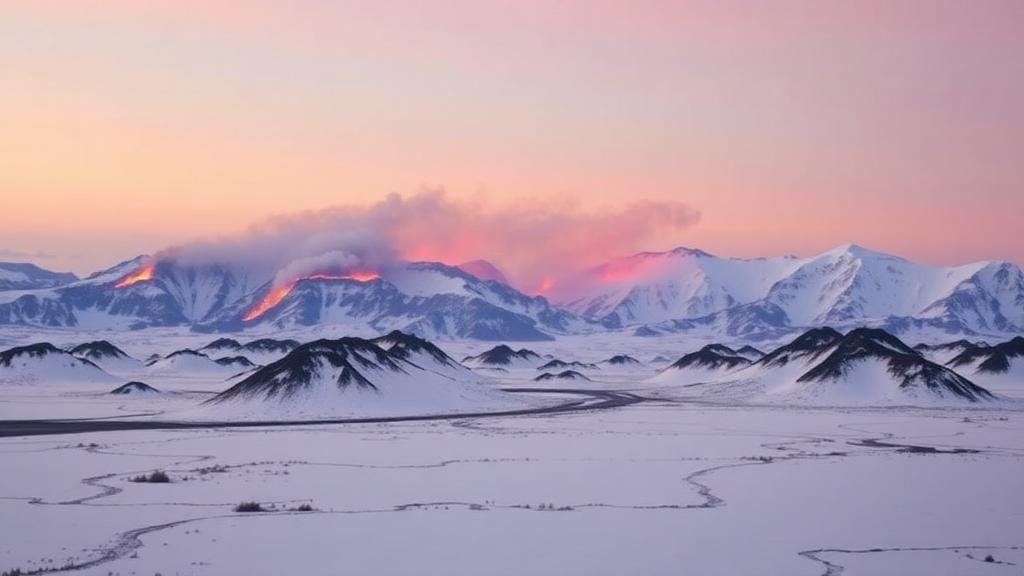
Ninety million years ago, the landscape that is now buried beneath kilometres of West Antarctic ice was anything but frozen. A team of researchers led by the Alfred Wegener Institute, Helmholtz Centre for Polar and Marine Research, together with RWTH Aachen University and Northumbria University, has uncovered compelling evidence that wildfires swept repeatedly through temperate rainforests that flourished just 900 kilometres from the South Pole during the Late Cretaceous. The discovery, published in the journal Communications Earth & Environment, documents the southernmost wildfires ever recorded on Earth and reveals an unexpected partnership between fire and the earliest known polar peatlands, an ancient co-evolution that carries striking lessons for how modern peatlands, now among the planet’s most important carbon stores, may respond to a warming climate.
The story begins with a sediment core recovered from the Amundsen Sea during an expedition of the research icebreaker Polarstern. In 2020, the same international team, led by marine geologist Dr Johann Klages of the Alfred Wegener Institute, stunned the scientific community when they announced in the journal Nature that the core contained an extraordinarily well-preserved forest soil dating back roughly 90 million years, complete with abundant pollen, spores and a dense network of fossil roots. During the Cretaceous, tectonic conditions placed this temperate rainforest even farther south than the drill site itself, a mere 900 kilometres from the geographic South Pole. Today, average annual temperatures at that location hover around minus 30 degrees Celsius, and the entire region lies beneath an ice sheet several kilometres thick.
The climate that supported such a forest was shaped by greenhouse conditions unlike anything in the recent geological past. Atmospheric carbon dioxide concentrations during the warmest interval of the Cretaceous were four to six times higher than preindustrial modern levels, and the average annual temperature in the West Antarctic rainforest reached around 12 degrees Celsius, roughly two degrees warmer than present-day Germany. Rainfall was plentiful but strongly seasonal: dry periods regularly gave way to monsoon-like rainy seasons. For about four months of each year, the forest endured the continuous darkness of the polar night, yet conifers and tree ferns thrived, and dinosaurs roamed through the misty swamplands. It was this combination of warmth, abundant moisture and pronounced seasonality that set the stage for the fires the team has now documented.
In the new study, the researchers re-examined the same core using a broader suite of analytical methods, and the evidence of fire proved unmistakable. Throughout the Late Cretaceous section of the sediment sequence, the team identified microscopic charcoal particles, the diagnostic residue of vegetation burned in situ or transported short distances by water and wind. Critically, the abundance of these charcoal particles increased steadily in the younger sediments, indicating that fires became more frequent as the ecosystem evolved. The particles themselves carried chemical and structural signatures showing that the fuel was mainly soft conifer wood burned at relatively low temperatures, a pattern typical of surface fires that creep through undergrowth and ground litter without climbing into the forest canopy.
Fire left its mark in more than charcoal. The sediments also yielded amber, the fossilised form of tree resin, appearing in a configuration that suggests the resin flowed over fire-damaged areas of tree trunks and hardened into a protective seal, much as living conifers today exude resin to wall off wounds. Together, the charcoal and amber record a forest that was burned and healed, burned and healed again, over an extended stretch of Late Cretaceous time. Because volcanically active areas lay at least 400 kilometres away from the site during that period, the researchers conclude that the most plausible ignition source was not lava or volcanic ash flows but lightning strikes from thunderstorms, a conclusion consistent with the strongly seasonal, storm-prone climate inferred from the broader sedimentological and palaeontological evidence.
Perhaps the most consequential discovery in the core concerns what grew back after the fires. The sediments contain countless spores of peat moss of the genus Sphagnum, the same group of plants that dominates raised bogs across the modern Northern Hemisphere. These spores provide evidence of some of the earliest raised bogs known, and their rise was closely intertwined with the recurrence of fire. According to the scenario the researchers developed from their data, the temperate and very swampy Antarctic rainforest, with its alternating dry and monsoon seasons, gradually silted up and transitioned into a peatland dominated by peat mosses. Wildfires, growing ever more frequent, played a decisive role in that transition by keeping the vegetation open, preventing the re-establishment of dense forest, and creating the conditions under which waterlogged, moss-dominated ground could persist and expand.
Once the peat bog had formed, fire did not disappear from the system. Instead, it changed character. Ground-level smouldering fires occurred repeatedly within the peat itself, burning slowly through damp, carbon-rich material rather than racing through standing forest. Co-first author Prof. Dr Ulrich Salzmann of Northumbria University draws a direct line from that ancient process to the present day, noting that such smouldering ground fires resemble those that have become increasingly common in German peatlands in recent years, where prolonged drought has lowered water tables and left once-saturated peat vulnerable to slow, persistent combustion. The Antarctic core thus preserves a complete natural experiment in how fire, hydrology and vegetation interact during the birth and maturation of a peatland, conducted under greenhouse conditions far warmer than today’s.
The climate significance of that experiment is difficult to overstate. Peatlands are among the most effective long-term carbon stores on Earth, accumulating partially decomposed plant material over thousands to millions of years because waterlogged conditions slow decay to a crawl. Co-first author Prof. Dr Thorsten Bauersachs of RWTH Aachen University emphasises that peatlands played a key role in the climate system then as now, precisely because of this capacity to lock away carbon over long periods. Paradoxically, the Cretaceous record suggests that in a warm climate, where wetlands dry out more quickly and fires that suppress forest development occur more frequently, conditions can actually favour the formation of new peatlands, allowing carbon-rich plant matter to accumulate even as the world warms. Fire, in other words, was not merely a destructive force in this ancient ecosystem but an architect of one of the planet’s most durable carbon sinks.
For the research team, the parallels between the Cretaceous Antarctic and today’s high latitudes were among the most surprising findings of the study. Dr Johann Klages, co-first author of the paper, describes the team’s astonishment at finding evidence in the core of an early Antarctic ecosystem that, in many respects, resembled today’s Arctic raised bogs and also experienced regular fires. Modern raised bogs in Arctic and boreal regions face acute threats from climate change and increasing drought, and the fate of the carbon they store is a major uncertainty in projections of future warming. The West Antarctic record demonstrates that peat formation and fire can coexist and even reinforce one another under greenhouse conditions, but it also shows how sensitive these systems are to the balance between moisture and burning, a balance that human-driven warming is now shifting across the northern peatlands.
The study also underscores how much remains hidden beneath the Antarctic ice. A single sediment core, drilled through the seafloor of the Amengen Sea region, has now yielded a rainforest soil, a fire history and the trace of the earliest polar peatlands, all from a time when the South Pole itself was green. As analytical methods grow more sensitive, existing cores continue to surrender new secrets, and each one refines the picture of how Earth’s most extreme greenhouse intervals functioned. Ninety million years ago, lightning-lit fires crackled through swampy conifer forests under a polar night, and from those ashes rose the bogs that would bury carbon for geological time. Understanding that ancient dance between flame and moss may prove essential to anticipating what a warming world will do to the peatlands that still guard vast reservoirs of carbon today.
Subject of Research: Cretaceous wildfires and early Sphagnum peatland formation near the South Pole
Article Title: Evidence of ancient wildfires near the South Pole
Article References: Evidence of ancient wildfires near the South Pole. (n.d.). Original publication
Image Credits: AI Generated
DOI: Not provided
Keywords: Antarctica, wildfires, Cretaceous, peatlands, Sphagnum, paleoclimate, charcoal, amber, carbon storage, West Antarctica, sediment core, climate change
Cite Scienmag News
Violet Maxwell. (October 4, 2026). Ancient Wildfires Raged Near the South Pole 90 Million Years Ago. Scienmag. https://scienmag.com/ancient-wildfires-raged-near-the-south-pole-90-million-years-ago/
Violet Maxwell. "Ancient Wildfires Raged Near the South Pole 90 Million Years Ago." Scienmag, 4 October 2026, https://scienmag.com/ancient-wildfires-raged-near-the-south-pole-90-million-years-ago/. Accessed 4 October 2026.
Violet Maxwell. "Ancient Wildfires Raged Near the South Pole 90 Million Years Ago." Scienmag. October 4, 2026. https://scienmag.com/ancient-wildfires-raged-near-the-south-pole-90-million-years-ago/


