


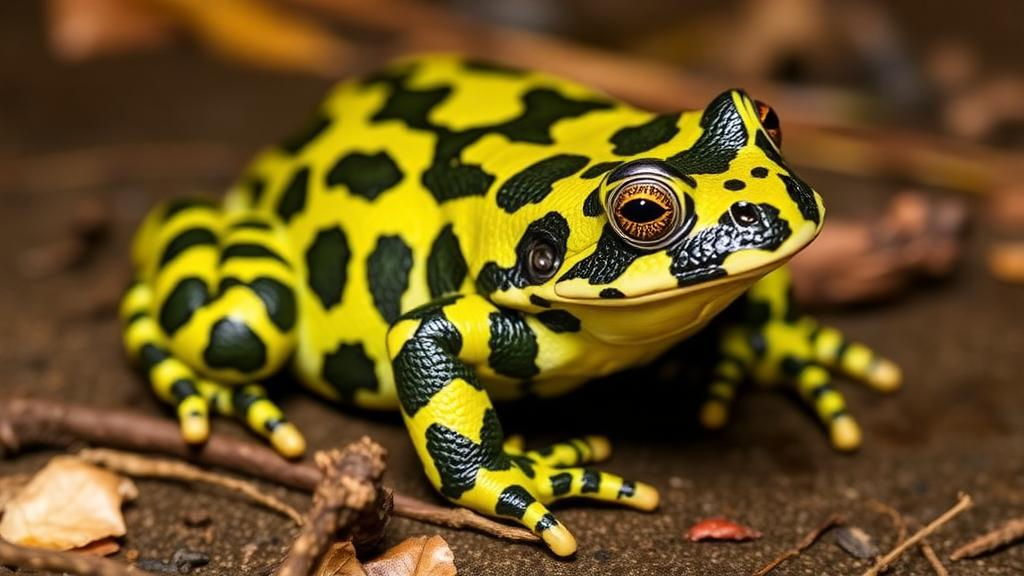
Across the humid forests of Central and South America, a microscopic fungus has quietly orchestrated one of the most devastating wildlife declines ever recorded. Amphibian chytridiomycosis, caused by the fungal pathogen Batrachochytrium dendrobatidis, has swept through tropical frog communities since the 1970s, pushing countless species toward extinction. Among the hardest hit have been the harlequin toads of the genus Atelopus, a group of brightly colored stream-breeding amphibians that once thrived along montane waterways from Costa Rica to Bolivia. Now, a new study from scientists at the Smithsonian’s National Zoo and Conservation Biology Institute and the Smithsonian Tropical Research Institute offers a carefully reasoned path forward: detailed maps of Panama that pinpoint where the disease is least likely to strike hardest, and where captive-bred frogs might finally stand a fighting chance when returned to the wild.
The research, published in the Journal for Nature Conservation, builds on a deceptively simple ecological insight. Just as human influenza surges in winter and recedes in summer, chytrid severity fluctuates with temperature and humidity. The fungus thrives in cool, moist conditions and falters when environments become too hot or too dry for its zoospores to survive and infect amphibian skin. By combining previously developed models that tracked where the disease occurs and when it reaches peak intensity, the research team constructed new chytrid suitability maps for Panama. These maps identify climatic refugia, places that are environmentally hostile to the pathogen yet perfectly hospitable to the frogs themselves. In effect, the scientists have produced a ranking system for potential release sites, allowing conservationists to direct scarce reintroduction resources toward locations where the odds of survival are highest.
The urgency of this work is rooted in painful experience. Conservationists have previously released captive-bred harlequin toads back into Panamanian forests, only to watch many of the animals succumb to the chytrid fungus that persists in soils, waterways and the skin of resistant carrier species. Brian Gratwicke, a conservation biologist at the Smithsonian’s National Zoo and Conservation Biology Institute and senior author of the study, explained that these repeated losses underscored the need for a smarter siting strategy. By mapping climatic refuges, he noted, the team finally has a practical tool to rank candidate release sites and select places where released animals have the best chance of persisting. The approach transforms what has largely been a gamble into a data-driven decision, grounded in the seasonal dynamics of a pathogen that can be modeled with the same rigor applied to crop pests or human disease vectors.
The analytical core of the study lies in comparing where harlequin toads still survive against the modeled intensity of chytrid infection across seasons. The results were striking. Most Atelopus species in Panama were found to persist only at sites where more than 80 percent of the seasons were unsuitable for medium and high-intensity infections. In other words, surviving populations cling to the very few corners of the landscape where the fungus cannot reliably build to lethal levels. This pattern provides strong indirect evidence that the disease, rather than habitat loss alone, is the dominant filter determining where these amphibians can endure. It also validates the underlying models: if the suitability maps were meaningless, surviving populations should be distributed randomly with respect to predicted disease pressure, and they are not.
One species stands out as a remarkable exception. The variable harlequin toad, Atelopus varius, was the only species found at sites classified as suitable for the disease. Scientists interpret this as consistent with growing evidence that the species may have evolved some degree of resistance to chytrid. Such evolutionary responses have been documented elsewhere in the amphibian world, where populations that survived initial epizootics sometimes carry genetic variants that blunt the fungus’s effects. If A. varius truly possesses enhanced tolerance, it could serve as both a biological benchmark for understanding resistance and a candidate for reintroduction programs that do not require the strictest disease-free conditions. For the many Atelopus species that lack this advantage, however, the refugia maps remain the most promising blueprint.
Beyond guiding reintroductions, the maps serve a second, equally valuable purpose: locating wild populations that may have quietly persisted in places scientists have not yet searched. Carrie Lewis, a doctoral candidate at George Mason University and lead author of the publication, emphasized that the ability to identify climate refugia is critical for finding populations that might have disappeared from most of their former range. These surviving pockets could act as genetic reservoirs, supplying founders to bolster assurance colonies under human care and providing stock to augment dwindling wild populations. In conservation genetics, maintaining diversity is paramount; small, isolated refugial populations risk inbreeding, and infusing new genes from rediscovered survivors could mean the difference between a population that limps along and one that recovers robustly.
The study also confronts an uncomfortable complication: climate change is redrawing the map in real time. The models forecast areas that, while currently suitable for the fungus, may become unsuitable in the coming years as temperatures rise and rainfall patterns shift. These emerging refuges could expand the portfolio of potential release sites, offering new opportunities that did not exist a decade ago. Yet the same climatic forces carry a threat. Many harlequin toads are adapted to cool, mountainous habitats, and warming may render those high-elevation refuges inhospitable to the frogs even as they become inhospitable to the fungus. The interplay between pathogen suitability and amphibian habitat suitability is therefore not a simple overlap but a moving target that conservation planners must track continuously, updating models as conditions change.
The research is already moving from theory to practice. Roberto Ibáñez, a staff scientist at the Smithsonian Tropical Research Institute and co-author of the study, reported that guided by the climate refugia and habitat-suitability maps, the team has begun surveying potential sites for habitat quality and preparing for release trials. These field experiments will allow scientists to test the climate refugia hypothesis directly, comparing survival rates of released frogs at sites predicted to be disease refuges against those at more chytrid-suitable locations. Such experimental validation is essential; models are hypotheses, and only on-the-ground outcomes with tagged, monitored animals can confirm that the mapped refuges deliver the protection they promise. Success would establish a template transferable to other chytrid-affected landscapes across the neotropics.
The institutional machinery behind this effort reflects decades of investment. The Panama Amphibian Rescue and Conservation Project, founded in 2009, unites Zoo New England, Cheyenne Mountain Zoo, the Smithsonian’s National Zoo and Conservation Biology Institute and the Smithsonian Tropical Research Institute in a coordinated mission to build captive populations of species at risk, develop methods to reduce the impact of chytrid, and return imperiled species to the wild. The new research was supported in part by the Bezos Earth Fund, signaling growing philanthropic recognition that amphibian conservation requires both ex situ insurance colonies and in situ solutions. The modeling study itself employed computational simulation, a method well suited to integrating climate data, disease dynamics and species distributions across complex tropical terrain.
For a genus that has become an emblem of the global amphibian crisis, the Panama maps represent something rare: actionable hope. Harlequin toads, with their jewel-like colors and their dependence on clean, flowing streams, are sentinels of ecosystem health, and their decline has rippled through the food webs of montane forests. If release trials in the mapped refuges succeed, captive-bred frogs descended from rescued founders could once again patrol Panamanian streams, and the framework could be extended to other countries and other pathogens. The study does not promise a cure for chytrid, which remains ubiquitous across the region. What it offers instead is precision, the knowledge of exactly where the odds tilt in the frogs’ favor, and a disciplined strategy for spending that advantage before it disappears in a warming, shifting world.
Subject of Research: Mapping climatic refugia of the chytrid fungus to guide reintroduction of harlequin toads in Panama
Article Title: Climate refuges may be key to restoring imperiled amphibians
Article References: Climate refuges may be key to restoring imperiled amphibians. (n.d.). Original publication
Image Credits: AI Generated
DOI: Not provided
Keywords: amphibian chytrid fungus, harlequin toads, Atelopus, climate refugia, Panama, reintroduction, conservation biology, Smithsonian, Batrachochytrium dendrobatidis, captive breeding, disease ecology, climate change
Cite Scienmag News
Margaret Porter. (October 4, 2026). Mapping Climate Refuges to Give Panama’s Harlequin Toads a Second Chance. Scienmag. https://scienmag.com/mapping-climate-refuges-to-give-panamas-harlequin-toads-a-second-chance/
Margaret Porter. "Mapping Climate Refuges to Give Panama’s Harlequin Toads a Second Chance." Scienmag, 4 October 2026, https://scienmag.com/mapping-climate-refuges-to-give-panamas-harlequin-toads-a-second-chance/. Accessed 4 October 2026.
Margaret Porter. "Mapping Climate Refuges to Give Panama’s Harlequin Toads a Second Chance." Scienmag. October 4, 2026. https://scienmag.com/mapping-climate-refuges-to-give-panamas-harlequin-toads-a-second-chance/


