


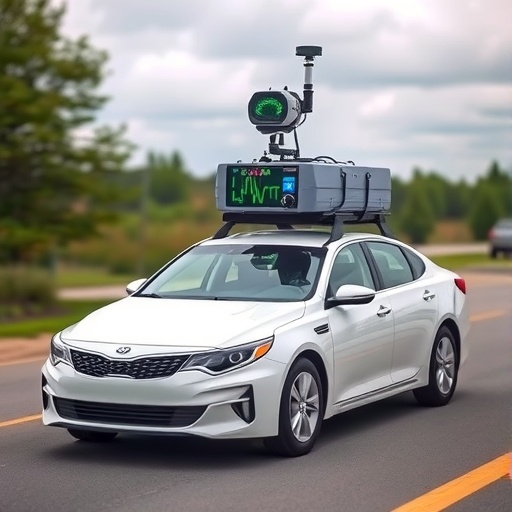
Researchers at East China Normal University have built a vehicle-mounted spectroscopy system that can detect methane in real time while driving at highway speeds, offering a practical way to track down hidden leaks of one of the most potent greenhouse gases, according to a study published in the Optica Publishing Group journal Optics Express. The work represents a notable step in moving a demanding laboratory measurement technique out of the lab and onto the open road, where the vast majority of real-world methane emissions actually occur.
Methane, released from natural gas infrastructure, livestock farms, landfills and coal mines, has a far greater warming effect than carbon dioxide over the near term, yet its leaks are typically invisible to the naked eye. Scientists and policymakers have increasingly focused on methane because of its outsized short-term climate influence: although it remains in the atmosphere for a much shorter time than carbon dioxide, it traps heat far more effectively while it persists. That combination makes cutting methane emissions one of the fastest available levers for slowing atmospheric warming, and it has motivated international pledges and national regulations aimed at finding and fixing leaks across the oil and gas supply chain. The difficulty, however, has always been detection. Leaks from buried distribution pipelines, aging compressor stations and abandoned wells are diffuse, intermittent and scattered across enormous geographic areas, which makes them expensive and slow to find with conventional surveying methods.
Beyond its climate impact, methane escaping from gas pipelines and other infrastructure can also create fire and explosion hazards, making rapid detection a matter of both environmental and public safety. Natural gas distribution networks run beneath dense residential neighborhoods in many cities, and even small underground leaks can accumulate in confined spaces such as utility vaults and building basements. Utilities already conduct scheduled leak surveys, but those programs typically rely on handheld or vehicle-mounted point sensors that sample air at a single location at a time, a slow process that can miss transient plumes or misjudge where a leak is actually located once wind has dispersed the gas.
“Dual-comb spectroscopy uniquely enables simultaneous, high-precision measurement of multiple gases, but is sensitive to environmental noise, which can degrade its performance. Our work addresses and overcomes this key challenge,” said research team leader Wenxue Li of East China Normal University. He envisions sport utility vehicles equipped with the system cruising residential streets day and night, capturing methane concentrations from underground pipeline leaks, recording GPS coordinates and automatically notifying maintenance crews. In that vision, leak detection becomes something closer to routine mapping than to a specialized investigation: a city could survey its entire gas distribution network on a regular schedule, building a time-resolved picture of where emissions arise and how they change.
The new instrument is based on mid-infrared dual-comb spectroscopy, a technique that identifies gases using two precisely matched frequency combs — light sources that emit many evenly spaced wavelengths simultaneously. Frequency combs, whose development earned a Nobel Prize in physics, have transformed optical measurement by turning the precision of atomic-clock-like lasers into practical spectroscopic tools. The mid-infrared spectral region is particularly valuable for gas sensing because many molecules, including methane, have strong and distinctive absorption fingerprints there. When infrared light passes through air containing methane, the gas absorbs specific wavelengths in patterns that act like a molecular barcode, allowing the gas to be identified and quantified. In a dual-comb arrangement, the interference between the two combs allows researchers to read those absorption features with high precision across many wavelengths at once, without the moving parts and mechanical scanning that limit conventional spectrometers.
Dual-comb spectrometers have traditionally been laboratory instruments. Their performance depends on carefully aligned optics, including fixed telescopes and mirrors, which make them ill-suited to roaming the streets in search of unknown leaks. In the lab, researchers can stabilize temperature, isolate instruments from vibration and spend long minutes aligning beams to maximize signal quality. On a moving vehicle, none of those conditions hold. Real-world emission sources can be scattered across an area and can shift with changing wind direction, so a practical field instrument must tolerate vibration, weather and continuous movement while still delivering laboratory-grade accuracy. This mismatch between laboratory performance and field robustness has long been the central obstacle preventing dual-comb spectroscopy from being deployed for routine environmental monitoring.
To bridge that gap, the research team combined several advances into a compact, mobile package. The frequency combs are produced by specially designed, vibration-resistant fiber lasers, an engineering choice that addresses the most fragile part of the system, since even tiny misalignments in laser cavities can degrade comb performance. The researchers also developed a scheme that allows the two comb light sources to remain naturally synchronized, eliminating the complex active hardware normally needed to keep them in phase — a major simplification for a system subjected to the constant jolting of a moving vehicle. Passive mutual coherence of this kind reduces power consumption, removes components that could fail in the field and makes the whole instrument easier to operate for personnel who are not laser specialists.
The mid-infrared light passes through a compact open-path gas cell that provides an effective 25-meter optical path through air drawn from the surroundings. This folded path dramatically increases sensitivity without requiring a large instrument footprint: because absorption scales with the distance light travels through the gas sample, folding a long path into a small multi-pass cell lets the instrument detect very faint concentrations while remaining small enough to mount in a vehicle. According to Daping Luo, a member of the research team, the system requires no pre-deployed hardware at the field site, maintains near-laboratory-grade detection accuracy while in motion, supports vehicle speeds up to 100 kilometers per hour, and can geolocate gas plume hotspots. The hardware is compact, relatively low in power consumption and built in a modular plug-and-play design, which the researchers say should ease maintenance and future upgrades.
The team evaluated the system in two stages. First, short drives on a university campus at roughly 20 kilometers per hour collected data at multiple locations, allowing the researchers to verify basic operation under mild conditions. Then came a more demanding trial: a one-hour, 47-kilometer road test on urban roads and expressways at speeds up to 100 kilometers per hour, with readings taken every second. The instrument achieved a figure of merit of 3.4 × 10⁶ Hz — a performance benchmark comparable to typical laboratory-based mid-infrared dual-comb systems — and measured methane with a precision of 66 parts per billion and water vapor with a precision of 114 parts per million. For context, ambient methane concentrations are on the order of two parts per million, so a precision of 66 parts per billion corresponds to sensitivity at the few-percent level of the background, sufficient to flag meaningful local enhancements above it.
During the long-distance urban measurements, background methane averaged 1.815 parts per million while water vapor averaged 1.072 percent. These readings remained consistent throughout the drive, providing a stable baseline against which localized increases in gas concentration — the telltale signature of a leak — could be identified. The team also carried out controlled methane-release tests, driving past two simulated leaks to detect and locate the resulting plumes. In one test, the vehicle circled a leak to build a two-dimensional concentration map that closely matched local wind patterns, demonstrating the system’s ability to not just detect gas but to visualize how it disperses. That mapping capability matters operationally: knowing the shape and orientation of a plume helps crews trace a dispersed cloud back to its source, which is often displaced from the point of highest concentration.
Collectively, the road tests confirmed that the hardware withstands the vibration and outdoor weather conditions of real roads and can accurately capture both atmospheric background concentrations and high-concentration plume signals from controlled sources. Because the same drive yielded simultaneous methane and water vapor data, the approach also illustrates the core promise of dual-comb spectroscopy: measuring multiple gases at once with a single instrument, something point sensors that probe only one species typically cannot do. Water vapor is more than a byproduct of the measurement — it is the dominant interference in infrared gas sensing, and measuring it alongside methane allows the system to correct for its effects and improve the reliability of the methane retrieval.
The researchers are candid that the current setup is a research prototype with room to grow. Their development roadmap includes expanding the spectral coverage so that multiple trace gas species can be monitored simultaneously, suppressing baseline drift during long integration times, developing automated analysis software capable of handling the massive volumes of data generated by mobile operation, and continuing to shrink the system’s size, weight and cost. The data challenge is substantial: taking a full spectrum every second over hours of driving produces datasets that must be processed, quality-controlled and translated into actionable leak locations, ideally without manual review.
The potential applications extend beyond city streets. With further development, the technology could help cities and industries quantify hard-to-detect greenhouse gas emissions, providing data to support emissions-reduction policies. More accurate leak localization could enable targeted repairs, reduce resource waste and improve air quality for residents living near gas infrastructure. The researchers also hope to integrate the system onto unmanned aerial vehicles, extending methane detection to off-road areas such as farmland, landfills and remote wellheads — destinations where a vehicle cannot go but where some of the largest and least-monitored methane sources lie. If mobile, high-precision spectroscopy of this kind can be scaled and automated, it could give regulators, utilities and researchers a far clearer picture of where methane is escaping, and a faster route to stopping it.
Cite Scienmag News
Russell Cooper. (August 31, 2026). Vehicle-mounted spectroscopy system detects methane in real time. Scienmag. https://scienmag.com/vehicle-mounted-spectroscopy-system-detects-methane-in-real-time/
Russell Cooper. "Vehicle-mounted spectroscopy system detects methane in real time." Scienmag, 31 August 2026, https://scienmag.com/vehicle-mounted-spectroscopy-system-detects-methane-in-real-time/. Accessed 3 September 2026.
Russell Cooper. "Vehicle-mounted spectroscopy system detects methane in real time." Scienmag. August 31, 2026. https://scienmag.com/vehicle-mounted-spectroscopy-system-detects-methane-in-real-time/


