


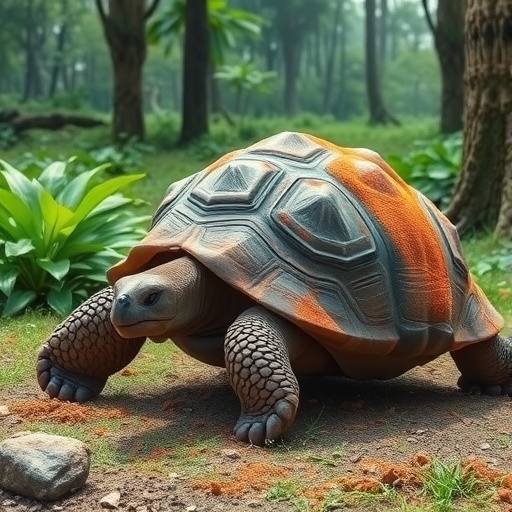
Some of the most important genomes of our time are not stored in freezers or sequencing centers, but in the drawers and vaults of natural history museums, locked inside bones that have been gathering dust for more than a century. A new study from Yale University shows just how much evolutionary history those shelves still hold. Using a new combination of computational tools designed to squeeze information from hopelessly fragmented DNA, Yale researchers have reconstructed the identities of two ancient, extinct giant tortoise lineages that once lived on the Galapagos Islands. The specimens at the heart of the study were so degraded that, in some cases, less than one percent of the genome could be read — material that conventional genomic analyses would have discarded without a second thought. Yet from those molecular scraps, the team managed to place the long-dead animals precisely on the tortoise family tree, confirming that the San Cristóbal and Santa Fe island lineages were distinct evolutionary branches that disappeared after humans reached the archipelago. The findings, published in Proceedings of the Royal Society B, could also reshape ongoing efforts to restore giant tortoise populations across the Galapagos, because the genetic legacy of the extinct lineages may still survive inside hybrid tortoises alive today.
Ancient DNA is one of the most unforgiving materials in all of molecular biology. From the moment an organism dies, its genome begins to disintegrate: enzymes released by dying cells shear the long DNA molecules apart, water and oxygen attack the chemical backbone of the double helix, and bacteria colonizing the remains sprinkle the sample with their own foreign genes. What survives after decades or centuries is not a genome at all but a debris field — billions of minuscule fragments, often only a few dozen letters of genetic code long, scarred by chemical damage that causes sequencing machines to misread them. Researchers measure the quality of sequencing data in terms of coverage, the average number of times each position in the genome is actually observed; modern reference genomes are typically read thirty times over or more. The tortoise bones in the new study sit at the opposite extreme. In some specimens, less than one percent of the genome could be read, a regime known as ultra-low coverage, in which the signal from genuine tortoise DNA drowns in contamination and statistical noise. Conventional genomic analyses routinely discard samples in this state, because missing information can distort reconstructed evolutionary relationships, making closely related lineages look distant and distant ones look close.
The Yale-led team confronted that challenge head-on. Working with dried bones from historical museum specimens, including five individuals belonging to the two extinct lineages, the researchers extracted whatever DNA remained and faced the realities of what they had. “The challenge of this study was to reconstruct the genetic relationships of extinct Galapagos giant tortoises, knowing that the DNA we were able to obtain from museum specimens was going to be highly degraded and fragmented and have a high proportion of contamination,” said study lead author Alexander Ochoa, a former associate research scientist in Yale’s Department of Ecology and Evolutionary Biology who is beginning a new position as an assistant professor at the State University of New York at Old Westbury this fall. With genotypes that unreliable and genomes that incomplete, no single specimen could tell its own story. Instead of treating that as a fatal flaw, Ochoa and his colleagues designed their entire analytical strategy around it, asking a different question: not whether the fragments were enough to rebuild a genome, but whether they were enough to say where the animal belonged on the tree of life.
The answer came from a computational strategy that treats degraded DNA as a pattern-matching problem rather than an assembly problem. First, the researchers built a reference phylogenetic tree using high-quality genomes from living giant tortoises and other, better-preserved historical specimens — a backbone that encodes the known evolutionary relationships among tortoise populations across the archipelago. They then combined the scraps of genetic information recovered from each degraded specimen and superimposed, or placed, that information onto the tree, a technique known as phylogenetic placement. Every short fragment recovered from an ancient bone becomes a tiny vote about where its owner belongs: a fragment carrying a variant found only in one island lineage pulls the sample toward that branch, while the combined weight of millions of such votes overwhelms the noise from damaged and contaminating DNA. Because the method pools statistical signal across the entire set of fragments instead of relying on any single position, it can deliver a reliable answer even when less than one percent of the genome survives. In effect, the approach bypasses the need for a more complete DNA sample, extracting a lineage’s identity from the echoes it left behind.
Applied to the museum bones, the method delivered a clear verdict. The new computational approach successfully identified specimens from the extinct San Cristóbal and Santa Fe island lineages, confirming that they represent two distinct evolutionary branches rather than strays from surviving populations. “These are two distinct lineages,” Ochoa said, adding that linking the past with the present underscores current conservation efforts across the Galapagos archipelago. The distinction matters because Galapagos giant tortoises evolved along separate trajectories on different islands, each population accumulating its own suite of genetic variants over vast stretches of time; when a lineage vanishes, an entire branch of that natural experiment is lost with it. Both lineages at the center of the study vanished after humans reached the archipelago, and both survive today only as bones in museum collections — bones that, until now, held too little recoverable DNA to tell their story. By proving that fragments this degraded can still yield a definitive identification, the study effectively reopens evolutionary case files that scientists had been forced to close.
The story of how these lineages vanished, and how they might partially return, is inseparable from human history. Sailors who visited the Galapagos over the centuries treated the giant tortoises as living provisions, carrying the animals from one island to another as cargo and a source of fresh meat on long voyages. Some of these displaced tortoises survived their transplantation and bred with tortoises from a different island, weaving foreign genes into local populations and blurring the genetic boundaries that geography had created. Due to these human-driven migration events, the researchers note, the genomes of the extinct lineages may still be “living” in extant, hybrid tortoises that roam the archipelago today. In other words, extinction, in the genetic sense, may not be absolute: even when every purebred member of a lineage is gone, its DNA can persist, diluted but intact in fragments, within the descendants of hybrids born long after the last true representatives of the lineage died.
That possibility transforms the study from a historical detective story into a practical conservation tool. “In this regard, captive breeding programs that mate these hybrids may be able to recover the genomes of the extinct lineages in future generations,” Ochoa said. “The tools developed in our study are not only useful for the discovery of extinct lineages but could also be applied to broader wildlife conservation efforts.” The logic follows from basic genetics. A hybrid tortoise carries some fraction of its ancestry from an extinct lineage, scattered across its chromosomes in blocks. When hybrids are mated with one another, those blocks recombine, and breeding programs informed by genomic data can, over successive generations, assemble an increasing share of the extinct lineage’s genome in living animals. The researchers say the findings could also aid ongoing efforts to expand giant tortoise populations in the Galapagos archipelago by revealing which living animals carry which ancestral genes. For conservation managers deciding which tortoises to pair, the difference between guesswork and genomics could determine whether a lost lineage is rebuilt or lost forever.
The research grew out of a long-running initiative in the laboratory of Adalgisa Caccone, a senior research scientist and lecturer in Yale’s Department of Ecology and Evolutionary Biology and a member of Yale’s Faculty of Arts and Sciences, who has spent years charting the genetic diversity of Galapagos giant tortoises and is a co-author of the new study. The work also depended on a remarkably international network of collaborators, including researchers from Newcastle University, the University of California, Berkeley, the University of Connecticut, Woods Hole Oceanographic Institution, Pacific Northwest Oceanographic Laboratory, the University of New Mexico, the University of Crete, the Foundation for Research and Technology – Hellas (FORTH), and MacEwan University. The resulting paper, “Integration of ultra-low coverage whole-genome sequences for reconstructing the evolutionary history of Galapagos giant tortoises,” was published in Proceedings of the Royal Society B on July 22, 2026, and stands as a proof of concept for an entire class of specimens that genomics had largely written off.
Beyond the Galapagos, the study carries a message for anyone who assumed that old, degraded specimens had nothing left to give. Natural history museums around the world hold millions of preserved animals collected over centuries, many of them extinct species or vanished populations, most of them stored long before anyone imagined DNA sequencing. As the technology matured, scientists learned to pull genomes from some of these treasures, but the most heavily degraded samples remained off-limits, stranded behind the barrier that conventional analysis imposes on ultra-low coverage data. By showing that a carefully designed computational framework can convert fragments representing less than one percent of a genome into a definitive evolutionary identification, the Yale team has effectively lowered that barrier for extinct and endangered species everywhere. The giant tortoises of San Cristóbal and Santa Fe may never walk their islands again in their original form, but their genetic messages, scribbled in fragments no longer than a sentence, have finally been read — and some of them, remarkably, may still be walking the Galapagos today, disguised inside the hybrids they left behind.
Cite Scienmag News
Juliet Wilcox. (August 29, 2026). Ancient giant tortoise DNA reveals secrets lost to time. Scienmag. https://scienmag.com/ancient-giant-tortoise-dna-reveals-secrets-lost-to-time/
Juliet Wilcox. "Ancient giant tortoise DNA reveals secrets lost to time." Scienmag, 29 August 2026, https://scienmag.com/ancient-giant-tortoise-dna-reveals-secrets-lost-to-time/. Accessed 3 September 2026.
Juliet Wilcox. "Ancient giant tortoise DNA reveals secrets lost to time." Scienmag. August 29, 2026. https://scienmag.com/ancient-giant-tortoise-dna-reveals-secrets-lost-to-time/


