


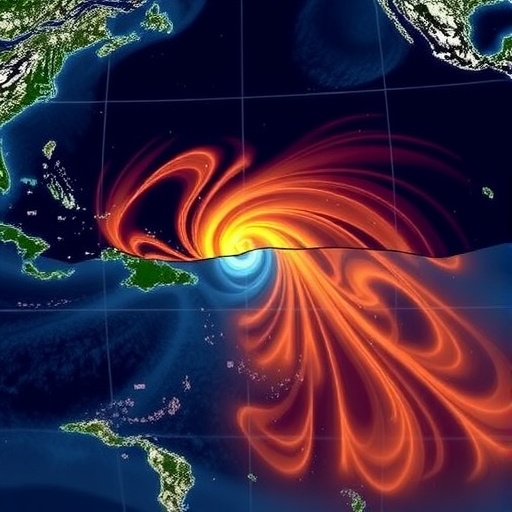
In an era dominated by escalating concerns over climate change, uncovering the underlying processes that govern the ocean’s heat absorption and redistribution has emerged as a critical frontier in climate science. Oceans have long been recognized as the planet’s primary reservoir for excess heat generated by anthropogenic activities, with studies revealing that approximately 89% of this surplus thermal energy since 1970 has been sequestered in the ocean rather than remaining in the atmosphere. This preferential uptake profoundly influences global climate dynamics, mediating the pace and extent of atmospheric warming.
One of the pivotal mechanisms attributed to this heat uptake involves wind-driven ocean circulation patterns. These circulations act as conduits, facilitating the transfer of thermal energy from the ocean surface into deeper layers. However, elucidating the precise roles and variability of these processes has been challenging, primarily due to the limited temporal scope of instrumental climate records. These records, while invaluable, often span just decades to a century and are susceptible to noise introduced by natural climatic oscillations, complicating the extraction of clear causal relationships.
To circumvent these limitations, paleoclimate research leverages geological proxies and sedimentary archives to extend the temporal canvas far beyond the modern observational window. Such an approach allows for the reconstruction of oceanic and atmospheric conditions over millennia, revealing slow-evolving patterns and abrupt transformations that instrumental data alone cannot capture. A recent breakthrough in this field was achieved through the study of a marine sediment core obtained from the equatorial Atlantic, focusing on the thermal history of intermediate-water masses roughly 800 meters below the surface.
This extensive study, led by Earth science professor Syee Weldeab at the University of California, Santa Barbara, unveiled a striking thermal anomaly occurring in the mid- to late Holocene epoch. The sediment record distinctly shows an abrupt warming event of nearly 5 degrees Celsius beginning around 5,700 years ago, peaking approximately 2,500 years ago. Intriguingly, this substantial warming does not correspond with any significant changes detected in surface sea temperatures, indicating that the source of heat originated from processes remote from the equatorial region itself.
What renders this discovery particularly compelling is the implication that the interior ocean functions as an independent and vast heat reservoir, capable of storing thermal energy without concurrent surface manifestations. This challenges conventional paradigms that closely associate oceanic heat content variations with surface temperature trends. It also underscores the significance of subsurface dynamics in modulating climate on centennial and millennial timescales.
Further analysis attributes the driving force behind this subsurface warming to shifts in the Southern Hemisphere’s ocean-atmosphere system. Specifically, an intensification and a poleward migration of the Southern Hemisphere westerly wind belt during austral summers are implicated. These alterations in atmospheric circulation enhanced the subduction—the process where surface waters are driven below the mixed layer—of relatively warm surface water masses, transporting this heat into intermediate depths and channeling it toward the tropical ocean interior.
This mechanism highlights a remarkable teleconnection: climate forcings in high-latitude southern regions exert profound influences on tropical ocean temperatures deep below the surface. Such findings recalibrate our understanding of global ocean-climate interactions, emphasizing the need to consider spatially and temporally distant drivers when modeling climate variability and change.
Moreover, these paleoclimate insights carry urgent relevance for present and future climate trajectories. Contemporary observations reveal a continued poleward shift and strengthening of Southern Hemisphere westerly winds, mirroring historical patterns associated with deep ocean warming. This ongoing trend suggests the subsurface ocean warming mechanism identified in the Holocene could be reactivating under current climate change scenarios, potentially accelerating heat uptake into the abyssal ocean layers and modulating the rate of atmospheric warming.
By expanding the spatial mapping of this mid-Holocene warming across global oceans, researchers aim to delineate the full extent and variability of this heat transfer process. Such efforts are vital to refine climate models, which often grapple with accurately representing deep ocean heat uptake and its feedbacks to the climate system. A more comprehensive incorporation of these paleoclimate-derived mechanisms could vastly improve predictive capabilities and climate resilience strategies.
This research thus provides a crucial and nuanced layer to the narrative of oceanic heat storage, challenging assumptions that focus narrowly on surface temperature proxies. It reveals the ocean interior as an active player in climate regulation, buffering surface climate and distributing heat over extensive temporal and spatial scales through complex circulation dynamics linked to atmospheric wind patterns.
As global efforts to mitigate and adapt to climate change intensify, recognizing and incorporating deep ocean processes becomes indispensable. The findings presented by Syee Weldeab and colleagues invigorate scientific discourse on how past climate variability informs future shifts, underscoring the ocean’s integral role in Earth’s climate system.
Ultimately, this work punctuates the intertwined nature of atmospheric and oceanic circulations and their collective imprint on Earth’s thermal equilibrium. By unveiling a previously uncharted conduit of deep ocean warming tied to Southern Hemisphere winds, the study charts a path forward for climate science that bridges millennia of climate history with emergent contemporary changes, enriching our understanding of the planet’s evolving climate tapestry.
News Publication Date: 8-May-2026.
Web References:
Media Contact: Harrison Tasoff, University of California – Santa Barbara, harrisontasoff@ucsb.edu
Cite Scienmag News
Violet Maxwell. (May 28, 2026). Remote winds may trigger intense tropical warming deep beneath the ocean surface. Scienmag. https://scienmag.com/remote-winds-may-trigger-intense-tropical-warming-deep-beneath-the-ocean-surface/
Violet Maxwell. "Remote winds may trigger intense tropical warming deep beneath the ocean surface." Scienmag, 28 May 2026, https://scienmag.com/remote-winds-may-trigger-intense-tropical-warming-deep-beneath-the-ocean-surface/. Accessed 3 September 2026.
Violet Maxwell. "Remote winds may trigger intense tropical warming deep beneath the ocean surface." Scienmag. May 28, 2026. https://scienmag.com/remote-winds-may-trigger-intense-tropical-warming-deep-beneath-the-ocean-surface/


