


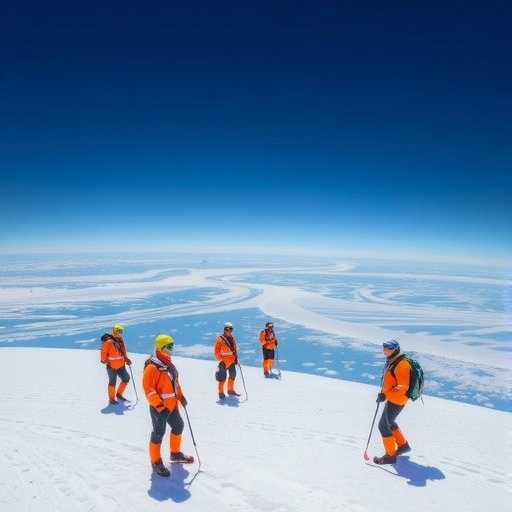
The Southern Ocean is changing faster than scientists can fully measure it—and a new European research project is preparing an unprecedented effort to understand why. Beginning on August 1, 2026, the EU-funded SYNCHRONY project will bring together 27 institutions from across the globe to investigate the tightly connected ocean, Antarctic ice, atmosphere and biological systems surrounding Antarctica. Coordinated by the Alfred Wegener Institute, Helmholtz Centre for Polar and Marine Research, the four-year initiative will receive approximately €8.5 million from the European Union and aims to transform how the region is observed, modelled and protected.
The Southern Ocean acts as a major regulator of the global climate. It absorbs heat and carbon dioxide from the atmosphere, redistributes energy through its currents and helps form dense water that sinks into the deep ocean. Yet this climate engine is undergoing rapid disruption. Antarctic sea ice has declined dramatically in recent years, portions of the West Antarctic Ice Sheet are losing mass, and evidence suggests that the formation of deep water may be weakening. These changes could alter ocean circulation, accelerate climate feedbacks and reshape ecosystems far beyond Antarctica.
Scientists still cannot reliably predict the consequences because the Southern Ocean is one of the most difficult places on Earth to observe. Vast distances, severe storms, drifting sea ice and long periods of darkness limit the number of research expeditions and instruments that can operate there. Observations are often collected by different countries using separate technologies, sampling schedules and data standards. This fragmentation makes it difficult to combine measurements or determine whether a sudden change reflects a local event or a basin-wide transformation.
SYNCHRONY is designed to address that problem by creating a coordinated observing system linking ships, autonomous instruments, satellites, fixed observatories and biological surveys. Researchers will harmonise data streams so that measurements of temperature, salinity, currents, sea ice, snow, atmospheric conditions, microorganisms and larger marine life can be analysed together. Such integration is essential because the Antarctic system does not operate in isolated compartments: changes in sea-ice thickness can affect ocean-atmosphere heat exchange, light penetration, plankton growth, carbon uptake and the food web simultaneously.
The project will contribute directly to Antarctica InSync, a major international initiative associated with the United Nations Ocean Decade. Between 2027 and 2029, Antarctica InSync is expected to establish one of the largest coordinated observing networks ever deployed in a polar environment. SYNCHRONY will help provide the scientific infrastructure and shared data framework needed to interpret those observations. The effort also supports preparations for the fifth International Polar Year in 2032 and 2033, while complementing established networks such as the Scientific Committee on Antarctic Research and the Southern Ocean Observing System.
The Alfred Wegener Institute will contribute five planned Polarstern cruise legs during the principal Antarctica InSync observation period, spanning the Antarctic summers of 2027–28 and 2028–29. The ship-based missions will be combined with autonomous platforms capable of collecting measurements beneath sea ice, in the open ocean and through the atmosphere. The institute will also use the multidisciplinary HAFOS observatory in the Weddell Sea, where long-term measurements can reveal processes that short expeditions often miss. Together, these platforms will offer a more continuous view of a region that changes across seasons and depths.
A central scientific challenge is improving Earth system models. Many current models represent Antarctic processes too simply or omit them altogether, including the effects of snow on sea ice, the formation and breakup of ice shelves, turbulent exchanges between ocean and atmosphere, and biological responses to changing light and nutrient conditions. SYNCHRONY researchers will compare observations with model simulations to identify these weaknesses. Better representations of processes such as ocean mixing, carbon transport and ice-ocean interaction could substantially improve forecasts of sea-level rise, climate feedbacks and ecosystem change.
The project will also focus on biodiversity, which is often difficult to monitor in remote polar waters. Changes in sea ice can modify habitats for algae, krill, fish, seabirds, seals and whales, while warming and shifting currents may open pathways for species to move into new areas. By linking physical measurements with ecosystem observations and biological data products, researchers hope to determine how environmental changes propagate through the Antarctic food web. Making these datasets openly accessible will allow scientists worldwide to detect patterns that would remain invisible in isolated national databases.
SYNCHRONY brings together polar research organisations, universities, data specialists and science communication institutions from Europe, Africa, Asia and Oceania. Its partners include the Norwegian Polar Institute, the British Antarctic Survey, the European Polar Board, the National Oceanography Centre, the Korea Polar Research Institute and universities in Belgium, France, Germany, Italy, New Zealand, South Africa, Sweden and the United Kingdom. The project’s organisers say that only sustained international cooperation can produce the comprehensive evidence needed for long-term decisions on climate protection, biodiversity conservation and the future governance of the Southern Ocean.
The urgency is growing as Antarctica enters a period of increasingly visible instability. Scientists can document individual extremes, but the larger question is how the ocean, ice, atmosphere and biosphere will evolve as a connected system. By synchronising observations, expanding autonomous monitoring and improving the models used to interpret climate risk, SYNCHRONY aims to turn scattered measurements into actionable knowledge. Its results could help governments and international bodies anticipate changes rather than simply respond to them—making the project a potentially decisive step toward understanding one of the planet’s most influential and rapidly changing environments.
Web References: https://doi.org/10.3030/101295248
Cite Scienmag News
Violet Maxwell. (July 31, 2026). New Observing System Tracks the Southern Ocean. Scienmag. https://scienmag.com/new-observing-system-tracks-the-southern-ocean/
Violet Maxwell. "New Observing System Tracks the Southern Ocean." Scienmag, 31 July 2026, https://scienmag.com/new-observing-system-tracks-the-southern-ocean/. Accessed 4 September 2026.
Violet Maxwell. "New Observing System Tracks the Southern Ocean." Scienmag. July 31, 2026. https://scienmag.com/new-observing-system-tracks-the-southern-ocean/


