


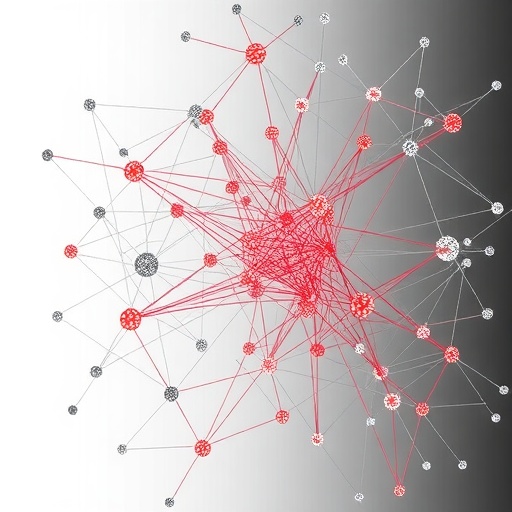
In recent years, the scientific community has witnessed a surge in interest surrounding the dynamics of complex systems, driven by their ubiquitous presence in natural and engineered environments. From the collective motion of bird flocks to the global transmission patterns of infectious diseases, emergent phenomena in these systems challenge traditional modeling approaches due to their intricate spatiotemporal interactions and nonlinear behaviors. Now, a groundbreaking study led by researchers Romeijnders, van Boven, Corman, and colleagues introduces an innovative framework that promises to revolutionize how we model and understand these phenomena. Their work, published in the prestigious journal Nature Communications in 2026, unveils event-based spatiotemporal networks as a powerful mathematical and computational toolkit that captures the subtleties of emergent complex behaviors with unprecedented fidelity.
At its core, this research tackles one of the most intractable problems in modern science: how localized events, each unfolding in space and time, collectively give rise to macroscopic patterns that defy straightforward prediction. Traditional models often fall short because they rely on static representations or continuous fields, obscuring the discrete and time-dependent nature of interactions in complex systems. Event-based spatiotemporal networks diverge from these classical methods by formalizing phenomena as sequences of discrete events connecting spatial units with temporal causality at their heart. This paradigm shift illuminates the often hidden pathways through which local perturbations ripple outward, generating global system-wide effects.
One of the standout features of this approach is its robust adaptability across domains. The researchers demonstrate that event-based spatiotemporal networks are not confined to any single disciplinary silo but can be seamlessly applied to diverse contexts ranging from ecological networks and neuronal circuits to social contagion and urban traffic flows. By anchoring the model in empirical event data—such as discrete timestamps of communication, movement, or molecular interactions—they circumvent the need for oversimplifying assumptions that often plague continuous models. This fidelity to real-world dynamism opens new frontiers for both fundamental discovery and practical forecasting.
Delving into the technical architecture, the framework constructs nodes representing spatially localized entities or regions, interconnected via edges that embody temporally sequenced events. Importantly, edges are weighted and directed by the timing and nature of these events, capturing directionality and intensity of influence through the network over time. Advanced algorithms then parse these evolving networks to detect emergent clusters, predict cascade effects, and identify critical transition points. By harnessing techniques from temporal graph theory and machine learning, the study offers tools to dynamically track how local changes propagate, merge, or dissipate within the system’s fabric.
From a computational perspective, handling the vast complexity inherent in event-based data requires both scalability and precision. The authors introduce novel optimization methods that streamline processing while preserving granularity, enabling their models to efficiently manage datasets spanning millions of events distributed across large geographic or biological scales. These innovations provide a blueprint for real-time monitoring in systems where rapid decisions are paramount, such as epidemic management or infrastructure resilience planning.
Beyond the realm of pure science, the implications of this modeling revolution are profound. By improving our capacity to predict emergent phenomena, policymakers and engineers can develop more targeted intervention strategies to mitigate risks. For example, in epidemiology, identifying the precise spatiotemporal pathways of pathogen transmission could inform more effective quarantine protocols while minimizing social disruption. In urban planning, understanding traffic congestion as an emergent pattern of discrete events may lead to innovative designs that preempt bottlenecks before they fully materialize.
The study also marks a significant conceptual advance in our understanding of complexity itself. By framing emergent phenomena not as inexplicable anomalies but as outcomes of identifiable event sequences, it invites a reevaluation of what it means to infer causality and to design interventions in highly interconnected systems. This perspective harmonizes with growing trends towards data-driven science while honoring the intricate temporal rhythms that govern real-world processes.
What truly sets this framework apart is its versatility in accommodating uncertainty and noise, ubiquitous in empirical data. Rather than treating these as nuisances, the model integrates probabilistic elements that reflect the stochastic nature of event occurrences, thereby enhancing robustness without sacrificing explanatory power. Such resilience is crucial when translating theoretical insights into actionable intelligence in unpredictable environments.
The collaborative nature of the research team, drawing expertise from physics, computer science, ecology, and social sciences, exemplifies the interdisciplinary spirit necessary to tackle problems of complexity. Their integrative approach paves the way for new educational curricula and research consortia focused on the emerging science of event-based complex networks, promising to foster innovation at the intersection of theory and application.
Looking ahead, the authors envision extensions of their framework to incorporate multi-layered event structures and feedback loops, which are common in biological and social systems but challenging to model with existing approaches. Combining event-based networks with agent-based simulations or hybrid modeling techniques could further unravel the layered complexity of adaptive systems, enabling even more nuanced and predictive toolkits.
In addition to theoretical contributions, the study’s supplementary materials include open-source software enabling other researchers and practitioners to deploy event-based spatiotemporal networks on their own datasets. This democratization of tools is expected to accelerate discoveries and technological breakthroughs across domains as diverse as climate science, neuroscience, and urban analytics.
The research also resonates with contemporary trends in artificial intelligence, where temporal dependencies and causal inference are hotly pursued topics. Integrating the insights from event-based network models with machine learning architectures may yield hybrid systems capable of learning from and responding to complex environmental cues with greater agility and interpretability.
Media coverage and early citations suggest that this work is gaining traction as a landmark contribution to complexity science. Its viral resonance stems from both the elegance of its conceptual innovation and its tangible relevance to pressing global challenges, capturing the imagination of scientists, technologists, and decision-makers alike.
As the scientific community digests this advance, one thing remains clear: the event-based spatiotemporal network paradigm lights a beacon on the path toward mastering the complexity of emergent phenomena. It bridges scales, links disciplines, and transforms how we envision understanding, predicting, and ultimately shaping the complex world around us. This breakthrough heralds a new era where complexity is no longer a barrier but a gateway to deeper knowledge and smarter solutions.
Cite Scienmag News
Ophelia Keating. (May 30, 2026). Modeling Complex Systems with Event-Based Spatiotemporal Networks. Scienmag. https://scienmag.com/modeling-complex-systems-with-event-based-spatiotemporal-networks/
Ophelia Keating. "Modeling Complex Systems with Event-Based Spatiotemporal Networks." Scienmag, 30 May 2026, https://scienmag.com/modeling-complex-systems-with-event-based-spatiotemporal-networks/. Accessed 4 September 2026.
Ophelia Keating. "Modeling Complex Systems with Event-Based Spatiotemporal Networks." Scienmag. May 30, 2026. https://scienmag.com/modeling-complex-systems-with-event-based-spatiotemporal-networks/


