


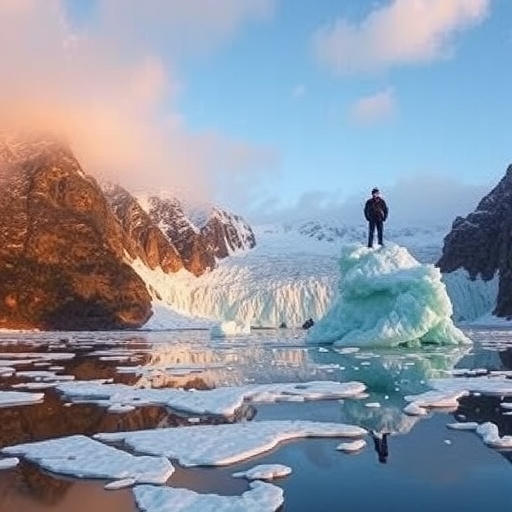
In the relentless quest to understand the dynamics of Earth’s ice sheets amid a warming climate, a groundbreaking study has emerged from Kalaallit Nunaat—more commonly known as Greenland—challenging longstanding assumptions about the mechanisms driving ice-sheet disintegration. Contrary to prior expectations, new research reveals that hydro-fracture processes on ice sheets are not notably advanced inland by the draining of lake water at lower elevations. This novel insight complicates the narrative of rapid glacial collapse and demands a recalibration of predictive models that have so far guided climate prognosis and sea-level rise forecasts.
At the heart of ice-sheet decay lies hydro-fracturing—a phenomenon where surface meltwater pools permeate through crevasses, deepening and widening these cracks until sections of the glacier calve or collapse. Scientists had postulated that the drainage of supraglacial lakes, especially those at lower elevations, would serve as efficient conduits, driving hydro-fracturing deeper and further inland, thereby accelerating ice-sheet retreat and destabilization. However, the meticulous observations and advanced modeling presented in this pioneering study convey a different reality. Instead of catalyzing inland ice-sheet fracture progression, lower-elevation lake drainages appear to exert little influence on the inland extension of hydro-fracturing zones.
This comprehensive study was executed with an interdisciplinary approach that combined high-resolution satellite imagery, in-situ measurements, and sophisticated computational models designed to simulate the physical processes at play. The focus was directed towards key catchments in Greenland, where the interplay between meltwater accumulation, lake drainage events, and fracture propagation could be accurately monitored over seasonal cycles. By integrating these diverse data streams, the researchers were able to disaggregate the factors contributing to hydro-fracture dynamics, unveiling complexities previously obscured in coarser, less-detailed analyses.
One profound implication of this discovery lies in the revised understanding of ice-sheet vulnerability to climate-induced melting. The prevailing consensus has leaned towards a rapidly intensifying feedback loop, where meltwater lakes proliferate and drain repeatedly, accelerating fracture propagation and ice loss. However, findings from Kalaallit Nunaat challenge this paradigm, illustrating that hydraulic connectivity resulting from lower-elevation lake drainages is insufficient to advance ice-sheet hydro-fracture significantly inland. Instead, hydro-fracturing may be governed predominantly by other factors such as ice thickness, basal conditions, and the intrinsic structural integrity of the glacier ice itself.
The study highlights the critical role of local topography and lake basin characteristics in modulating the impact of drainage events. Lower-elevation lakes are more confined by surrounding terrain or linked by fracture pathways that do not extend far inland, limiting their capacity to influence deeper ice-sheet regions. Moreover, the transient nature of these drainage events implies that the temporal window during which hydro-fracturing can be triggered is narrow, reducing the cumulative impact on ice-sheet stability across seasonal timescales.
To unravel these dynamics, the researchers developed novel diagnostic tools capable of detecting subtle fracture initiations and quantifying the propagation rate of hydro-fractures following lake drainage. These tools leveraged remote sensing data improved by machine learning algorithms that classified surface features and fracture morphology with unprecedented accuracy. This granular level of detail revealed that fracture growth is often arrested or deflected by variations in ice properties, such as crystal orientation fabric and impurity concentration, further complicating any direct link between lake drainage and inland fracture advancement.
The implications extend beyond glaciology, touching on oceanography and global sea-level rise projections. By clarifying that lower-elevation lake drainage is not a straightforward mechanism for accelerating ice-sheet destabilization, the study suggests that predicted rates of iceberg calving and mass loss may be overestimated in current climate models. This calls for recalibration, especially in dynamically coupled models that simulate physical interactions between the cryosphere, atmosphere, and ocean systems.
Importantly, the research also underscores the necessity of regional specificity in climate impact assessments. Greenland’s ice sheet is not a monolith; variations in elevation, surface hydrology, and ice mechanics create a mosaic of localized responses to melting and fracturing processes. The evidence from Kalaallit Nunaat provides a case study advocating for more fine-scaled parameterizations within global ice-sheet models, improving their precision and predictive value.
Furthermore, the findings provoke essential questions about the thresholds of hydro-fracture initiation and propagation. While lower-elevation lakes do not drive fracture inland, the role of higher-elevation or larger lakes remains to be fully quantified. The study opens avenues for targeted field campaigns to examine these variables and their interaction with other meltwater pathways such as moulins and englacial channels.
From a methodological perspective, the integration of multi-temporal satellite datasets with terrestrial observations marks a significant advancement in cryospheric research. This multi-modal approach enables validation of remote sensing inferences against direct ground-truthing, enhancing confidence in conclusions drawn and providing a robust framework for similar studies in other polar regions.
Hence, the study not only refines our fundamental understanding of ice-sheet hydro-fracture mechanics but also compels the scientific community to revisit long-held assumptions in cryosphere-climate feedback loops. It exemplifies the critical need for continued monitoring and innovative analytical techniques to disentangle the complex interactions governing ice-sheet behavior as Earth’s climate continues its unprecedented transformation.
In sum, this investigation into Greenland’s hydrological processes reframes the discourse on ice-sheet vulnerability and resilience. By demonstrating that lower-elevation lake drainages do not meaningfully advance hydro-fracture inland, the research adds a nuanced layer to predictions of ice mass loss, sea-level rise, and their subsequent impacts on global systems. This paradigm shift will undoubtedly influence future scientific inquiry and policy-making as humanity navigates the challenges of a warming world.
As the climate crisis escalates, such nuanced insights are invaluable, reminding us that Earth’s systems operate through intricate, often counterintuitive mechanisms. The knowledge that not all melting phenomena accelerate destabilization equally grants hope for more targeted mitigation strategies, leveraging the specificity of ice-sheet responses to better safeguard the polar cryosphere and its global ramifications.
In the rapidly evolving field of glaciology, this study exemplifies how persistent inquiry and refined technology converge to challenge dogma and reveal deeper truths. It invites a reevaluation of the feedback models that have shaped climate response plans and fosters a more precise comprehension of the pathways by which meltwater influences ice-sheet integrity.
Future research inspired by these findings will likely focus on the detailed characterization of lake drainage from varying elevations, the interaction of fracture mechanics with basal hydrology, and the integration of climate forcing scenarios into ice-sheet stability models. Together, these endeavors aim to construct a comprehensive and accurate picture of Greenland’s cryospheric future—essential knowledge as humanity prepares for the environmental transformations that lie ahead.
Cite Scienmag News
Violet Maxwell. (May 27, 2026). Ice-Sheet Hydro-Fracture Halted by Low-Elevation Lakes. Scienmag. https://scienmag.com/ice-sheet-hydro-fracture-halted-by-low-elevation-lakes/
Violet Maxwell. "Ice-Sheet Hydro-Fracture Halted by Low-Elevation Lakes." Scienmag, 27 May 2026, https://scienmag.com/ice-sheet-hydro-fracture-halted-by-low-elevation-lakes/. Accessed 3 September 2026.
Violet Maxwell. "Ice-Sheet Hydro-Fracture Halted by Low-Elevation Lakes." Scienmag. May 27, 2026. https://scienmag.com/ice-sheet-hydro-fracture-halted-by-low-elevation-lakes/


