


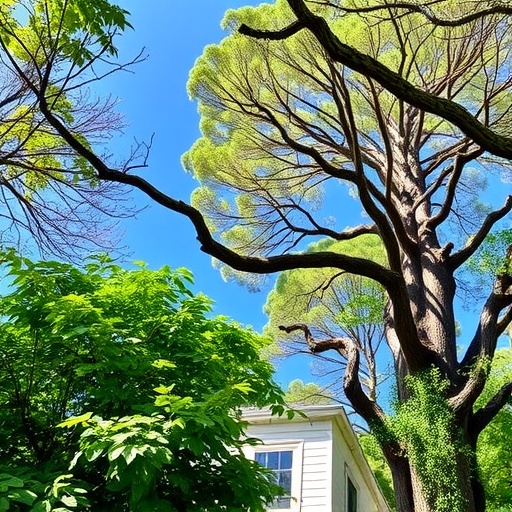
Urban trees are widely seen as natural air purifiers, cooling streets while capturing particles and absorbing gaseous pollutants. But new measurements from Beijing suggest that the choice of tree species may influence urban air quality in a far more complicated way. Researchers have found that trees can release highly reactive gases that, under hot and sunny conditions, help drive the formation of ground-level ozone, a pollutant linked to respiratory disease and reduced lung function. The findings indicate that urban greening programs could unintentionally worsen ozone pollution if they rely heavily on tree species that emit large quantities of isoprene.
The study, conducted by researchers at Jinan University in China in collaboration with the University of Innsbruck in Austria, is among the few investigations to directly measure volatile organic compounds released within a real city environment. Instead of estimating emissions from vegetation using models designed mainly for forests and other natural ecosystems, the researchers monitored Beijing’s atmosphere from a 102-meter platform on the Beijing Meteorological Tower and from a laboratory at its base. Between May and July 2021, their instruments recorded chemical signals and atmospheric turbulence ten times every second, allowing the team to observe how the city’s emissions changed with temperature, sunlight, wind and human activity.
The scientists measured volatile organic compounds, or VOCs, a broad family of carbon-based gases released by vegetation, fuels, solvents, paints, cleaning products, cooking and other sources. Human-made VOCs, often called anthropogenic VOCs, have traditionally received much of the attention in air-pollution policy because they react with nitrogen oxides, or NOx, in sunlight to produce ozone. Yet plants also emit biogenic VOCs, known as BVOCs. These natural emissions are not pollutants in the same way in every environment, but some are extremely reactive in the atmosphere. Their significance may increase as cities become greener, temperatures rise and regulations reduce emissions from vehicles, industry and consumer products.
The Beijing measurements revealed a striking difference between the quantity of emissions and their chemical impact. Biogenic sources accounted for only about one-tenth of the VOCs measured by the researchers, while contributing nearly half of the total VOC reactivity. Reactivity describes how readily a compound participates in atmospheric chemical reactions, and it is often more important for ozone formation than the sheer mass of emissions. The dominant compound was isoprene, a small hydrocarbon released by many plants. Although isoprene represented only one component of the city’s overall emissions, it accounted for more than 90 percent of the chemical reactivity associated with the biogenic VOCs detected in the study.
Temperature amplified the effect dramatically. As temperatures rose from 20 degrees Celsius to 35 degrees Celsius, the chemical reactivity of VOCs released by urban vegetation increased approximately seven- to eightfold. By comparison, the reactivity of VOCs from human sources rose by about 40 percent, or 1.4 times, over the same temperature range. As a result, the share of total VOC reactivity attributed to vegetation climbed from 21 percent at cooler conditions to 74 percent during the hottest conditions. This temperature sensitivity is consistent with the biology of isoprene-producing plants: warmer conditions accelerate the biochemical processes that generate isoprene, while sunlight supplies the energy needed for its production and release.
The atmospheric chemistry becomes especially important when NOx is present. Ozone is not emitted directly by trees or traffic; it forms through a chain of reactions involving VOCs, nitrogen oxides and sunlight. Isoprene can react rapidly with atmospheric oxidants, producing intermediate compounds that alter the chemical cycling of nitrogen oxides and promote ozone formation under suitable conditions. The relationship is nonlinear, meaning that the effect of additional VOCs depends on the existing balance between VOCs, NOx, sunlight and other atmospheric constituents. In the Beijing observations, the researchers found that on days when ozone production was particularly sensitive to changes in VOCs, peak ozone concentrations increased with temperature at nearly the same rate as the reactivity of vegetation emissions. That parallel strongly supports a connection between heat-enhanced tree emissions and elevated ozone.
The researchers next compared Beijing with direct measurements from other cities, adjusting the results for differences in temperature and sunlight. Beijing’s isoprene emissions were the highest among the urban areas examined and approached levels measured in temperate forests. The result could not be explained simply by the amount of greenery. Several cities had similar levels of vegetation but emitted far less isoprene. By examining tree inventories and vegetation data from more than 20 cities, the team identified tree composition as a major factor. Approximately 35 percent of Beijing’s trees belong to species capable of emitting isoprene, including weeping willow and Chinese white poplar. Across the cities included in the comparison, isoprene emissions varied by more than tenfold and closely followed the proportion of high-emitting tree species.
The findings may be particularly relevant for rapidly expanding cities in Asia and Oceania, where urban forests are growing under increasingly hot conditions. Thomas Karl, an atmospheric physicist at the University of Innsbruck and a co-author of the study, noted that European cities generally contain fewer tree species that emit large amounts of isoprene. Native European species often release monoterpenes, another group of BVOCs that can contribute to ozone formation and other atmospheric reactions, but usually in smaller quantities than isoprene. The comparison suggests that the air-quality consequences of urban greening cannot be assessed from canopy cover alone. Two cities with the same number of trees may have very different atmospheric effects depending on which species dominate their streets, parks and residential neighborhoods.
The authors emphasize that the results are not an argument for removing mature trees or reducing urban vegetation. Trees provide essential benefits, including shade, cooling, carbon storage, habitat and the removal of airborne particles. Instead, the study points toward a more detailed approach to urban planning in which the BVOC emission potential of tree species is considered alongside water requirements, heat tolerance, biodiversity, maintenance costs and resilience to pests. In Beijing, the researchers estimate that replacing high-emitting trees in just one-tenth of the city’s total urban tree population with low-emitting species during routine renewal could reduce isoprene emissions by at least 29 percent. Such a gradual strategy would avoid the ecological and social costs of wholesale tree removal while making future plantings more compatible with air-quality goals.
The study also reinforces the continuing importance of controlling NOx emissions. Even highly reactive plant emissions cannot produce large amounts of ozone without nitrogen oxides and sunlight, and the chemistry varies from one urban atmosphere to another. Cleaner vehicles, industrial controls and reductions in combustion-related NOx therefore remain central to ozone policy, particularly during heatwaves. At the same time, a warming climate may increase the release of reactive BVOCs precisely when sunlight and stagnant air already favor ozone accumulation. By combining direct atmospheric measurements with detailed knowledge of urban tree inventories, the researchers show why the future of clean, climate-resilient cities may depend not only on planting more trees, but on planting the right trees in the right places.
News Publication Date: 19-Aug-2026
Web References: https://doi.org/10.1126/sciadv.aee5583
References: Science Advances, DOI: 10.1126/sciadv.aee5583
Cite Scienmag News
Russell Cooper. (August 19, 2026). Tree Species Choices Significantly Influence Urban Air Quality. Scienmag. https://scienmag.com/tree-species-choices-significantly-influence-urban-air-quality/
Russell Cooper. "Tree Species Choices Significantly Influence Urban Air Quality." Scienmag, 19 August 2026, https://scienmag.com/tree-species-choices-significantly-influence-urban-air-quality/. Accessed 4 September 2026.
Russell Cooper. "Tree Species Choices Significantly Influence Urban Air Quality." Scienmag. August 19, 2026. https://scienmag.com/tree-species-choices-significantly-influence-urban-air-quality/


