


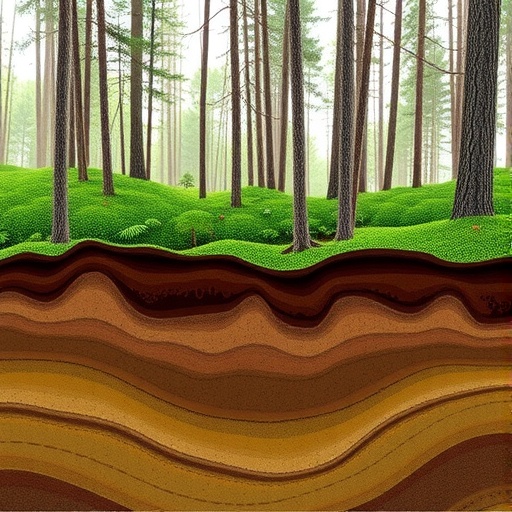
As rising seas push salty water further inland, the forests that line the coast are quietly drowning—not just above ground, where dead and dying trees form eerie “ghost forests” visible from space, but below ground, in a hidden world of microbes, minerals, and dissolved gases whose response to flooding may determine whether these ecosystems survive or collapse. A new study, published in the journal Biogeochemistry, reveals that the chemistry of floodwater itself—not merely the fact of inundation—shapes how these soils release greenhouse gases and lose their stored carbon. The findings suggest that brackish intrusion may push upland coastal forests toward ecological transition faster than freshwater flooding alone.
An international team led by Rosmery Cruz-O’Byrne, Ashleigh Montgomery, Angelia Seyfferth, and Rodrigo Vargas, spanning Arizona State University, the University of Delaware, Pacific Northwest National Laboratory, and the Smithsonian Environmental Research Center, set out to answer a deceptively simple question: when a coastal forest soil is flooded repeatedly, does it matter whether the water is fresh or salty? The answer, the researchers found, is a resounding yes—and the consequences extend from the fate of soil carbon to the emission of methane and nitrous oxide, two of the most potent greenhouse gases in the atmosphere.
Sea level rise and intensifying storm surges are among the most tangible fingerprints of climate change along the world’s coastlines. In regions such as the mid-Atlantic United States, low-relief coastal plains mean that even modest increases in sea level translate into saltwater pushing far up creeks and into the shallow groundwater beneath forests that evolved under freshwater conditions. The visible toll is well documented: tens of thousands of hectares of formerly forested land have already converted to marsh or open water in the Chesapeake Bay region alone. But the early stages of this transition—the first soil-scale battles fought between oxygen and oxygen-starved microbes—have remained largely invisible to science, even as they determine how much carbon is retained and how much greenhouse gas escapes.
To probe this hidden realm, the team conducted a mesocosm flow-through incubation experiment using intact soil monoliths—cylindrical cores of soil, 22 centimeters deep and 22 centimeters in diameter—extracted from a temperate upland coastal forest. Crucially, the researchers kept the soil architecture intact rather than homogenizing samples, preserving the natural layering of organic matter, roots, and minerals that governs how water, gases, and nutrients move through the profile. The monoliths were subjected to repeated pulses of either freshwater or brackish water, simulating the episodic flooding events that increasingly batter coastal forests during storms and king tides.
The experimental design allowed for continuous, high-frequency measurement of the three major greenhouse gases—carbon dioxide, methane, and nitrous oxide—fluxing from the soil surface. At the same time, the researchers sampled porewater, the water held within the soil’s pore spaces, tracking a veritable arsenal of chemical indicators: dissolved organic and inorganic carbon, chromophoric dissolved organic matter (CDOM), sulfate, sulfide (HS⁻), ferrous iron (Fe²⁺), manganese (Mn²⁺), ammonium, nitrate plus nitrite, pH, and the redox potential (Eh), which measures how chemically reducing—or oxygen-starved—the soil environment has become. To interrogate the soil’s solid phase, they applied Fourier-transform infrared spectroscopy (FTIR), a technique that identifies the organic functional groups—polysaccharides, aromatic compounds, and nitrogen- or sulfur-bearing moieties—attached to soil particles.
The results painted two strikingly divergent pictures. Freshwater flooding disturbed the soils, but the brackish water treatments left deeper and more lasting scars. Soils that had received brackish pulses showed stronger “legacy effects”—a term the researchers use to describe changes that persisted after the floodwaters receded—manifesting as more intensely reducing conditions, elevated fluxes of both methane and nitrous oxide, and chemically altered soil organic matter. In other words, the salty water didn’t just perturb the system temporarily; it reprogrammed it.
One of the most intriguing findings concerns methane, a greenhouse gas with more than 80 times the warming power of carbon dioxide over a twenty-year horizon. Elevated concentrations of hydrogen sulfide in the porewater, combined with the isotopic signature of the emitted methane—measured as δ¹³C-CH₄—revealed that two anaerobic processes were occurring simultaneously: sulfate reduction and methanogenesis. Typically, sulfate reducers outcompete methanogens for substrate, suppressing methane production in marine sediments. But in these flooded forest soils, the two processes coexisted, and the isotopic data pointed to a methylotrophic pathway for methane production—meaning the methanogens were building methane from single-carbon compounds like methanol and methylamines rather than from the conventional acetate or carbon dioxide-hydrogen routes. This is a relatively underappreciated mechanism, and its prominence here suggests that brackish flooding reshapes not only how much methane is produced but how.
The nitrogen story proved equally consequential. The researchers observed simultaneous accumulation of ammonium and nitrous oxide in the brackish treatments, a combination that points to a tangle of interacting processes. These include dissimilatory nitrate reduction to ammonium—a pathway in which microbes convert nitrate all the way back to ammonium rather than to nitrogen gas—alongside the desorption of ammonium from soil exchange sites as brackish cations displaced it, and incomplete denitrification that terminated at nitrous oxide instead of benign nitrogen gas. Each of these processes means that nitrogen, which normally cycles tightly within forest soils, becomes mobilized and, in part, escapes to the atmosphere as a potent greenhouse agent.
Perhaps most significant for the global carbon balance is what happened to the soil’s mineral-organic partnerships. In healthy upland soils, organic carbon is often locked away through organo-mineral associations—chemical bonds and electrostatic attractions that bind dissolved organic molecules to iron oxides, clay minerals, and other reactive surfaces, shielding them from microbial decomposition for decades to centuries. The study found that brackish flooding destabilized these associations, releasing ferrous iron, manganese, and dissolved organic carbon into the porewater. The mechanism is familiar from ocean chemistry: sulfate in seawater is reduced to sulfide under anoxic conditions, and sulfide reacts with iron oxides, dismantling the very structures that protect soil carbon. As those bonds break, carbon that had been safe from microbes is flushed into the water column, where it can be respired to carbon dioxide or methane, or exported to coastal waters.
The spectroscopic evidence deepened the picture. FTIR analysis revealed the degradation of polysaccharides—relatively labile plant-derived compounds—and the incorporation of sulfur- and nitrogen-containing functional groups into the soil organic matter, a chemical fingerprint of the new, brackish-influenced conditions. Meanwhile, optical indices of the dissolved organic matter indicated that the remaining carbon pool had shifted toward smaller, more aromatic degradation products and a composition that is less humified and more microbially derived—essentially, the organic matter released from disrupted complexes bore the signature of microbial reworking rather than the stable, plant-derived humus of a healthy forest soil.
Taken together, these findings carry sobering implications. The vulnerability of upland coastal forest soils to repeated inundation is not uniform; it depends critically on the chemistry of the invading water. Brackish intrusion triggers a cascade of feedbacks—sulfide-driven iron reduction, methanogenesis via methylotrophic routes, nitrogen mobilization, and carbon release from organo-mineral shields—that destabilize soil carbon stocks and may accelerate the broader ecosystem transition from forest to marsh. Because these legacy effects persist beyond individual flooding events, each storm surge or salt intrusion event may erode the soil’s resilience a little further, priming it for greater greenhouse gas emissions during the next flood.
As coastal populations brace for more frequent flooding, this study reminds us that the most consequential changes may be happening beneath our feet—in the quiet chemistry of soil porewater, where the fate of carbon, nitrogen, and the climate itself is being negotiated one flood at a time.
Cite Scienmag News
Bethany Barker. (September 4, 2026). Coastal forest soils respond differently to repeated flooding and changing water chemistry. Scienmag. https://scienmag.com/coastal-forest-soils-respond-differently-to-repeated-flooding-and-changing-water-chemistry/
Bethany Barker. "Coastal forest soils respond differently to repeated flooding and changing water chemistry." Scienmag, 4 September 2026, https://scienmag.com/coastal-forest-soils-respond-differently-to-repeated-flooding-and-changing-water-chemistry/. Accessed 4 September 2026.
Bethany Barker. "Coastal forest soils respond differently to repeated flooding and changing water chemistry." Scienmag. September 4, 2026. https://scienmag.com/coastal-forest-soils-respond-differently-to-repeated-flooding-and-changing-water-chemistry/


