


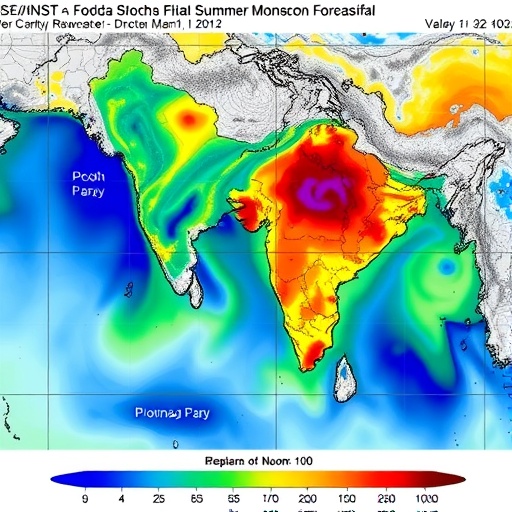
The Indian summer monsoon has long been one of the most consequential and most stubbornly difficult climate phenomena on Earth to predict beyond a single season. Now, a new study published in Theoretical and Applied Climatology reports that decadal climate prediction systems, when properly initialized with the observed state of the ocean, can extract meaningful forecast skill for Indian Summer Monsoon Rainfall (ISMR) on timescales of up to ten years—a horizon at which rainfall has traditionally been considered essentially unknowable. The research, carried out by Suneet Dwivedi and Mudit of the K Banerjee Centre of Atmospheric and Ocean Studies at the University of Allahabad together with B. N. Goswami of the ST Radar Centre at Gauhati University, offers a technical reassessment of how far the predictability of monsoon rainfall can realistically be stretched, and it delivers a message with substantial implications for agriculture, water resource management, and economic planning across the Indian subcontinent.
The study hinges on a comparison between two fundamentally different kinds of climate model experiment. The first is the archive of hindcasts produced under the Decadal Climate Prediction Project, or DCPP, a component of the Coupled Model Intercomparison Project Phase 6 (CMIP6). In these experiments, coupled atmosphere-ocean climate models are started not from arbitrary initial conditions but from estimates of the actual observed climate state at a particular year—typically with the ocean temperature and salinity fields nudged toward observations. The second kind is the standard uninitialized CMIP6 simulation, in which models run freely from preindustrial or historical starting points with no attempt to synchronize their internal variability with the real world. Uninitialized projections capture only the response of the climate system to external forcings—natural drivers such as solar variability and volcanic eruptions, and anthropogenic drivers such as rising greenhouse gas concentrations and aerosol emissions—while treating internal climate variability as chaotic noise. The DCPP hindcasts, by contrast, gamble that some of that internal variability, particularly the slow memory stored in the ocean, is predictable if the model is set on the right initial footing.
The verdict of the comparison is unambiguous. When Dwivedi and colleagues measured the correlation between predicted and observed decadal fluctuations of ISMR, the initialized DCPP hindcasts outperformed the uninitialized CMIP6 simulations across large and economically vital portions of India. The improvement in skill was significant over the northwest, west-central, central, and northeast regions of the country, the very zones where monsoon rainfall variability most directly modulates crop yields, reservoir levels, and rural livelihoods. In practical terms, the result suggests that a substantial fraction of the decade-to-decade swings in monsoon rainfall—swings that farmers and water managers experience as the difference between bumper harvests and drought—may be locked into the slowly evolving ocean-atmosphere system in a way that initialization can reveal.
The ocean is central to this story. The North Atlantic, the tropical Indian Ocean, and the Pacific all store heat and redistribute it on timescales of years to decades, and these slow oceanic modes imprint themselves on the atmospheric circulation that organizes monsoon rainfall. Earlier work has shown that ocean initialization improves decadal prediction of North Atlantic sea surface temperature, ocean heat content, and regional rainfall in places as far-flung as the Sahel and Northeast Asia. What the new study adds is a systematic demonstration, using the CMIP6-era DCPP archive and observational rainfall datasets such as those from the Global Precipitation Climatology Centre, that the same mechanism extends to the Indian monsoon—an object whose rainfall is dominated by intense, small-scale convection and by teleconnections to phenomena like the El Niño-Southern Oscillation and the Indian Ocean Dipole, both of which have historically eroded confidence in long-lead forecasts.
Yet the study also uncovers a troubling and technically important caveat: the DCPP hindcasts of ISMR are overconfident on the decadal timescale. The researchers found that the correlation between individual ensemble members of the same hindcast experiment—essentially, how well one model realization predicts another realization started from nearly identical conditions—was considerably better than the correlation between those same realizations and the actual observations. This gap is the signature of a model that has more coherence with itself than with the real world. In forecast verification terms, the models are unrealistically internally consistent: their internal variability is more reproducible and more strongly predictable within the model’s own dynamical framework than the observed variability is in nature. An overconfident prediction system of this kind can produce beautifully precise-looking decadal forecasts whose actual reliability is lower than the ensemble spread implies. This echoes a broader finding in the decadal prediction literature, where questions about whether seasonal-to-decadal systems underestimate the predictability of the real world—or, in some formulations, overestimate their own—remain actively debated.
The overconfidence finding matters for how decadal monsoon forecasts should ultimately be used. A perfect-prog framework in which model-internal predictability is taken as a proxy for real-world predictability would systematically overstate the value of initialized forecasts for ISMR. Corrections that calibrate the forecast distribution against observations, or verification approaches that account for the forecast-observation correlation structure, become essential if decadal monsoon information is ever to underpin operational climate services. The authors frame their work in precisely this context: the potential of DCPP hindcasts to enhance decadal predictability of ISMR is real, but it must be quantified honestly before it can be translated into products that farmers, reservoir operators, and insurers can act upon.
A second, subtler contribution of the paper lies in its dissection of the relative roles of initialization and external forcing. Short-term climate projections from coupled models have traditionally been built on the assumption that the predictable component at these timescales comes almost entirely from the imposed forcing trajectory—the gradual warming driven by greenhouse gases, the episodic cooling from volcanic eruptions, the modulation by solar variability, and the regional effects of anthropogenic aerosols. Internal variability, by this conventional view, is noise to be averaged away over large ensembles, not signal to be forecast. The new results directly challenge that framing for the Indian monsoon. By demonstrating that initialized hindcasts beat uninitialized simulations even after the forced component is accounted for, the study shows that a predictable signal can be extracted from internal variability itself, provided the model is initialized with an accurate picture of the ocean state. The ocean’s heat content and circulation anomalies evolve slowly enough that their influence on the following several monsoon seasons is, to a meaningful degree, deterministic rather than random.
The methodology behind such a conclusion is demanding. Decadal hindcast experiments are launched at regular intervals—typically every year or every five years—and run forward for up to a decade with multiple ensemble members per start date, allowing the skill of year-one through year-ten forecasts to be evaluated against observed rainfall. Verification frameworks for interannual-to-decadal prediction, developed over the past decade and a half, provide the statistical machinery: anomaly correlations computed after removing the model mean bias, comparisons against both observations and uninitialized control runs, and careful treatment of drift, the tendency of initialized models to relax back toward their own preferred climate in the first few forecast years. The University of Allahabad team applied this apparatus to regional monsoon rainfall, a variable that is far noisier and harder to verify than the sea surface temperatures over which most decadal prediction skill assessments have historically been performed.
The stakes of getting monsoon decadal prediction right are hard to overstate. India’s economy remains deeply sensitive to the summer monsoon, which delivers the bulk of the annual rainfall that sustains agriculture, hydropower, and drinking water supplies for well over a billion people. Seasonal forecasting of ISMR has improved in recent years but remains limited, and skillful information at the multi-year horizon would open planning possibilities—crop diversification strategies, reservoir management schedules, drought preparedness—that no seasonal forecast can support. Decadal-scale predictability of the monsoon has also been a matter of scientific controversy, with studies pointing to potential multi-decadal variability in ISMR and to teleconnections with North Atlantic sea surface temperatures, the Interdecadal Pacific Oscillation, and Eurasian snow cover, all of which carry decadal memory. The new work provides the first CMIP6-era, DCPP-based quantification of how much of that memory can actually be converted into forecast skill over Indian regions.
The researchers are careful to position their findings as a demonstration of potential rather than a finished operational capability. The ensemble members of the DCPP hindcasts agree with one another better than with reality, which means the skill numbers must be interpreted with the overconfidence caveat in mind. Initialization techniques themselves remain an active research frontier: full-field initialization, anomaly initialization, and various schemes for assimilating ocean observations each carry trade-offs, and initialization shocks—transient errors introduced when observations are thrust into a model whose state is inconsistent with them—can temporarily degrade forecasts, particularly in the North Atlantic. Which initialization strategy best serves monsoon prediction specifically is a question the authors’ results sharpen but do not fully resolve.
Nevertheless, the central message stands and is likely to reverberate through both the climate prediction community and the growing climate services sector. The Indian summer monsoon, long treated as the archetype of climatic chaos at multi-year horizons, is not entirely chaotic after all. A portion of its decade-scale variability is anchored in the ocean, retrievable through careful initialization, and therefore forecastable. With improved ocean initialization strategies, continued model development, and honest calibration of overconfident ensembles, decadal predictions of ISMR could move from the research frontier into the toolkit of planners entrusted with securing India’s water and food future.
Cite Scienmag News
Violet Maxwell. (September 3, 2026). Decadal predictions show skill for Indian summer monsoon rainfall forecasting. Scienmag. https://scienmag.com/decadal-predictions-show-skill-for-indian-summer-monsoon-rainfall-forecasting/
Violet Maxwell. "Decadal predictions show skill for Indian summer monsoon rainfall forecasting." Scienmag, 3 September 2026, https://scienmag.com/decadal-predictions-show-skill-for-indian-summer-monsoon-rainfall-forecasting/. Accessed 3 September 2026.
Violet Maxwell. "Decadal predictions show skill for Indian summer monsoon rainfall forecasting." Scienmag. September 3, 2026. https://scienmag.com/decadal-predictions-show-skill-for-indian-summer-monsoon-rainfall-forecasting/


