


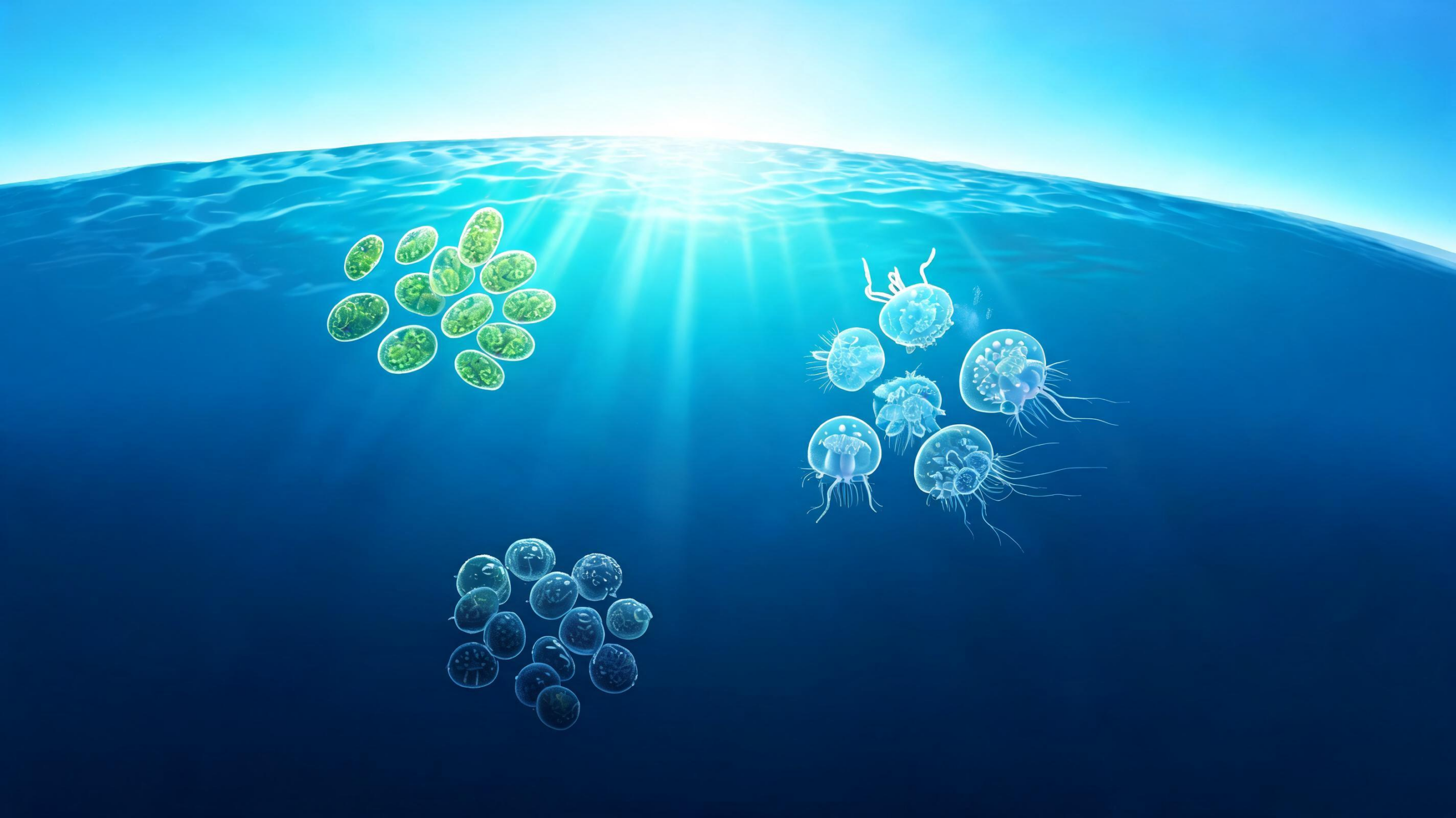
In the sunlit layers of the world ocean, a remarkable group of microscopic organisms quietly blurs the boundary between plant and animal. Known as mixoplankton, these single-celled protists can both photosynthesize like algae and engulf prey like predators, and a new global analysis has now mapped, with unprecedented breadth, where each of their distinct functional types lives and why. By combining tens of thousands of DNA sequences from across the planet with machine learning and classical oceanographic statistics, an international research team has shown that these versatile microbes are not ecological curiosities at the margins of marine food webs but ubiquitous, environmentally structured players whose distributions follow temperature, salinity, and nutrient gradients with striking consistency.
The study, published in the journal Ocean Microbiology, drew on the metaPR2 database, a curated collection of processed 18S rRNA gene metabarcodes from more than forty studies spanning thousands of samples worldwide. The researchers classified roughly 47,000 marine protist amplicon sequence variants, or ASVs, into functional categories using the Mixoplankton Database, a resource that catalogues known mixotrophic species and their trophic strategies. Four mixoplankton types emerged as the focus of the analysis: constitutive mixoplankton, which build their own chloroplasts; generalist non-constitutive mixoplankton, which steal chloroplasts from a broad range of prey; plastidic specialist non-constitutive mixoplankton, which selectively retain plastids and even nuclear material from specific prey for weeks or months; and endosymbiotic specialist non-constitutive mixoplankton, which harbor long-term photosynthetic symbionts inside their cells.
These distinctions matter because each strategy carries different physiological costs and ecological consequences. Constitutive mixoplankton, which include familiar dinoflagellate and haptophyte genera such as Alexandrium, Karlodinium, and Karenia, can photosynthesize continuously while opportunistically consuming prey. Generalists of the non-constitutive kind, such as ciliates in the genera Strombidium and Laboea, must feed frequently, on scales of hours to days, because their stolen plastids degrade quickly. Plastidic specialists such as Mesodinium and Dinophysis can maintain sequestered photosynthetic machinery for extended periods, while endosymbiotic specialists like Ornithocercus and the green form of Noctiluca scintillans sustain stable partnerships with algal cells that contribute sugars and recycle nutrients derived from prey digestion.
After filtering the data to euphotic-zone samples, those from the upper 200 meters where light penetrates, the final dataset comprised nearly 44,000 ASVs and more than 366 million reads from 4,190 samples reaching latitudes from roughly 74 degrees south to 89 degrees north. Mixoplankton appeared in 94 percent of the samples, confirming their global ubiquity. Overall, mixoplankton accounted for about 7 percent of protist ASVs, corresponding to 3,537 sequence variants and 192 species, which represents some 44 percent of the species listed in the Mixoplankton Database. Protozooplankton and parasites dominated the ASV counts at 38 and 24 percent respectively, while diatoms made up 8 percent and other phytoplankton 22 percent.
To untangle the patterns hidden within this enormous dataset, the team turned to self-organizing maps, an unsupervised machine learning technique that condenses thousands of ASV abundance profiles into two-dimensional neuronal grids that can then be hierarchically clustered. Because sequencing methodology, particularly the choice between the V4 and V9 hypervariable regions of the 18S rRNA gene and the seawater filtration strategy, strongly shapes recovered community composition, the researchers deliberately analyzed separate subdatasets defined by consistent methods rather than pooling everything together. The clustering, applied independently to three subdatasets, each explained between 75 and 78 percent of total variance and produced community groupings that aligned with four major oceanic biomes: polar, subpolar to temperate, temperate to subtropical, and subtropical to tropical.
Those biome assignments were far from arbitrary. Principal component ordination and temperature-salinity-nitrate diagrams showed that the machine learning clusters ordered themselves consistently along environmental gradients of temperature, salinity, and nitrate concentration, with statistical tests confirming significant differences among clusters. Polar and subpolar communities were associated with the coldest waters and highest nitrate levels, while temperate, subtropical, and tropical communities corresponded with warmer, nutrient-poor conditions. Salinity played a comparatively weaker structural role, likely because it varies over a relatively narrow range in marine waters. The resulting biogeography matched classical oceanographic regions described in earlier plankton studies, lending confidence to the approach.
Within this framework, each mixoplankton functional type revealed its own ecological signature. Constitutive mixoplankton were broadly distributed across all biomes and showed distributional patterns closely paralleling those of non-diatom phytoplankton, suggesting either functional overlap or shared resource use between the two groups. Generalized additive models, which can capture non-linear relationships, showed that constitutive mixoplankton reached high relative abundances across a wide temperature span from near zero to 30 degrees Celsius, typical oceanic salinities, and low nitrate concentrations, consistent with the idea that mixotrophy confers a competitive advantage when dissolved nutrients are scarce. Endosymbiotic specialists, by contrast, were restricted to warmer subpolar through tropical waters and were largely absent from polar regions, with more than 88 percent of their sequence variants in one subdataset belonging to Collodaria, radiolarian colonies characteristic of oligotrophic open oceans.
The remaining two mixotypes were scarcer but ecologically revealing. Generalist non-constitutive mixoplankton, the least abundant group, consistently co-occurred with diatoms and extended into nitrate-rich regimes of 20 to 30 micromolar, echoing their dependence on frequent ingestion of phototrophic prey that flourish in productive waters; they were also detected in upwelling zones such as the equatorial Pacific and the Agulhas Current. Plastidic specialists spanned all biomes but were sparse, and in this study appeared in lower-nutrient conditions than previously reported, a shift the authors attribute to seasonal sampling differences and the capacity of retained plastids to sustain photosynthesis across varying nutrient regimes. Diatoms themselves, the only protists confidently confirmed as strictly phototrophic, were predominantly tied to cold, nitrate-rich waters, while protozooplankton and parasites displayed trends generally inverse to those of the mixoplankton, hinting at partitioned consumer niches and host-driven distributions.
The analysis also exposed how profoundly methodological choices shape what scientists see. Mixoplankton richness and relative abundance were, respectively, threefold and sixfold higher in the V9 dataset than in the V4 dataset, largely because the Tara Oceans V9 data captured radiolarians whose exceptionally high rRNA gene copy numbers are differentially amplified by the two marker regions. Comparisons of samples sequenced with both markers showed roughly 60 percent species overlap and significantly correlated abundances, yet one endosymbiotic radiolarian, Collozoum amoeboides, appeared three orders of magnitude more abundant in V9 than in V4. Filtration strategy added further complications, since fragile cells can be disrupted during size fractionation while unfractionated samples can mask rarer groups. The authors stress that these discrepancies do not undermine the conclusions but underscore the need for careful, method-aware interpretation.
By placing mixoplankton within the full context of marine protistan communities at a global scale, the study delivers the first community-level assessment of mixoplankton biogeography relative to co-occurring functional types, and it establishes an empirical foundation for incorporating these organisms into predictive models of marine ecosystem dynamics. The researchers argue that future work should prioritize targeted detection of the underrepresented generalist and plastidic specialist types, whose sparse detection partly reflects their small numbers of known species and the fragility of their cells, and should embrace emerging transcriptomic machine learning methods that can infer trophic mode from gene expression in field communities. As oceans warm and nutrient cycles shift, knowing which mixoplankton strategies dominate where, and under what environmental conditions, may prove essential for forecasting how marine food webs and biogeochemical cycles will respond.
The recognition of mixoplankton as a distinct ecological category represents a relatively recent shift in plankton science. For much of the twentieth century, marine protists were sorted into a simple dichotomy of phytoplankton and zooplankton, an arrangement that implicitly assumed photosynthesis and phagotrophy were mutually exclusive trophic modes. Observations of planktonic ciliates carrying algal plastids and dinoflagellates consuming prey date back more than a century, but only with the development of trait-based frameworks and curated databases has the full diversity of these strategies become systematically catalogued.
The ecological stakes of this reclassification are considerable. Because mixoplankton can acquire nutrients through both dissolved uptake and prey ingestion, they occupy a flexible position in microbial food webs, capable of acting as primary producers when inorganic nutrients are scarce and as grazers when prey are abundant. This dual capacity influences how carbon and nitrogen move through planktonic communities, and models that omit mixotrophy risk misallocating energy flow and nutrient recycling pathways.
The global niche patterns documented in the study also carry implications for a changing ocean. As surface waters warm and stratification intensifies, nutrient supply to the euphotic zone is expected to decline in many regions, conditions that favor organisms able to supplement photosynthesis with feeding. The observed affinity of constitutive mixoplankton for warm, oligotrophic waters, and of endosymbiotic specialists for tropical and subtropical biomes, suggests that these groups may expand as such conditions become more widespread, potentially reshaping community composition and the efficiency of biological carbon export.
Equally important is the methodological legacy of the work. By demonstrating that marker gene choice and sample processing measurably alter perceived mixoplankton abundance, the analysis provides a cautionary benchmark for future metabarcoding surveys and underscores the value of standardized, method-aware databases for tracking marine biodiversity over time.
Subject of Research: Environmental structuring of mixoplankton functional types within marine protist communities: a global analysis
Article Title: Environmental structuring of mixoplankton functional types within marine protist communities: a global analysis
Article References: Larsson, M. E., Leles, S. G., Mitra, A., Faure, E., Vaulot, D., & Santoferrera, L. (2026). Environmental structuring of mixoplankton functional types within marine protist communities: a global analysis. Ocean Microbiology, 2(1), Article 1. https://doi.org/10.1186/s44375-026-00007-3
Image Credits: AI Generated
DOI: 10.1186/s44375-026-00007-3
Keywords: Environmental, structuring, mixoplankton, functional, types, within, marine, protist, communities, global, analysis, scientific research
Cite Scienmag News
Violet Maxwell. (September 3, 2026). Environmental structuring of mixoplankton functional types within marine protist communities: a global analysis. Scienmag. https://scienmag.com/environmental-structuring-of-mixoplankton-functional-types-within-marine-protist-communities-a-global-analysis/
Violet Maxwell. "Environmental structuring of mixoplankton functional types within marine protist communities: a global analysis." Scienmag, 3 September 2026, https://scienmag.com/environmental-structuring-of-mixoplankton-functional-types-within-marine-protist-communities-a-global-analysis/. Accessed 5 October 2026.
Violet Maxwell. "Environmental structuring of mixoplankton functional types within marine protist communities: a global analysis." Scienmag. September 3, 2026. https://scienmag.com/environmental-structuring-of-mixoplankton-functional-types-within-marine-protist-communities-a-global-analysis/


