


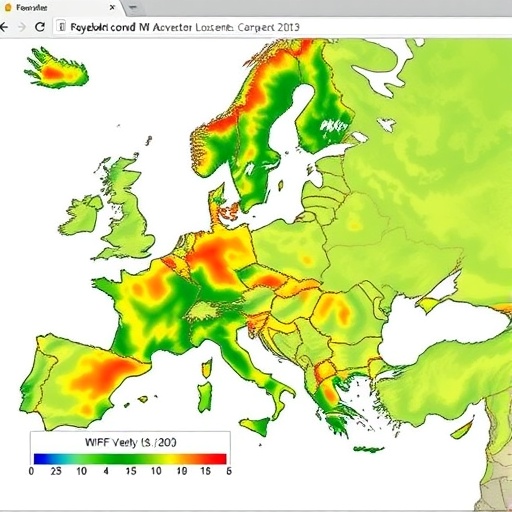
The Weather Research and Forecasting Model has long been one of the most powerful and widely used tools in atmospheric science, serving forecasters, researchers, educators, and operational centers around the world. But with that power comes complexity, and one of the most persistent sources of frustration for WRF users has never been the physics of the atmosphere itself. It has been the configuration files that must be prepared before the model can run at all. A new browser-based software environment called WRF Configuration Studio, described in the journal Earth Science Informatics, aims to tackle exactly that problem, offering scientists a graphical, web-based way to design model domains, edit namelists, manage data assimilation workflows, and inspect registry metadata without ever touching a terminal or a text editor.
WRF is a numerical weather prediction system that simulates atmospheric processes by solving the compressible, nonhydrostatic equations of fluid motion on a discretized grid. Because the model is designed to serve an extraordinary range of applications, from regional forecasting and hurricane research to wildfire-atmosphere coupling, air chemistry modeling, and hydrological prediction, its configuration surface is correspondingly vast. Before a single simulation can begin, a user must translate a scientific objective into a set of concrete technical choices: the geometry of the computational domain, the map projection on which that domain is drawn, the paths to static terrestrial datasets, the timing controls that govern integration steps, the parameterization schemes for physics processes, and the dynamical core settings that determine how the equations are solved.
Each of these choices lives in configuration files with strict syntax requirements. The WRF Preprocessing System, which prepares the static and meteorological input data for the model, reads a namelist.wps file. The model itself reads a namelist.input file containing hundreds of possible variables. Workflows that incorporate observational data require additional configuration for the WRF Data Assimilation system, known as WRFDA, and for the observation processing tool OBSPROC. Misplacing a comma, choosing an inconsistent time step, or defining a domain with incorrect nesting ratios can all lead to cryptic runtime errors that may take hours or days to diagnose, particularly for students and researchers new to the system.
WRF Configuration Studio addresses this friction point directly. Developed by William Hatheway, Jeremy T. Benik, and Jiří Richter, the software provides a complete configuration environment that runs entirely in a web browser. Its domain workflow allows users to interactively design the geographic regions over which WRF will compute its forecasts, selecting the grid dimensions, spatial resolution, and projection parameters visually rather than by typing coordinates into a text file. A notable feature for high-latitude work is the provision of dedicated Northern and Southern Hemisphere polar map views, including hemisphere-aware Polar Stereographic routing and projection-specific geographic reference overlays. This is a meaningful improvement for researchers configuring simulations over the Arctic or Antarctic, where projection handling is notoriously error-prone and where a poorly chosen true latitude or central meridian can distort domain geometry in subtle ways.
Beyond domain design, the studio covers the full breadth of WRF configuration. It offers WPS namelist editing, a complete-catalog editor for namelist.input that exposes the entire range of model settings, and dedicated support for WRFDA group visibility, allowing users to structure and inspect their data assimilation configurations graphically. It can also export observation-processing settings as namelist.obsproc files, preserving compatibility with the standard WRF observation pipeline. A Registry-derived metadata review feature gives users a way to examine the underlying variable definitions and structural metadata that the WRF model itself relies on, offering a level of transparency into the model’s internal configuration schema that has previously been accessible only to those willing to read the Fortran registry source directly.
Perhaps the most thoughtful design decision, according to the authors, is what the software does not do. WRF Configuration Studio deliberately positions itself as a configuration layer, not a replacement for the model or its official tools. It provides non-blocking compatibility guidance, warnings and suggestions that alert users to potential structural errors without preventing them from proceeding. Model execution, the scientific judgment behind physics scheme selection, and the validation of forecast results all remain firmly in the hands of the user and the official WRF-family tools maintained by the community. This separation of concerns means the studio cannot introduce the kind of silent, opinionated defaults that sometimes plague graphical front-ends, while still catching the preventable structural mistakes that waste so much computational and human time.
The software carries a distinguished pedigree. The authors explicitly trace a lineage back to the early graphical WRF Standard Initialization workflows developed at the National Oceanic and Atmospheric Administration’s Forecast Systems Laboratory, where a team including Paula McCaslin, John Smart, Brent Shaw, and Brian Jamison built one of the first graphical user interfaces for preparing WRF initial conditions in the early 2000s. That effort evolved into the WRF Domain Wizard, a Java-based graphical tool for designing WRF domains that accompanied the model for many years. WRF Configuration Studio continues this practical tradition while expanding its scope considerably, moving beyond domain generation into a comprehensive configuration environment spanning preprocessing, data assimilation, observation processing, and metadata review. Where earlier tools were desktop applications tied to specific platforms, the new studio’s browser-based delivery makes it accessible from any operating system without installation, a significant advantage for classroom use and for research groups working across heterogeneous computing environments.
The timing of such a tool is apt. Numerical weather prediction has undergone what researchers have called a quiet revolution over the past two decades, with models like WRF becoming foundational infrastructure for everything from national meteorological services to wildfire behavior prediction, volcanic ash cloud forecasting, and road icing indices for winter maintenance decision-making. The WRF community has grown to include thousands of users in academia, government, and industry, many of whom encounter the model’s configuration complexity as their first and steepest barrier to entry. Versions 3 and 4 of the Advanced Research WRF core, documented extensively in NCAR technical notes, introduced increasingly sophisticated dynamics and physics options, and the WRFDA variational and ensemble data assimilation system described in the Bulletin of the American Meteorological Society has become central to modern forecasting workflows. Every one of these capabilities multiplies the number of configuration decisions a user must make correctly.
WRF Configuration Studio version 1.0.0 is being released for public distribution through the project’s GitHub repository and a hosted GitHub Pages interface, meaning users can launch the tool directly in their browser with no local installation. The authors describe the release as self-funded and maintain that public access will be guaranteed no later than the publication of the article. The metadata architecture underlying the studio is derived from the WRF registry, the canonical definition of the model’s state variables and configuration structures, ensuring that the tool remains synchronized with the model’s own understanding of its settings rather than imposing a parallel, potentially divergent schema.
For educators, the implications are immediate. Courses in mesoscale meteorology and numerical weather prediction frequently require students to configure and run WRF simulations, and instructors report that configuration errors consume a disproportionate share of teaching time. A browser-based environment with visual domain design and guided namelist editing lowers that barrier substantially, allowing students to focus on the atmospheric science rather than on debugging file syntax. For operational forecasters, particularly those in smaller national services or in developing countries, the tool promises faster and more reliable setup of regional modeling systems, including the specialized high-latitude workflows that polar map views support.
The authors are careful to acknowledge limitations. The software improves configuration transparency and reduces preventable structural errors, but it cannot validate whether a chosen physics suite is scientifically appropriate for a given problem, whether a domain is large enough to capture the phenomena of interest, or whether a forecast is accurate. Those judgments remain the province of the scientist. The studio also does not execute the model, run the preprocessing system, or perform data assimilation; it prepares and structures the inputs that those tools consume. In this sense, it occupies a carefully bounded niche in the WRF ecosystem, one that has historically been underserved but that touches every single WRF workflow at its inception.
As the WRF model continues to evolve, with new releases expanding its physics, dynamics, and coupling capabilities, tools like WRF Configuration Studio may prove essential to keeping the community’s configuration burden manageable. The project’s design philosophy, graphical transparency without opinionated control, reflects a mature understanding of what scientific software should do: illuminate complexity rather than hide it, catch errors rather than obscure them, and leave the science where it belongs, with the scientist. For a model that underpins weather forecasting, wildfire prediction, air quality modeling, and hydrological forecasting around the globe, a more humane front door may turn out to be one of the most quietly impactful contributions to the atmospheric sciences this year.
Cite Scienmag News
Violet Maxwell. (September 3, 2026). Browser-based studio simplifies WRF modeling and data assimilation setup. Scienmag. https://scienmag.com/browser-based-studio-simplifies-wrf-modeling-and-data-assimilation-setup/
Violet Maxwell. "Browser-based studio simplifies WRF modeling and data assimilation setup." Scienmag, 3 September 2026, https://scienmag.com/browser-based-studio-simplifies-wrf-modeling-and-data-assimilation-setup/. Accessed 3 September 2026.
Violet Maxwell. "Browser-based studio simplifies WRF modeling and data assimilation setup." Scienmag. September 3, 2026. https://scienmag.com/browser-based-studio-simplifies-wrf-modeling-and-data-assimilation-setup/


