


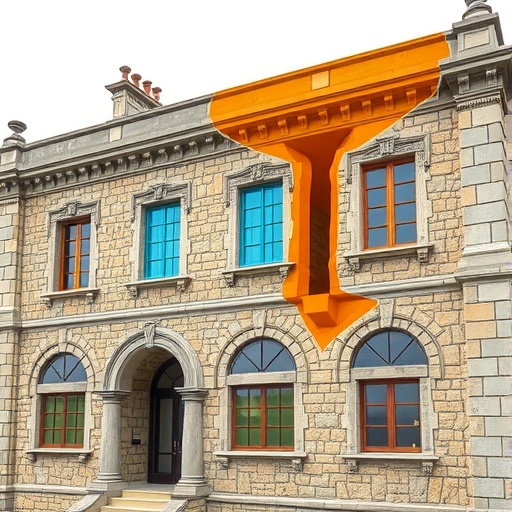
Engineers assessing whether a historic stone church façade will survive an earthquake have long faced an uncomfortable dilemma: the most accurate computer models of masonry collapse are so computationally expensive that they force analysts to make simplifying assumptions whose consequences are largely unknown. A new study from McGill University has now quantified exactly how much those assumptions matter, showing that some modelling shortcuts are surprisingly safe while others can skew predictions of a building’s strength and displacement capacity by dramatic margins. The findings offer heritage engineers, for the first time, a quantitative roadmap for deciding which simplifications can be tolerated and which could quietly compromise a seismic assessment.
The research, published in the Bulletin of Earthquake Engineering, focuses on a typical nineteenth-century unreinforced masonry stone church façade located in Montréal, Canada. Led by Ersilia Giordano, with Lucy Davis and Daniele Malomo, all of the Department of Civil Engineering at McGill, the team used the Distinct Element Method, or DEM, a numerical framework in which a structure is represented not as a continuous solid but as an assembly of discrete rigid or deformable blocks connected by interfaces that can open, slide, and rotate. This discontinuum approach is uniquely suited to capturing the failure modes that dominate unreinforced masonry, in which damage typically proceeds through separation along mortar joints, cracking of units, and the gradual formation of collapse mechanisms rather than through the distributed yielding seen in modern steel or reinforced concrete frames.
Out-of-plane failure, in which a wall is pushed perpendicular to its own surface and rocks, slides, or overturns, is among the most dangerous and most common mechanisms in masonry buildings during earthquakes. Church façades are particularly vulnerable because they are often tall, slender, and only weakly connected to the roof and side walls behind them, behaving in extreme cases as free-standing walls teetering on their base. Post-earthquake survey teams in Italy, New Zealand, and elsewhere have repeatedly documented façade overturning as a signature damage mode in churches, making the reliable assessment of these elements a priority for the protection of both cultural heritage and public safety. Yet modelling a full façade at the level of individual stones and mortar joints, a so-called meso-scale approach, generates models with thousands of blocks and contacts whose nonlinear dynamic or static analyses can take days of computation, leaving little room to explore the uncertainties inherent in every real assessment.
The McGill team therefore set out to answer a deceptively simple question: when analysts move from a detailed meso-scale representation toward a coarser macro-scale model, which of the assumptions they must adopt along the way actually change the answer? The investigation examined three broad categories of modelling choice. The first concerned façade discretization, that is, how finely the masonry is subdivided into blocks, ranging from faithful representations of individual stones to large macro-blocks idealizing entire regions of the façade. The second concerned boundary conditions, including how the façade is restrained where it meets the roof, the lateral walls, and the foundation, connections whose real stiffness and strength are often poorly documented in historic buildings. The third concerned the mechanical properties assigned to the block interfaces, and in particular whether the interface behavior was assumed to be purely frictional and unlimited in compressive capacity, or whether a compressive strength limit was introduced to mimic the crushing of mortar and stone at points of concentrated contact pressure.
The analyses were conducted as nonlinear static, or pushover, simulations, in which a lateral load pattern representative of seismic action is progressively increased until the structure reaches its peak resistance and ultimately collapses. This deterministic approach is the pragmatic choice in professional practice, since the prohibitive computational burden of discontinuum models at building scale rarely permits the sort of stochastic treatment of uncertainties that is routine for smaller or simpler models. But, as the authors note, the impact of the simplifications embedded in these deterministic models on engineering predictions had remained mostly unknown, a gap the study set out to close with a systematic, side-by-side comparison of modelling variants applied to the same real structure.
The results carry two headline messages. The first is reassuring: simplified representations of the masonry fabric may be entirely sufficient for force-based assessments, provided that the boundary conditions are accurately characterized. In other words, engineers do not necessarily need to model every stone in a façade to estimate how much lateral force it can resist, so long as they invest their limited resources in understanding how the façade is actually tied to, or separated from, the rest of the building. This finding effectively redirects modelling effort away from geometric fidelity and toward the often-neglected task of characterizing connections, which archival research, onsite survey, and targeted testing can support far more efficiently than brute-force micro-modelling.
The second message is a warning. When a compressive strength limit was introduced at the block interfaces, allowing the model to simulate local crushing rather than assuming infinitely strong contacts, the predicted structural response degraded substantially. Peak resistance dropped by as much as 32 percent, and ultimate displacement capacity fell by up to 48 percent compared with models that ignored crushing. These are not marginal corrections. An assessment that neglects the finite compressive capacity of masonry interfaces can therefore overestimate both the force a façade can carry and the deformation it can sustain before failure, potentially leading to retrofit decisions that leave a heritage building with less safety margin than its owners believe. The effect is especially relevant for stone masonry, where point contacts between irregular units can generate highly concentrated compressive stresses that locally exceed material strength even when global stress levels appear modest.
Beyond these headline numbers, the study contributes a methodological framework that other researchers and practitioners can adapt. By holding the case study structure fixed and varying one modelling assumption at a time, the authors isolated the sensitivity of the pushover response to each choice, converting what had been a matter of engineering judgment into an evidence-based hierarchy of importance. The work also situates itself within a broader research trajectory in computational masonry mechanics, which spans continuum finite element approaches, applied element methods, rigid-body limit analysis, and bonded-block discrete models. The McGill group, which has previously applied pragmatic meso-scale discontinuum analysis to Dutch masonry churches and developed macro-distinct element techniques for simulating combined in-plane and out-of-plane failure, argues that discontinuum tools are increasingly mature for practice; what has been missing, and what this study supplies, is guidance on how to use them responsibly when information about the building is incomplete.
The case study itself adds a distinctive geographic dimension to a literature dominated by Mediterranean and European examples. Eastern Canada’s religious and industrial heritage comprises a substantial stock of unreinforced stone masonry buildings, many erected in the nineteenth century using construction techniques documented in period handbooks and archival records. Montréal’s seismic hazard is moderate by global standards, but the 1988 Saguenay earthquake demonstrated that significant events can occur in the region, and the vulnerability of unreinforced masonry to out-of-plane action does not require a great earthquake to become life-threatening. The façade analysed in the study, belonging to a church in the Viauville district whose history was documented in collaboration with heritage researchers, is representative of a building typology found across Québec and beyond, which strengthens the transferability of the conclusions.
For the practitioners who must ultimately decide how to assess and retrofit these structures, the study’s quantitative basis for selecting modelling simplifications arrives at a moment when computational tools have outpaced the guidance for using them. Software implementing the distinct element method, originally developed in the 1970s for rock mechanics and now embodied in codes capable of simulating polyhedral block systems in three dimensions, is increasingly accessible, and design standards for the seismic evaluation of existing buildings increasingly acknowledge nonlinear analysis as the most reliable route to capacity estimation. But standards offer little instruction on how to discretize a historic façade, what to assume about its boundary restraints, or whether interface crushing must be modelled. The McGill results suggest a practical ordering of priorities: characterize connections first, adopt a compressive strength cap at interfaces rather than assuming indestructible contacts, and only then consider refinements to the representation of the masonry texture itself.
The work also highlights the limits of what deterministic modelling can achieve. Because each variant of the model represents a single realization of assumptions about geometry, materials, and support conditions, the spread of results across variants serves as a proxy for the uncertainty that a stochastic analysis would otherwise capture explicitly. The up to 48 percent reduction in ultimate displacement attributable to a single modelling choice implies that the uncertainty band around any individual assessment may be wide, a caution both to analysts reporting a single capacity value and to authorities interpreting them. The authors suggest that their framework can be extended to other façade typologies, loading directions, and analysis types, including dynamic and multi-mode collapse simulations, gradually building the evidence base needed to codify discontinuum modelling practice for heritage masonry.
In an era when heritage buildings face simultaneous threats from earthquakes, climate-driven deterioration, and urban densification, tools that make rigorous structural assessment affordable are more than academic curiosities. By showing where simplification is safe and where it is dangerous, the McGill team has taken a concrete step toward assessments that are both computationally feasible and trustworthy, helping engineers protect centuries of built heritage without silently overestimating its ability to stand through the next earthquake.
Cite Scienmag News
Violet Maxwell. (September 4, 2026). Modelling assumptions shape out-of-plane failure analysis of stone masonry façades. Scienmag. https://scienmag.com/modelling-assumptions-shape-out-of-plane-failure-analysis-of-stone-masonry-facades/
Violet Maxwell. "Modelling assumptions shape out-of-plane failure analysis of stone masonry façades." Scienmag, 4 September 2026, https://scienmag.com/modelling-assumptions-shape-out-of-plane-failure-analysis-of-stone-masonry-facades/. Accessed 4 September 2026.
Violet Maxwell. "Modelling assumptions shape out-of-plane failure analysis of stone masonry façades." Scienmag. September 4, 2026. https://scienmag.com/modelling-assumptions-shape-out-of-plane-failure-analysis-of-stone-masonry-facades/


