


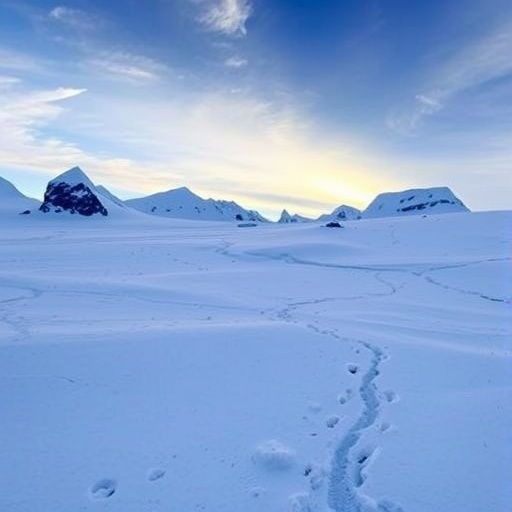
Antarctica briefly appeared to defy its long-term trajectory. Between 2021 and 2023, unusually heavy snowfall added enough mass to large parts of the ice sheet to offset ice lost from its margins, creating the impression that the continent’s decades-long retreat had slowed. The striking reversal prompted a broader question: was Antarctica beginning to benefit from a warmer, wetter climate, or was the apparent recovery simply a temporary fluctuation? A new study by researchers at the University of California, Santa Barbara, the University of Washington and collaborating institutions concludes that the answer lies in an exceptional pulse of tropical ocean warmth—not in a durable climate trend.
The finding matters because Antarctica is the largest reservoir of land-based ice on Earth. Its ice sheet covers an area larger than the United States and Mexico combined and contains enough frozen water to exert a profound influence on future sea levels. The balance between snowfall accumulating on the interior and ice flowing toward the ocean at the edges determines whether the continent gains or loses mass. In most recent decades, Antarctica has experienced a net decline because ocean-driven melting beneath floating ice shelves has accelerated the discharge of inland ice. The snowfall of the early 2020s temporarily disrupted that pattern, but the underlying processes responsible for ice loss remained active.
Ice shelves are particularly important in this system. These floating extensions of the Antarctic Ice Sheet act as buttresses, slowing the movement of glaciers toward the sea. When relatively warm seawater enters cavities beneath them, it can melt their undersides even when air temperatures remain far below freezing. Thinning ice shelves provide less resistance to inland ice, allowing glaciers to flow more rapidly into the ocean. In East Antarctica, the Totten Ice Shelf is one example of a region contributing to ice loss. Yet during the study period, the additional snow deposited across parts of the continent increased surface mass rapidly enough to compensate for losses from ice shelves and glacier fronts.
The researchers wanted to determine whether the extra precipitation represented an early signal of a warmer atmosphere or an isolated event. Climate physics offers a plausible reason for Antarctica to become snowier in a warming world: warmer air can hold more water vapor. Through the Clausius–Clapeyron relationship, atmospheric moisture capacity increases by roughly 7 percent for every 1-degree Celsius rise in temperature, provided other conditions remain suitable. In theory, a warmer planet could transport more moisture toward high southern latitudes, increasing snowfall over the Antarctic interior and partially offsetting ice loss. But the amount of moisture in the atmosphere is only part of the story. Its source, the path of storms and the circulation patterns that carry it southward are equally important.
To trace those pathways, the scientists used a computational technique that effectively tags water molecules according to their origin. The method follows moisture as it evaporates from the ocean, moves through the atmosphere and eventually falls as snow over Antarctica. Rather than treating precipitation as a local phenomenon, the approach reveals which ocean regions supplied the vapor and how atmospheric circulation delivered it to the ice sheet. The analysis linked much of the exceptional snowfall between 2021 and 2023 to the tropical warm pool, a broad region of unusually warm seawater extending across parts of the western Pacific and eastern Indian oceans.
During those years, sea-surface temperatures in the warm pool rose well above average. The additional heat intensified evaporation, loading the atmosphere with moisture. Large-scale circulation then transported that moisture toward East Antarctica, where it fell as snow. The connection illustrates how tropical ocean conditions can influence weather thousands of kilometers away. Warm tropical anomalies can alter pressure patterns, atmospheric waves and storm tracks, redirecting moisture into regions that would not necessarily receive it under average conditions. In this case, the result was an extraordinary accumulation of snow over portions of East Antarctica, enough to change the continent’s short-term mass balance.
The discovery also helps explain why Antarctica can appear to undergo dramatic changes over just a few years. Because the ice sheet is so vast, a relatively modest increase in average snow depth across a large area can represent a huge amount of water. That temporary gain can obscure continuing losses around the coast, especially when measurements are made over short intervals. Satellite observations and other mass-balance estimates may therefore show a slowdown in overall ice loss even while warm ocean water continues to erode vulnerable ice shelves from below. The apparent improvement is real in the accounting of total mass, but it does not necessarily signal a reversal of the mechanisms driving long-term decline.
Historical records indicate that the tropical warm pool naturally experiences episodes of multi-year warming followed by a return toward average conditions. The researchers argue that the 2021–2023 anomaly fits this recurring pattern. Although human-caused warming is altering the global climate and has been linked to conditions that accelerate ice loss in West Antarctica, the specific moisture surge behind the recent East Antarctic snowfall is more consistent with natural variability in the tropical climate system. Separating the effects of greenhouse-gas-driven change from naturally repeating ocean fluctuations remains difficult, particularly in the tropics, where several interacting climate processes can produce similar signals.
The study’s central warning is that short-term improvements in Antarctic mass balance should not be mistaken for evidence that climate change has stopped or that irreversible ice loss has been cancelled. The continent’s surface may gain mass during an unusually snowy period while its floating ice shelves continue to thin and its glaciers continue to discharge ice into the ocean. Future snowfall could increase in a warmer atmosphere, but whether it will do so consistently, and whether it can keep pace with ocean-driven melting, remains uncertain. By identifying the tropical source of the recent precipitation, the researchers provide a clearer framework for interpreting future satellite observations and climate projections. Antarctica’s climate system is capable of producing sudden surprises, but a few snowy years do not erase the long-term pressure imposed by a warming planet.
References: Nature; University of California, Santa Barbara; University of Washington; Chinese Academy of Sciences; University of Alaska Fairbanks; Dartmouth University; Université catholique de Louvain.
Cite Scienmag News
Violet Maxwell. (August 20, 2026). Antarctica’s brief rebound reflected climate variability, not a new normal. Scienmag. https://scienmag.com/antarcticas-brief-rebound-reflected-climate-variability-not-a-new-normal/
Violet Maxwell. "Antarctica’s brief rebound reflected climate variability, not a new normal." Scienmag, 20 August 2026, https://scienmag.com/antarcticas-brief-rebound-reflected-climate-variability-not-a-new-normal/. Accessed 5 September 2026.
Violet Maxwell. "Antarctica’s brief rebound reflected climate variability, not a new normal." Scienmag. August 20, 2026. https://scienmag.com/antarcticas-brief-rebound-reflected-climate-variability-not-a-new-normal/


