


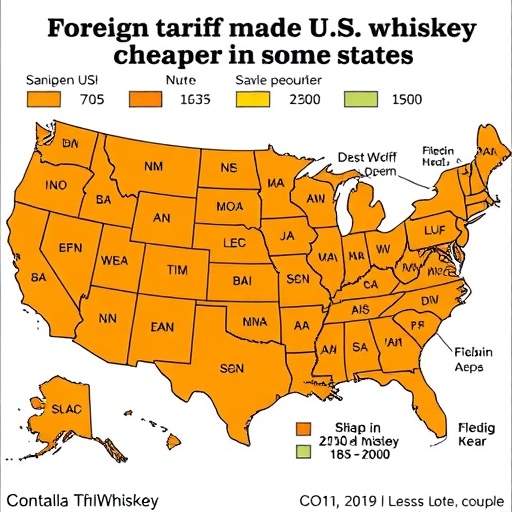
A surprising consequence of the 2018 trade war may be sitting on liquor-store shelves across the United States: American whiskey became cheaper in many parts of the country, even as prices rose in the nation’s most famous whiskey-producing states. New research examining millions of whiskey purchases shows how foreign tariffs can reshape domestic prices in ways that vary dramatically from one region to another. The study suggests that when export markets suddenly become more difficult to access, producers may respond not by changing what they make, but by changing what they charge—and the outcome depends heavily on local consumer preferences.
The findings center on a series of tariffs introduced by the Trump administration in 2018. The measures affected goods traded between the United States and several major economic partners, contributing to a broader trade dispute. In response, Mexico, the European Union, Canada and China imposed substantial tariffs on whiskey produced in the United States. Because whiskey represented the vast majority of U.S. liquor exports before the tariffs were introduced, the policy changes placed an important part of the American spirits industry under immediate pressure. Distillers suddenly faced higher barriers in foreign markets and a potential surplus of products that could no longer be sold abroad as easily.
To understand how producers responded, researchers analyzed sales data from 8,674 stores across the country during the 2018 calendar year. Their dataset included 2,514 distinct whiskey products, each sold in a standard 750-milliliter bottle. In total, the researchers examined approximately 11.4 million individual whiskey transactions. This unusually large sample allowed them to track price movements across locations and product categories while comparing the period before the export tariffs took effect with the months that followed.
Imported whiskeys provided a comparison group. Since foreign whiskeys were not subject to U.S. export tariffs, their prices offered a way to distinguish changes linked to the trade dispute from broader shifts in the alcohol market. The researchers compared the prices of American whiskeys with those of imported products over the same period. This observational approach cannot reproduce a laboratory experiment, but the timing of the tariff changes and the scale of the sales records created a natural opportunity to study how a sudden disruption in international trade influenced consumer prices at home.
The broad pattern was clear: American whiskey producers generally lowered prices after foreign tariffs reduced access to overseas customers. By making products less expensive in the United States, distillers could encourage additional domestic purchases and redirect some inventory toward American consumers. The strategy reflects a basic economic response to a sudden decline in external demand. If fewer bottles can be sold abroad, producers may try to stimulate sales in the domestic market through discounts or lower retail prices. For consumers in many states, the trade war therefore created an unexpected benefit at the checkout counter.
That benefit was not distributed evenly. In Kentucky and Tennessee, the two states most strongly associated with American whiskey production, prices for locally produced whiskey actually increased. These states are home to a large share of the whiskey sold in the United States, and consumers there may place a special value on products made nearby. The researchers argue that regional loyalty, familiarity with local distilleries and a strong cultural connection to whiskey may have allowed producers to charge a premium. In economic terms, consumers in these markets may have had a lower price sensitivity for locally produced whiskey, meaning that demand remained strong even when prices rose.
Outside the major whiskey hubs, prices generally fell, while states with already substantial demand often experienced little change or modest increases. This regional variation illustrates why national averages can conceal important differences in the way trade policy affects households. A tariff imposed abroad may reduce prices for consumers in one state while increasing them in another, depending on local tastes, brand identity and the availability of substitute products. Someone purchasing a nationally distributed bourbon in a region without a strong whiskey culture may benefit from intensified domestic competition, while a customer in Kentucky or Tennessee may be willing to pay more for a bottle identified with local production.
The structure of whiskey manufacturing helps explain why pricing became the most practical short-term response. Whiskey cannot be produced in unlimited quantities at short notice because many varieties must be aged for years before they can be sold. Distillers therefore cannot rapidly expand or reduce the supply of finished whiskey in response to a sudden change in international demand. A company facing weaker exports cannot simply remove large quantities of mature product from the market, nor can it quickly create replacement inventory if demand unexpectedly rises. Prices, by contrast, can be adjusted almost immediately through retailers, promotions and distribution decisions.
That imbalance between slow-moving production and fast-moving prices may become increasingly important during periods of political uncertainty. Trade disputes, sanctions, tax changes and diplomatic conflicts can alter market conditions long before manufacturers have time to redesign supply chains or modify production schedules. The whiskey case shows that producers may use pricing as a flexible buffer while waiting to see whether a policy change is temporary or permanent. It also demonstrates that consumers do not experience trade policy in a uniform way. The same international dispute can produce lower prices in one part of the country, higher prices in another and virtually no visible effect elsewhere.
The study, titled “Domestic Product Market Impacts of Politically Motivated Foreign Tariffs,” offers a detailed example of how global political tensions can travel through supply chains and reach ordinary retail transactions. Its conclusions extend beyond whiskey. Industries built around products that require long production cycles, specialized consumer preferences or strong regional identities may respond to trade shocks in similarly uneven ways. For American whiskey, the 2018 tariffs transformed foreign-market losses into a domestic pricing experiment: cheaper bottles across much of the country, but a premium for local pride in the places where whiskey is part of the landscape, economy and cultural identity.
News Publication Date: 17-Aug-2026
Web References: https://publications.aaahq.org/accounting-review/article/doi/10.2308/TAR-2024-0708/28015/Domestic-Product-Market-Impacts-of-Politically
References: The Accounting Review, DOI: 10.2308/TAR-2024-0708
Cite Scienmag News
Courtney Benton. (August 20, 2026). Foreign Tariffs Made U.S. Whiskey Cheaper in Some States. Scienmag. https://scienmag.com/foreign-tariffs-made-u-s-whiskey-cheaper-in-some-states/
Courtney Benton. "Foreign Tariffs Made U.S. Whiskey Cheaper in Some States." Scienmag, 20 August 2026, https://scienmag.com/foreign-tariffs-made-u-s-whiskey-cheaper-in-some-states/. Accessed 3 September 2026.
Courtney Benton. "Foreign Tariffs Made U.S. Whiskey Cheaper in Some States." Scienmag. August 20, 2026. https://scienmag.com/foreign-tariffs-made-u-s-whiskey-cheaper-in-some-states/


