


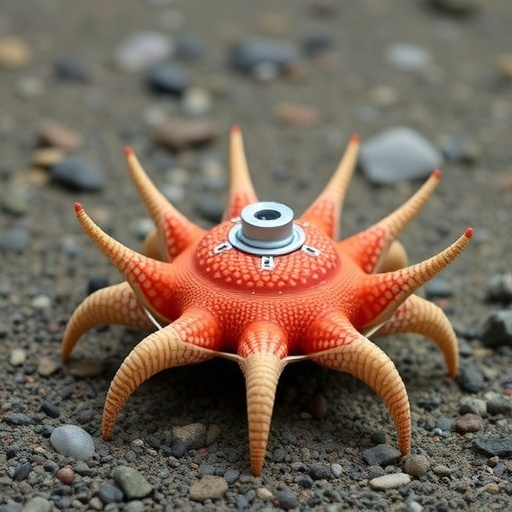
In a groundbreaking departure from conventional robotics design, researchers at Duke University have unveiled Argus, an innovative robot that epitomizes a novel principle termed “dynamic isotropy.” Unlike traditional robots that strive to mimic familiar biological forms such as humans, dogs, or insects, Argus breaks free from imitating natural morphologies. Instead, it embodies symmetry not merely as an aesthetic or structural property but as a dynamic functional capacity across all spatial dimensions. This paradigm shift restructures the foundational goals of robotic design, aiming to maximize a robot’s ability to maneuver with equal agility in any direction without the constraints of orientation.
The concept of dynamic isotropy, central to Argus’s design, quantifies how uniformly a robot can accelerate its center of mass in every conceivable direction. This metric, scoring from zero to one, measures a robot’s omnidirectional dynamism, with most sophisticated contemporary robots achieving scores below 0.6. Remarkably, Argus attains a score of 0.91, nearing the theoretical zenith. Such a high degree of symmetry at the dynamic level signifies a profound advancement, altering how a robot interprets its environment and executes movement. This unattainable uniformity in force generation liberates the robot from “front” and “back” distinctions, allowing equal competence in all spatial orientations.
To achieve this dynamic isotropy, the Duke research team simulated over 1,500 distinct robot morphologies, exploring a vast design landscape through computational models that considered the physical principles governing robotic motion. The culmination of these simulations is Argus’s unique architecture: twenty modular, telescoping legs arrayed at the vertices of a regular dodecahedron. Each leg is outfitted with a depth camera, collectively providing an almost perfect spherical sensor array that complements the robot’s omnidirectional actuation. This configuration enables instantaneous acceleration vectors to be uniformly distributed across three-dimensional space, a feat rarely achieved in robotic systems.
The seamless integration of whole-body actuation and whole-body perception in Argus provides it with exceptional versatility. Unlike conventional robots, which exhibit preferential directions of movement or sensor bias, Argus perceives and interacts with its environment isotropically. This arrangement enhances its resilience and adaptability, enabling it to perform a wide repertoire of tasks that would typically require reorientation or complex control schemes in other robots. The robotics team at Duke emphasizes that once a robot can accelerate equally well in every spatial dimension, the traditional challenges of spatial navigation and balance become fundamentally transformed.
Argus’s performance in real-world environments validates the efficacy of dynamic isotropy as a design principle. On Duke University’s diverse test terrains—ranging from smooth concrete and dense foliage to soft sand and wet surfaces—the robot demonstrated robust locomotion regardless of its orientation. It handled obstacles up to five inches in height with ease, rolling across challenging substrates without the need to realign or stabilize extensively. Perhaps more striking is Argus’s rapid self-stabilization following external perturbations, a demonstration of its control algorithms coupled with dynamic symmetry.
An exceptional illustration of Argus’s resilience is its ability to continue operation even when compromised. The robot was tested with three of its twenty legs rendered non-functional yet maintained effective mobility and control. This robustness is indicative of a distributed propulsion and sensing system where loss of individual components does not cripple the overall operation. Argus further exemplifies multifunctionality by carrying and accelerating a 10-pound payload at near its full speed, showcasing not only agility but also strength and stability.
Beyond terrestrial traversal, Argus extends its capabilities to complex locomotion tasks seldom achievable by standard robots. Its design allows it to climb narrow vertical walls by employing subsets of legs in a coordinated bracing and thrusting sequence. This behavior emulates natural organisms capable of multidirectional movement and stability on uneven or precarious surfaces. Its ability to track and push a three-foot cube while rolling continuously underscores a sophisticated interaction between perception, control, and dynamic symmetry, enabling multifaceted manipulation during locomotion.
The broader implications of Argus’s design philosophy suggest a transformative framework for future robotics. Dynamic isotropy, the research team asserts, transcends specific robot models, offering a unifying performance metric and design target applicable across existing and novel platforms. This principle integrates aspects of trajectory tracking, robustness, energy efficiency, resilience to damage, and environmental adaptability, systematically improving these performance domains as the degree of dynamic symmetry increases. By redefining the role of symmetry from static morphology to dynamic ability, the framework facilitates the development of robots that are inherently more agile and versatile.
This research does not merely contribute a new robot prototype but sets a precedent for the role of computational design in robotics. The comprehensive simulation sweep of 1,500 morphologies released alongside the study furnishes the scientific community with a resource for probing dynamic symmetry in various forms. It invites reexamination of traditional design biases and encourages exploration of unconventional body plans that prioritize functional uniformity in all spatial dimensions over biomimicry or thematic aesthetics.
The theoretical and empirical results achieved by the Duke team culminate in a vision of robotics that aligns closely with natural evolutionary principles. As noted by the project lead, Boyuan Chen, this approach resonates with how nature constructs organisms ranging from microscopic viruses to starfish—structures optimized for uniform interaction with their environments rather than directional biases. Argus embodies this insight in robotics, offering a platform that defies entrenched paradigms and opens new avenues for machines capable of discovery and adaptation in varied and unpredictable settings.
Ultimately, Argus represents a new family of robots built on fundamental physics and mathematical principles rather than anthropomorphic or animal-like templates. Its “all-seeing” namesake from Greek mythology reflects the integrative sensory design, encapsulating a machine whose body and sensor network are co-optimized for the highest attainable level of dynamic isotropy. This robot challenges the convention of designing robots solely for predefined tasks, instead proposing platforms as instruments of discovery, capable of unveiling deeper understanding about motion, control, and interaction.
The Duke General Robotics Lab’s long-term vision to develop Discovery Robotics manifests through Argus, emphasizing machines that learn, act, collaborate, and reveal unknown aspects of their operation and environments. This departure from instruction-following robots towards autonomous explorers of physical principles paves the way for a paradigm shift in how robotics are conceived, built, and deployed. As Argus demonstrates, the future of robotics lies not in replicating familiar forms but in harnessing foundational principles such as dynamic isotropy to unlock unprecedented capabilities.
With support from government agencies including DARPA and the U.S. Army Research Office, this research underscores the strategic importance of breakthroughs in robotic mobility and adaptability. The findings disseminated through Science Robotics underscore the robustness and multifunctionality of dynamically symmetric robots like Argus, highlighting their potential applications in environments ranging from terrestrial exploration to potentially low-gravity extraterrestrial missions. The Duke team’s work thus represents a leap forward in both theoretical robotics and practical engineering, setting a new benchmark for omnidirectional and multifunctional robotic systems.
Cite Scienmag News
Denise Maddox. (May 27, 2026). Sea-Urchin-Inspired Omnidirectional Robot Challenges Conventional Design Paradigms. Scienmag. https://scienmag.com/sea-urchin-inspired-omnidirectional-robot-challenges-conventional-design-paradigms/
Denise Maddox. "Sea-Urchin-Inspired Omnidirectional Robot Challenges Conventional Design Paradigms." Scienmag, 27 May 2026, https://scienmag.com/sea-urchin-inspired-omnidirectional-robot-challenges-conventional-design-paradigms/. Accessed 3 September 2026.
Denise Maddox. "Sea-Urchin-Inspired Omnidirectional Robot Challenges Conventional Design Paradigms." Scienmag. May 27, 2026. https://scienmag.com/sea-urchin-inspired-omnidirectional-robot-challenges-conventional-design-paradigms/


