



view more
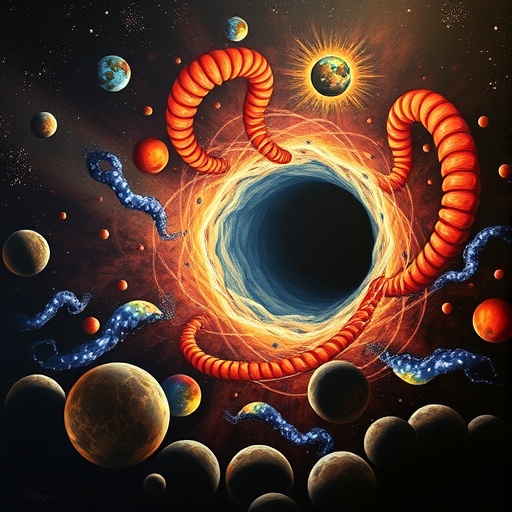
Credit: John A. Paice & Noel Castro Segura et al, ‘SwiftJ1727 – Final – No Overlay – DonorJetClouds’, (2026).
University of Warwick-led astronomers discover the cosmic digestive system of a black hole – showing that even when black holes appear faint, they’re not simply bottomless pits.
Black holes are often portrayed as cosmic gluttons that swallow everything that comes too close. But new observations of a dramatic black hole outburst – led by Warwick Postdoctoral Fellow Dr Noel Castro Segura – suggest the reality is much messier.
Using the European Southern Observatory’s Very Large Telescope (VLT), astronomers have followed the newly discovered black hole system, Swift J1727.8−1613, through a spectacular 2023 eruption.
Astronomers found that as the black hole consumed gas from a nearby star, it simultaneously launched some of that material back into space in the form of jets and winds. Critically, the massive outflows of material happen when black holes are very faint, when its activity is very low, much lower than previously thought – meaning black holes may behave less like bottomless pits and more like powerful cosmic digestive systems.
“People often imagine black holes simply swallowing everything around them,” said lead author Dr Noel Castro Segura, a Postdoctoral Fellow at the University of Warwick. “What we’re seeing is a much more complex process. Matter falls in, the system processes it, and a surprising amount is expelled again.”
The study provides one of the most detailed optical records yet of a black hole outburst, allowing researchers to watch how the system changed over time, rather than relying on a few observations. Rather than seeing a blackhole feeding from a star as a single photo, the evidence collected is throughout state changes.
Swift J1727.8−1613 was discovered when it suddenly flared into life in 2023, rapidly becoming one of the brightest X-ray sources in the sky. The system consists of a black hole pulling gas from a nearby star, creating a swirling disc of superheated material around it. During the outburst, astronomers had the opportunity to watch this feeding process unfold in real time as vents have rarely been observed in such quality.
One of the study’s most intriguing findings was that, as the black hole expelled a powerful jet, the disc feeding it also underwent significant changes. This offers a rare glimpse of the connection between matter falling towards a black hole and matter being expelled back into space.
Perhaps the most surprising result came after the black hole’s feeding frenzy had largely subsided. Even when Swift J1727 had faded to around one hundredth of its peak activity, the researchers found evidence that dense gas was still being blown away from the system.
The discovery suggests that black holes may continue driving powerful outflows long after their brightest activity has ended. In fact, the amount of material being expelled could rival the amount ultimately consumed by the black hole itself.
Reflecting on the digestive process of black holes, Dr Noel Castro Segura continued, “if black holes can continue shedding material even after their largest outbursts, it means they may be much less efficient eaters than we previously assumed. A significant fraction of the meal may never reach the black hole at all, changing our understanding of how binary stars in galaxies evolve.”
The observations add to growing evidence that black holes are not simply cosmic eaters. Instead, they appear to be dynamic systems that both consume and redistribute matter — taking material in, processing it and returning a substantial fraction to space through jets and winds.
Commenting on the research, Kyle Solomons, Doctoral Researcher at the University of Cape Town, said: “We usually gravitate towards the dramatic fireworks when a black hole outburst begins, but our observations show that the finale can be just as intense. Even as the system’s X-ray emission dropped to a fraction of its peak, it still had enough power to generate a massive expulsion of gas.”
For Swift J1727.8−1613, astronomers were able to watch that entire cycle unfold during a single outburst, providing one of the clearest views yet of how black holes feed, react, and influence their surroundings.
ENDS
Notes to Editors
- Paper: ‘Optical outburst evolution of the transient black hole X-ray binary Swift J1727.8 −1613: disc response to jet ejections and late-outburst emergence of powerful disc winds’ is published in Monthly Notices of the Royal Astronomical Society (MNRAS).
- DOI:
- Object: Swift J1727.8−1613
- Facility: ESO Very Large Telescope (VLT)
- Instrument: X-Shooter
- Lead author: Dr Noel Castro Segura, University of Warwick
- Illustration: Artist impression of SwiftJ1727 with donor jet clouds. Credit: John A. Paice & Noel Castro Segura et al, ‘SwiftJ1727 – Final – No Overlay – DonorJetClouds’, (2026).
For more information please contact:
- Dom Barker, Media & Communications Officer
- Dom.Barker@warwick.ac.uk | 07824 540727
- General and out-of-hours press office number: +44 (0)7392 125605 (please call as emails are not checked out of office hours).
About the University of Warwick
Founded in 1965, the University of Warwick is a world-leading institution known for its commitment to era-defining innovation across research and education. A connected ecosystem of staff, students and alumni, the University fosters transformative learning, interdisciplinary collaboration and bold industry partnerships across state-of-the-art facilities in the UK and global satellite hubs. Here, spirited thinkers push boundaries, experiment and challenge convention to create a better world.
Journal
Monthly Notices of the Royal Astronomical Society
Article Title
Optical outburst evolution of the transient black hole X-ray binary Swift J1727.8 −1613: disc response to jet ejections and late-outburst emergence of powerful disc winds
Article Publication Date
30-Jul-2026
Katherine Beauchamp
University of Warwick
katherine.beauchamp@warwick.ac.uk
Cite Scienmag News
Grant Pearson. (July 30, 2026). Black hole feeding frenzy ends in cosmic indigestion. Scienmag. https://scienmag.com/black-hole-feeding-frenzy-ends-in-cosmic-indigestion/
Grant Pearson. "Black hole feeding frenzy ends in cosmic indigestion." Scienmag, 30 July 2026, https://scienmag.com/black-hole-feeding-frenzy-ends-in-cosmic-indigestion/. Accessed 4 September 2026.
Grant Pearson. "Black hole feeding frenzy ends in cosmic indigestion." Scienmag. July 30, 2026. https://scienmag.com/black-hole-feeding-frenzy-ends-in-cosmic-indigestion/

