


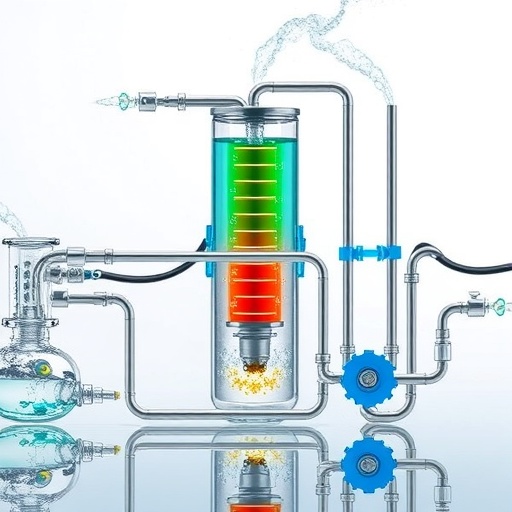

Highly saline industrial wastewaters containing heavy metals are common, yet no existing process can achieve both desalination and metal recovery in an integrated technology platform. Conventional desalination processes do not distinguish between heavy metals and background electrolyte and generate toxic brines with heavy metals, missing opportunities for resource recovery. Here we show that electrochemical ion pumping (EIP) has the unique capability to promote simultaneous desalination and metal recovery through programmable control of the electrode potential. As EIP transfers only a small amount of ions per half cycle via high-frequency circuit switching, the electrode potential can be maintained within a narrow window throughout operation, which allows redox reactions to be selectively activated or suppressed without interrupting continuous ion transport. At potentials above the Cu2+/Cu0 reduction threshold, the system desalinates only capacitively, with no metal deposition. Shifting the potential window to below this threshold triggers selective copper electrodeposition on the electrode while still performing desalination. In an asymmetric five-electrode EIP stack fed with a mixture of Cu2+, Ni2+ and Na+, positioning the potential window between the reduction potentials of Cu2+ and Ni2+ yielded selective Cu2+ capture on the electrode. These findings establish the electrode potential as a controllable operation parameter in EIP, providing an integrated platform for coupled water recycling and selective resource recovery from complex industrial brines.
Xu, L., Bello, O.A., Zaker, S.S.M.A. et al. Simultaneous desalination and selective metal recovery enabled by potential-regulated electrochemical ion pumping.
Nat Water (2026). https://doi.org/10.1038/s44221-026-00679-w
https://doi.org/10.1038/s44221-026-00679-w
Cite Scienmag News
Violet Maxwell. (July 30, 2026). Simultaneous desalination and selective metal recovery enabled by potential-regulated electrochemical ion pumping. Scienmag. https://scienmag.com/simultaneous-desalination-and-selective-metal-recovery-enabled-by-potential-regulated-electrochemical-ion-pumping/
Violet Maxwell. "Simultaneous desalination and selective metal recovery enabled by potential-regulated electrochemical ion pumping." Scienmag, 30 July 2026, https://scienmag.com/simultaneous-desalination-and-selective-metal-recovery-enabled-by-potential-regulated-electrochemical-ion-pumping/. Accessed 3 September 2026.
Violet Maxwell. "Simultaneous desalination and selective metal recovery enabled by potential-regulated electrochemical ion pumping." Scienmag. July 30, 2026. https://scienmag.com/simultaneous-desalination-and-selective-metal-recovery-enabled-by-potential-regulated-electrochemical-ion-pumping/

