

Tuesday, July 28, 2026
Science
No Result
View All Result
  • Login
  • HOME
  • SCIENCE NEWS
  • CONTACT US
  • HOME
  • SCIENCE NEWS
  • CONTACT US
No Result
View All Result
Scienmag
No Result
View All Result
Home Science News Space

Hierarchical Porous Carbon Enables Dual-Ion Relay Storage in Zinc Hybrid Capacitors

July 28, 2026
in Space
Reading Time: 2 mins read
0
Hierarchical Porous Carbon Enables Dual-Ion Relay Storage in Zinc Hybrid Capacitors

Hierarchical Porous Carbon Enables Dual-Ion Relay Storage in Zinc Hybrid Capacitors

65
SHARES
587
VIEWS
Share on FacebookShare on Twitter
ADVERTISEMENT

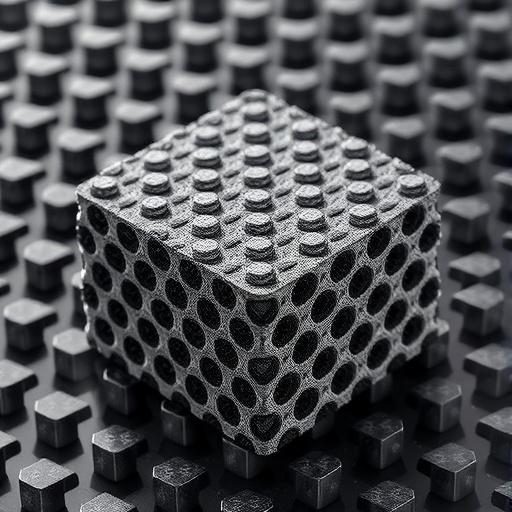
Aqueous zinc-ion hybrid capacitors (ZIHCs) promise a compelling balance of fast charge–discharge power and battery-like energy storage, while remaining comparatively safe, low-cost, and environmentally sustainable. Yet they have struggled with a long-standing tradeoff: zinc-anode kinetics and ion capacity often do not match the capacitive carbon cathode’s ability to store charge. Now, researchers report a strategy that directly addresses this mismatch by redesigning the carbon’s pore architecture and introducing a dual-ion storage pathway.

In a study published in ENG. Chem. Eng., the team developed hierarchical porous carbon nanosheets (CMK-x) from low-cost coal tar pitch. Using magnesium oxide as a structure-directing agent and potassium hydroxide as an activator, they tuned the heat-treatment temperature to optimize the pore-size distribution and surface chemistry. The best-performing sample, CMK-700, delivered a specific surface area of 2223.9 m²·g⁻¹, oxygen-containing functional groups at 10.15 at%, and a maximized ultramicroporous volume of 0.4836 cm³·g⁻¹.

The core advance is a “dual ion relay” mechanism that couples zinc-ion storage with proton-assisted access to ultramicropores. Larger hydrated zinc ions, [Zn(H₂O)₆]²⁺ (~0.86 nm), are preferentially accommodated in larger micropores and mesopores, where electric double-layer capacitance and adsorption on oxygen groups contribute to charge storage. However, their size and desolvation constraints prevent entry into ultramicropores (<1 nm).

In contrast, smaller hydrated protons (H₃O⁺, ~0.564 nm) can penetrate these confined ultramicropores. Molecular dynamics simulations and ex-situ characterization indicate that H₃O⁺ undergoes reversible chemical hydrogen adsorption/desorption inside ultramicropores—effectively “relaying” access so that regions previously inactive for zinc ions become electrochemically useful.

MD simulations of 0.7 nm and 1.0 nm slit-pores further support selective transport: [Zn(H₂O)₆]²⁺ is hindered by high desolvation energy barriers, while H₃O⁺ diffuses readily through the narrow channels. This selectivity validates the proposed proton-mediated route to additional pseudocapacitance.

Electrochemical tests show CMK-700 achieves a specific capacity of 368.1 mAh·g⁻¹ at 0.5 A·g⁻¹, outperforming CMK-600, CMK-800, and CMK-900. The galvanostatic charge–discharge profiles feature a plateau-like region between 0.3 and 0 V, linked to proton storage in ultramicropores.

At high rates, performance remained strong, retaining 133.7 mAh·g⁻¹ even at 20 A·g⁻¹. Cycling stability was also notable: 86.39% capacity retention after 21,000 cycles at 10 A·g⁻¹.

Finally, ex-situ SEM revealed discharge-related precipitates identified as Zn(OH)₂ and Zn₄ClO₄(OH)₇ below 0.3 V, which dissolve upon charging—consistent with reversible chemical precipitation/dissolution paired to proton adsorption–desorption.

Subject of Research: Not applicable
Article Title: Dual ion relay storage mechanism in hierarchical porous carbon electrode for aqueous zinc-ion hybrid capacitors
News Publication Date: 25-May-2026
Web References: http://dx.doi.org/10.1007/s11705-026-2681-3
References: 10.1007/s11705-026-2681-3
Image Credits: HIGHER EDUCATION PRESS

Keywords

dual ion relay; aqueous zinc-ion hybrid capacitors; hierarchical porous carbon; ultramicropores; proton storage; molecular dynamics simulations; pseudocapacitance; electric double-layer capacitance; hydrated zinc ions; ex-situ characterization

Tags: aqueous zinc-ion hybrid capacitorscoal tar pitch-derived carbondual-ion charge storage mechanismdual-ion relay storageenergy storage in supercapacitorsenvironmentally sustainable energy devicesHierarchical porous carbonhigh surface area porous carbonmagnesium oxide templatingpore architecture optimizationultramicroporous carbonzinc hybrid capacitors
Share26Tweet16
Previous Post

Monica L. Baskin Named Director of VCU Massey Comprehensive Cancer Center

Next Post

Iron-Loaded Biochar Boosts Electron Shuttling for Ammonium Nitrate Reduction in Rice Soils

Related Posts

Cavity-Assisted Nonlocal Metasurfaces Enable Efficient Broadband Optical Vortex Generation
Space

Cavity-Assisted Nonlocal Metasurfaces Enable Efficient Broadband Optical Vortex Generation

July 27, 2026
Variable Super-PeVatron in Cygnus X-3 Enables New Era of Time-Domain Astronomy
Space

Variable Super-PeVatron in Cygnus X-3 Enables New Era of Time-Domain Astronomy

July 27, 2026
Astronomers Detect First Wandering Black Hole on Outskirts of Galaxy
Space

Astronomers Detect First Wandering Black Hole on Outskirts of Galaxy

July 27, 2026
Astronomers Identify Extremely Bright Quasar Lenses in New Findings
Space

Astronomers Identify Extremely Bright Quasar Lenses in New Findings

July 27, 2026
All-Angle Acoustic Topological Insulators Enable Omnidirectional Antennas and Tunable Klein Tunneling
Space

All-Angle Acoustic Topological Insulators Enable Omnidirectional Antennas and Tunable Klein Tunneling

July 27, 2026
Physics Reveals Universal Structure of Exceptional Points in Nonlinear Systems
Space

Physics Reveals Universal Structure of Exceptional Points in Nonlinear Systems

July 27, 2026
Next Post
Iron-Loaded Biochar Boosts Electron Shuttling for Ammonium Nitrate Reduction in Rice Soils

Iron-Loaded Biochar Boosts Electron Shuttling for Ammonium Nitrate Reduction in Rice Soils

  • Mothers who receive childcare support from maternal grandparents show more

    Mothers who receive childcare support from maternal grandparents show more parental warmth, finds NTU Singapore study

    27656 shares
    Share 11059 Tweet 6912
  • University of Seville Breaks 120-Year-Old Mystery, Revises a Key Einstein Concept

    1061 shares
    Share 424 Tweet 265
  • Bee body mass, pathogens and local climate influence heat tolerance

    682 shares
    Share 273 Tweet 171
  • Researchers record first-ever images and data of a shark experiencing a boat strike

    546 shares
    Share 218 Tweet 137
  • Groundbreaking Clinical Trial Reveals Lubiprostone Enhances Kidney Function

    531 shares
    Share 212 Tweet 133
Science

Embark on a thrilling journey of discovery with Scienmag.com—your ultimate source for cutting-edge breakthroughs. Immerse yourself in a world where curiosity knows no limits and tomorrow’s possibilities become today’s reality!

RECENT NEWS

  • Early Adversity Tunes Brain and Behavior’s Oxytocin Response in Altruism
  • Ground Radar Detects Natural Electron Bernstein Waves in Earth’s Ionosphere
  • Mitophagy dampens mitochondrial DNA–triggered cGAS-STING activation in autoimmune thyroiditis
  • Early Brain Development Predicts Driving Experience in Youth With Congenital Heart Disease

Categories

  • Agriculture
  • Anthropology
  • Archaeology
  • Athmospheric
  • Biology
  • Biotechnology
  • Blog
  • Bussines
  • Cancer
  • Chemistry
  • Climate
  • Earth Science
  • Editorial Policy
  • Marine
  • Mathematics
  • Medicine
  • Pediatry
  • Policy
  • Psychology & Psychiatry
  • Science Education
  • Social Science
  • Space
  • Technology and Engineering

Subscribe to Blog via Email

Enter your email address to subscribe to this blog and receive notifications of new posts by email.

Join 5,146 other subscribers

© 2025 Scienmag - Science Magazine

Welcome Back!

Login to your account below

Forgotten Password?

Retrieve your password

Please enter your username or email address to reset your password.

Log In
No Result
View All Result
  • HOME
  • SCIENCE NEWS
  • CONTACT US

© 2025 Scienmag - Science Magazine

Discover more from Science

Subscribe now to keep reading and get access to the full archive.

Continue reading
