


None
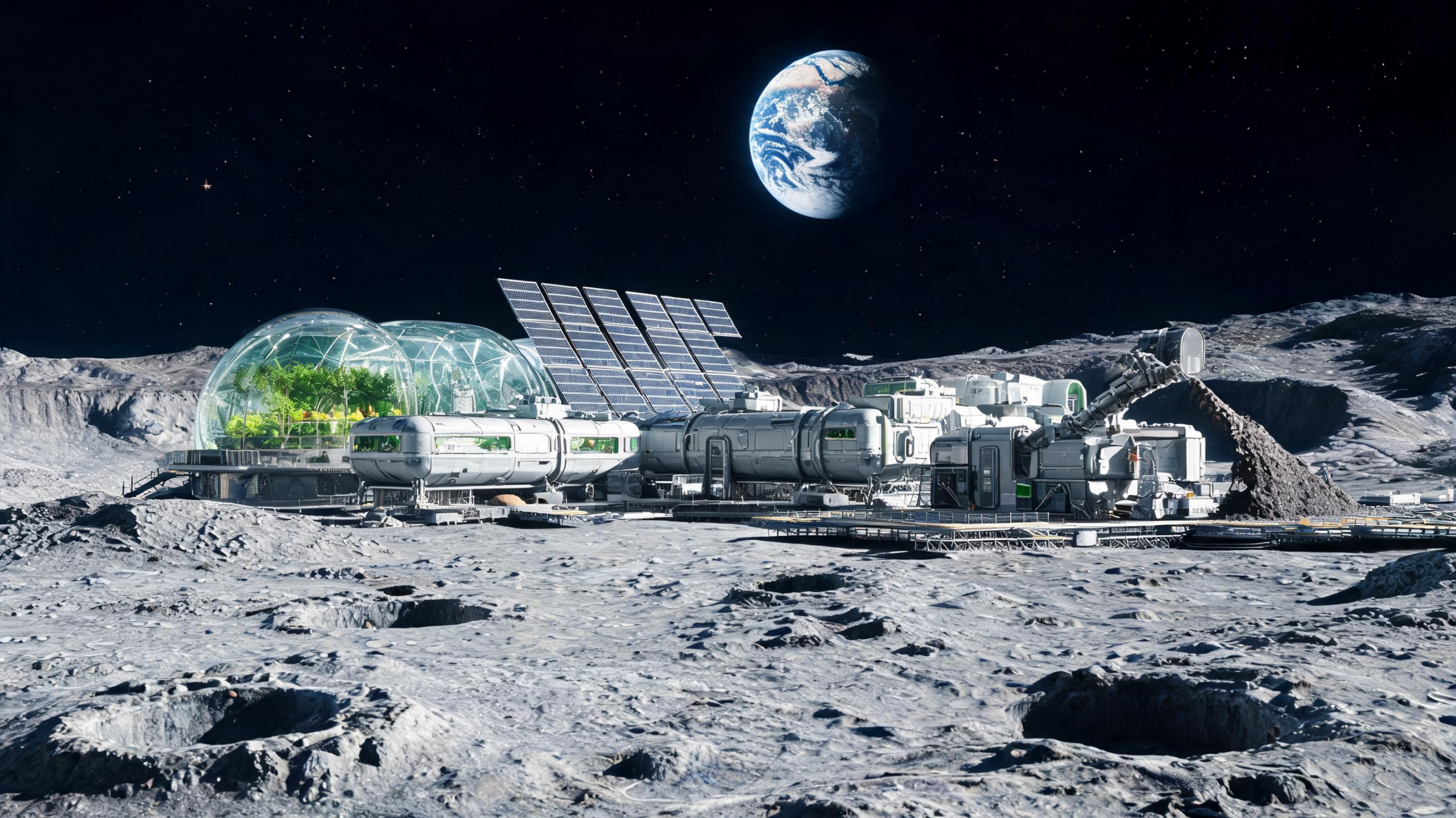
The notion of a Lunar Circular Economy represents a deliberate attempt to translate terrestrial sustainability thinking into the radically different operating environment of the Moon. On Earth, circular economy approaches seek to decouple economic activity from resource consumption by keeping materials in use through reuse, repair, remanufacturing, and recycling. Applied to lunar operations, the same logic becomes even more compelling, because every kilogram of material delivered to the lunar surface carries an enormous launch and logistics cost. A closed-loop system in which water, oxygen, metals, regolith-derived construction materials, and even organic waste are recovered and cycled through multiple mission lifecycles would reduce dependence on Earth-based resupply while simultaneously lowering the environmental burden of launches, manufacturing, and re-entry that currently accompanies space activity on Earth.
The six proposed Metrics for Sustainability offer a framework that moves beyond vague aspirations toward measurable performance. Material circularity captures the proportion of materials that remain in productive use across a lunar settlement, providing a quantitative analogue to recycling rates on Earth but extended to include the recovery of volatiles from waste streams and the repurposing of hardware at end of life. Life-support energy performance reflects the efficiency with which a habitat sustains breathable atmospheres, potable water, and thermal regulation, all of which demand continuous power through the two-week lunar night when solar generation is unavailable. Agricultural output measures the capacity of a settlement to produce food locally, which reduces launch mass from Earth, improves diet freshness for crews, and buffers against supply chain interruption.
Social cohesion as a metric may appear unusual in an engineering context, yet the evidence from isolated, confined, and extreme environments on Earth consistently shows that interpersonal dynamics, governance structures, and habitat design strongly influence mission outcomes. Research into salutogenesis in space emphasises that wellbeing is not merely the absence of illness but the presence of factors that help crews thrive, including a sense of coherence, meaningful work, and environments that support psychological adaptation. The finding that only a small minority of surveyed respondents expressed willingness to live in very small space settlements underscores that perceived habitability and community size matter to real people, and that any long-term lunar presence must be designed with human factors as rigorously as with power systems or landing pads.
Supply chain resilience, the fifth metric, acknowledges that even a mature lunar settlement will remain connected to Earth through the exchange of specialised components, scientific instruments, and personnel. Resilience in this context means the ability to absorb shocks, whether geopolitical conflict disrupts international partnerships, economic downturns curtail budgets, or a launch failure removes a critical logistics node. A settlement that can fabricate more of its own spares through additive manufacturing, maintain buffer stocks of essential consumables, and operate degraded systems safely for extended periods scores higher on this metric than one dependent on just-in-time delivery from Earth.
The final metric, legal and governance frameworks, is perhaps the most consequential and the least technologically deterministic. The Outer Space Treaty of 1967 established foundational principles, including that space is free for exploration and use by all states and that celestial bodies are not subject to national appropriation, but it was written long before the prospect of commercial lunar resource extraction became plausible. Subsequent instruments, national legislation, and multilateral initiatives have begun to address gaps, yet substantial ambiguity remains regarding property rights in extracted resources, standards of environmental protection on the lunar surface, coordination of activities to avoid harmful interference, and mechanisms for dispute resolution. The paper’s argument that the Spacefaring scenario is most desirable partly depends on the existence of agreed norms that allow multiple actors to operate without conflict.
The four scenarios, Red Tape, Run for Resources, Restricted Operations, and Spacefaring, function as a foresight tool that illuminates how different combinations of governance and technical choices lead to divergent futures. In a Run for Resources world, competitive dynamics could produce rapid activity but also duplication, environmental degradation of scientifically valuable sites, and increased risk of accident or confrontation. Restricted Operations, by contrast, might protect the lunar environment through excessive caution while foreclosing the benefits that a sustained presence could deliver, including scientific discovery, economic development, and the demonstration of technologies needed for eventual Mars missions. The Spacefaring scenario emerges as preferable because it couples ambitious activity with cooperative governance and sustainable practice, treating the Moon as a place where humanity learns to live and work off-planet responsibly.
The staged model of lunar presence, moving from robotic reconnaissance through short-termSortie missions to long-term habitation and eventually something akin to a lunar village, provides a useful temporal scaffold for planning sustainability interventions. At the robotic stage, sustainability considerations centre on planetary protection and the avoidance of contamination at sites of scientific interest, such as permanently shadowed regions where water ice records billions of years of solar system history. Short-term missions introduce questions of landing site selection, traffic management, and the cumulative effects of repeated landings on regolith dynamics and the exosphere. Long-term habitation raises the full suite of circular economy challenges, including waste processing, radiation shielding through regolith construction, and the provisioning of agriculture under artificial light.
The lunar night deserves particular emphasis because it dominates the engineering envelope of any permanent presence. Fourteen days of darkness mean that solar power alone cannot sustain life support without substantial storage or complementary generation, and options such as fuel cells, nuclear surface power, and strategically sited solar arrays at peaks of near-eternal light near the poles are all under active investigation. Any sustainability metric on energy performance must therefore account for night survivability, not just daytime efficiency, because a settlement that cannot reliably endure the night cannot claim long-term resilience. The paper’s pragmatic definition of permanence, as continuing operations by successive crews with continuous robotic support where technology cannot yet fully overcome the night, reflects this reality honestly.
In-situ resource utilisation sits at the heart of the technical vision. The lunar poles are believed to host water ice within permanently shadowed craters, a resource that can yield drinking water, breathable oxygen, and, through electrolysis, hydrogen and oxygen propellant. Regolith itself can be sintered or bound into building elements, providing radiation shielding and thermal mass without importing construction material. Oxygen constitutes a large fraction of regolith oxides, and extraction processes ranging from hydrogen reduction to molten regolith electrolysis are being developed at increasing levels of maturity. Extending ISRU toward ISRU-wellbeing, as the paper proposes, is a novel conceptual move: it suggests that local resources should support not only survival but flourishing, informing habitat architecture, lighting design that mimics terrestrial circadian cues, and communal spaces that foster the social cohesion the metrics seek to measure.
The proposal that the metrics could eventually be embedded in legal, governance, and technical agreements between stakeholders mirrors the way terrestrial environmental standards migrate from voluntary frameworks into binding regulation and procurement requirements. A common measurement language would allow agencies, commercial operators, and researchers to benchmark performance, compare approaches, and identify trade-offs transparently. It could also support proportionate regulation, since rules calibrated to measurable sustainability outcomes are less likely to be either ineffective or punitive than rules drafted in the abstract. The recommended research agenda, which prioritises refining the metrics and soliciting feedback from diverse stakeholder groups, recognises that legitimacy depends on participation, and that frameworks imposed without broad consultation are unlikely to endure.
Connections across the three space domains reinforce the argument that lunar sustainability cannot be pursued in isolation. Launch activity on Earth generates emissions and affects communities near spaceports, so reducing launch mass through ISRU indirectly reduces terrestrial impacts. Orbital infrastructure, including stations that act as gateways for lunar missions, must itself be operated sustainably amid growing congestion and debris in Earth orbit, since a collision or debris-generating event could interrupt the logistics chain on which lunar operations depend. Conversely, technologies matured for the Moon, such as closed-loop life support, advanced recycling, and autonomous construction, have clear applications in orbital habitats and eventually in Mars missions, making lunar sustainability a proving ground for broader spacefaring capability.
Historical context strengthens the case for proactive rather than reactive governance. On Earth, many environmental harms were addressed only after damage became evident and costly, whereas the Planetary Boundaries framework exemplifies an attempt to define safe operating limits in advance. The Moon offers a rare opportunity to apply that lesson preemptively, before large-scale activity begins, because key decisions about landing sites, resource extraction methods, and heritage protection for sites like the Apollo landing areas are still being made. Whether future generations will judge humanity’s return to the Moon as sustainable will depend substantially on choices made in the present decade, and the framework of a Lunar Circular Economy with measurable metrics provides a concrete starting point for making those choices deliberately rather than by default.
Subject of Research: Developing a sustainable human lunar presence using space resources
Article Title: Developing a sustainable human lunar presence using space resources
Article References: Cernev, T., de Zwart, M., & Hessel, V. (2026). Developing a sustainable human lunar presence using space resources. Space and Planetary Resources, 2(1), Article 8. https://doi.org/10.1007/s44461-026-00014-x
Image Credits: AI Generated
DOI: 10.1007/s44461-026-00014-x
Keywords: Developing, sustainable, human, lunar, presence, space, resources, scientific research
Cite Scienmag News
Sloane Callahan. (September 3, 2026). Developing a sustainable human lunar presence using space resources. Scienmag. https://scienmag.com/developing-a-sustainable-human-lunar-presence-using-space-resources/
Sloane Callahan. "Developing a sustainable human lunar presence using space resources." Scienmag, 3 September 2026, https://scienmag.com/developing-a-sustainable-human-lunar-presence-using-space-resources/. Accessed 4 October 2026.
Sloane Callahan. "Developing a sustainable human lunar presence using space resources." Scienmag. September 3, 2026. https://scienmag.com/developing-a-sustainable-human-lunar-presence-using-space-resources/


