


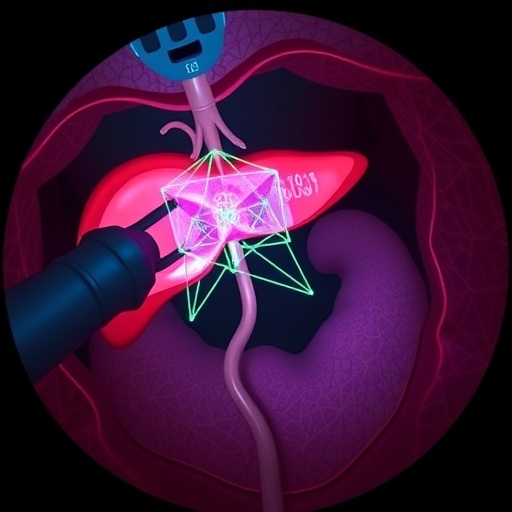
Liver cancer and chronic liver disease claim roughly two million lives every year, and despite rapid advances in imaging and targeted therapy, tissue diagnosis still depends on biopsy. Now, a team of biomedical engineers at King’s College London has unveiled a proof-of-concept robotic platform that could fundamentally change how clinicians reach deep-seated liver lesions. Writing in the International Journal of Computer Assisted Radiology and Surgery, Raghav Khanna, Nikola Fischer, Zhenting Du and Christos Bergeles describe an integrated system that pairs a tendon-driven continuum robot endoscope with a steerable bevel-tip needle and an artificial intelligence planner trained through deep reinforcement learning. The system is designed for endoscopic ultrasound-guided fine-needle biopsy, or EUS-FNB, a procedure in which a needle is advanced through the stomach wall into the liver. By making both the endoscope and the needle actively steerable, and by letting an algorithm chart the path, the researchers aim to extend biopsy access to lesions in the right lobe that rigid instruments currently struggle to reach.
The clinical problem the team set out to solve is well documented. Percutaneous biopsy, the most common route to liver tissue, is often unsuitable for patients with coagulopathy or altered anatomy, and even endoscopic approaches have hard limits. In standard EUS-FNB, a straight 19-to-23-gauge needle is pushed through the gastric wall in a fixed direction, meaning it cannot curve around blood vessels, bile ducts or other vital structures. That constraint confines the effective target zone and makes deep right-lobe lesions particularly difficult to sample. The procedure also carries a steep learning curve, which has limited its adoption beyond specialist centres. Transoral access does offer advantages, including shorter insertion depths, more favourable insertion angles, reduced recovery time, less post-operative pain and fewer complications, so the researchers reasoned that robotics could preserve those benefits while removing the geometric restrictions imposed by rigid needles.
The first stage of the platform is a tendon-driven continuum robot, or TDCR, that functions as an actively bending distal section of an endoscope. The robot’s structural body is produced by stereolithography 3D printing and consists of a base link, ten perpendicular spacer discs forming a proximal segment, a middle link, eight discs forming a distal segment, and an end link. The discs interlock through male-female mating surfaces that act as constrained pivot joints, and a central bore houses a steel spring backbone repurposed from single-wire endoscopic biopsy forceps. Six tendons run through peripheral channels in the proximal segment and three through the distal segment, terminating at the middle and end links. The tendons are wound around pulleys mounted on six Dynamixel XL-430 servos with a resolution of 0.01 millimetres per tick, daisy-chained to an Arduino R4 Uno controller. Because the TDCR is mounted on a conventional endoscope, it adds four bending degrees of freedom to the endoscope’s translational motion, enabling five-constraint control of tip position and orientation. Inverse kinematics are solved with the FABRIKc method, which models each continuum segment as a constant-curvature arc represented by virtual links and iteratively updates the bending angles and bending-plane angles until tip error falls below tolerance.
To benchmark the endoscope stage, the researchers commanded the TDCR to trace circular, diamond-shaped and crossed multi-planar arc trajectories while an Aurora magnetic tracking system recorded tip position. Across all tasks the robot achieved a mean absolute positioning error of 13.19 millimetres. The circular task, which demands smooth, planar, approximately constant-curvature motion, performed best, with an error of 10.39 millimetres and a dice similarity coefficient of 0.91 in the XY plane. The diamond trajectory yielded 12.97 millimetres, and the multi-planar arcs, deliberately placed at the edge of the workspace, reached 16.22 millimetres. Repeatability testing, in which four points were each sampled eight times, produced a standard deviation of 0.65 millimetres and a repeatability of 1.95 millimetres. The authors attribute the residual error to unequal tendon tension from the absence of pre-tensioning, friction and hysteresis in the tendon-disc interactions, and the constant-curvature assumption embedded in the kinematic model, and they outline mechanical fixes including steel bushings, nickel-titanium tendons and force sensing.
The second stage addresses the needle itself. Rather than a rigid stylet, the system deploys a steerable needle manufactured from a 0.5-millimetre solid nickel-titanium rod with a 20-degree bevel tip. Asymmetric forces on the bevel as it cuts through soft tissue cause the needle to bend naturally; advancing the needle produces curvature, while simultaneous translation and axial rotation produce straight motion. To amplify bending, the team hand-fabricated deep notches, 0.25 millimetres deep and 2.5 millimetres apart, using a diamond file on the distal section of the shaft. Two variants were built, one with a 3-centimetre notched section and one with an 8-centimetre notched section, and both were driven by a 3D-printed rack-and-pinion mechanism powered by Dynamixel servos, one for translation and one for rotation. An accordion-style guide, inspired by the biopsy needle guide in Intuitive Surgical’s Ion system, was added to prevent buckling of the non-working needle length while still permitting free translation and rotation.
Testing took place in a gelatine liver phantom mixed at 11.3 percent weight by volume, a concentration chosen because elastography studies identify gelatine concentrations of roughly 7, 11 and 15 percent as representative of healthy, fibrotic and cirrhotic liver tissue respectively. Needle trajectories were tracked with a dual-camera thresholding system across eight entry-target pairs with varying insertion points and orientations. The 3-centimetre notched needle achieved a mean absolute error of 21.78 millimetres on obstacle-avoidance trajectories, with a root mean square error of 23.47 millimetres, while the 8-centimetre notched needle, providing a longer bending section and more consistent curvature, improved those figures to 14.86 and 16.98 millimetres. In representative runs, the needles visibly deflected their paths to pass above virtual obstacles, confirming that the steering concept works and that the notching technique measurably increases achievable curvature. The authors note, however, that improvement was path-dependent: trajectories requiring frequent axial angle corrections did not benefit as clearly, and friction between the notched needle and the TDCR backbone caused a lag in tip rotation.
The intelligence behind the system’s navigation is NeedleNav, a soft actor-critic deep reinforcement learning model that the team believes is the first application of the soft actor-critic algorithm to liver lesion targeting with steerable needles. The network receives a nine-dimensional observation vector encoding entry position, entry orientation and target position, and outputs a three-part action at each step: an insertion length constrained between 0 and 5 millimetres, a binary command to steer straight or follow the fixed curvature, and a bending-plane angle between negative and positive pi. The actor and the two critic networks are multilayer perceptrons with two hidden layers of 256 units and ReLU activations, trained with the Adam optimiser. Actions are sampled through a reparametrised Gaussian and squashed with a hyperbolic tangent, while clipped double-Q learning, Polyak averaging of target critics with a coefficient of 0.005, and an automatically tuned entropy temperature jointly balance exploration against exploitation. A replay buffer of 200,000 transitions with minibatches of 256 supports off-policy learning, and a carefully shaped reward function rewards distance reduction, alignment, straight motion and early success while penalising collisions, excessive bending and rapid plane changes.
NeedleNav converged to obstacle-free trajectories in approximately 500 training episodes and to obstacle-avoidance trajectories in roughly 2,500 episodes, and preliminary tests showed the planner scaling to environments containing up to six independent obstacles. Because the planner is model-free, the authors argue it sidesteps a key weakness of classical optimisation-based needle planners, which require an accurate forward model of needle-tissue interaction and must replan whenever the needle deviates from its predicted path. Reinforcement learning also opens a route to robustness: future versions could be trained in noisy, domain-randomised environments or paired with uncertainty-aware models, and with real-time needle tracking the policy could adapt its short-term steering commands to the observed path rather than executing an open-loop plan.
The researchers are candid that clinical translation remains some distance away. A mature system would need needle accuracy of roughly 1 to 2 millimetres to reliably produce definitive samples from lesions that can be as small as one centimetre, and because needle error compounds endoscope error, the TDCR itself would need sub-millimetre precision. The current prototype uses a 25-gauge needle, thinner than the 19-to-23-gauge needles used clinically for tissue yield, and its small, notched profile may ultimately suit it better as a steerable guidewire over which a sampling sheath is advanced. Closed-loop steering is the team’s next major goal, since real liver tissue varies in stiffness and shifts with cardiac and respiratory motion, defeating any open-loop constant-curvature model. They also emphasise that autonomous operation would demand safety mechanisms including anatomical safety margins, insertion-force monitoring, automatic stop criteria and manual clinician override.
Even so, the study represents one of the first integrated evaluations of a continuum endoscope, a steerable needle and a learning-based path planner within a single phantom experiment, and it demonstrates feasible, quantified progress on every component. By combining flexible robotics with entropy-regularised reinforcement learning, the King’s College London team has sketched a pathway toward semi-autonomous endoscopic interventions that could one day let clinicians curl around anatomy, dodge hazards and biopsy tumours that today’s straight needles simply cannot touch.
Cite Scienmag News
Denise Maddox. (September 3, 2026). Endoscopic robot with deep learning path planning for liver biopsy. Scienmag. https://scienmag.com/endoscopic-robot-with-deep-learning-path-planning-for-liver-biopsy/
Denise Maddox. "Endoscopic robot with deep learning path planning for liver biopsy." Scienmag, 3 September 2026, https://scienmag.com/endoscopic-robot-with-deep-learning-path-planning-for-liver-biopsy/. Accessed 3 September 2026.
Denise Maddox. "Endoscopic robot with deep learning path planning for liver biopsy." Scienmag. September 3, 2026. https://scienmag.com/endoscopic-robot-with-deep-learning-path-planning-for-liver-biopsy/


