

Wednesday, July 29, 2026
Science
No Result
View All Result
  • Login
  • HOME
  • SCIENCE NEWS
  • CONTACT US
  • HOME
  • SCIENCE NEWS
  • CONTACT US
No Result
View All Result
Scienmag
No Result
View All Result
Home Science News Space

Black hole “blast” reaches 300,000 light years

July 29, 2026
in Space
Reading Time: 3 mins read
0
Black hole “blast” reaches 300,000 light years

Black hole “blast” reaches 300,000 light years

65
SHARES
587
VIEWS
Share on FacebookShare on Twitter
ADVERTISEMENT
Figure 1
image: Schematic illustration of the hierarchical structure of the Universe, from a galaxy group (a collection of galaxies) to an individual galaxy and the supermassive black hole at its center. Although a black hole is more than 100 million times smaller than the radius of its host galaxy, it plays a crucial role in the galaxy’s central region.

view more 

Credit: Tohoku University

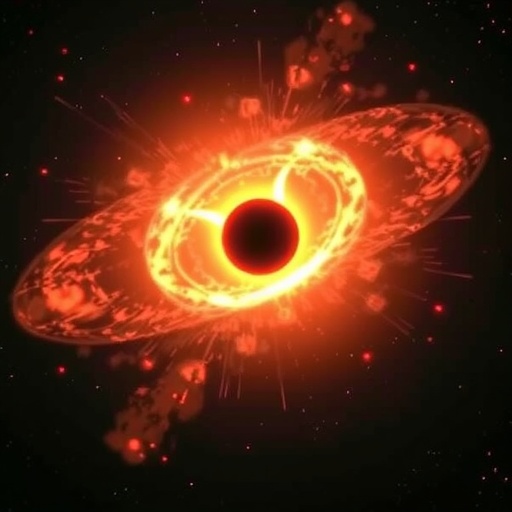
A team of researchers has discovered that the winds generated by supermassive black holes are 100 times more powerful than previously thought, carrying energy across distances of approximately 300,000 light-years. The discovery demonstrates that these explosive winds impact the vast expanse of space beyond the galaxies they inhabit.

“Black holes are largely known for sucking matter in, but they also eject gas in the form of powerful winds,” says Satoshi Yamada, Assistant Professor at Tohoku University’s Frontier Institute for Interdisciplinary Sciences (FRIS). “These winds were thought to be contained within the galaxy, but our study revealed that the force is immensely more powerful than previously understood.”

Yamada and his team, comprising colleagues from Kanazawa University and Tokyo Metropolitan University among others, harnessed the X-ray astronomy satellite XRISM to observe the activity of the quasar H1821+643, which is located in the constellation of Draco, approximately 3.4 billion light-years from Earth. Quasars are extremely luminous objects powered by supermassive black holes that actively consume gas.

The rapidly growing black hole is located at the center of the galaxy cluster, where it drives turbulence in the surrounding hot gas that emits X-rays. The researchers precisely determined the motion of the gas by analyzing the emission lines of iron ions.

High-precision observations by XRISM revealed that the high-temperature gas surrounding the black hole does not remain static, but violently disperses over a wide area due to turbulence. The researchers also confirmed that the flow of gas extends beyond the host galaxy, reaching distances of about 300,000 light-years away. The amount of energy involved in the turbulence was approximately 100 times greater than previous estimates and equivalent to several billion supernova explosions – the explosions that occur when stars reach the end of their lives.

“For the first time, we have shown that black holes influence the broader cosmic environment through a shock wave of astonishing power,” adds Yamada. “Black holes are key drivers of gas flows and motion in space, transporting vast amounts of energy to different regions of the cosmos.”

Details of the research were published in the journal Nature Astronomy on July 28, 2026.

Future observations are expected to further clarify the effects of black holes on their surrounding environment and how matter and elements circulate throughout the cosmos.


Journal

Nature Astronomy

DOI

10.1038/s41550-026-02939-x

Article Title

Vigorous turbulence driven by quasar-mode feedback in a cluster core

Article Publication Date

28-Jul-2026

Media Contact

Public Relations Office

Tohoku University

public_relations@grp.tohoku.ac.jp

Journal
Nature Astronomy
DOI
10.1038/s41550-026-02939-x
Tags: 000 light-yearsastrophysics black hole researchblack hole feedback mechanismsblack hole impact on galaxy clustersblack hole outflows and galaxy formationblack hole wind reach 300black hole-driven galaxy regulationcosmic scale black hole emissionsgalaxy evolution and black hole influencegalaxy-black hole relationshiphierarchical universe structureSupermassive black hole energy jets
Share26Tweet16
Previous Post

Taufer Leads NSF-Funded $9 Million Team to Accelerate AI-Driven Discovery

Next Post

Comment on: ‘Modelled impact of a multi-cancer early detection screening programme on cancer treatment in England

Related Posts

Zhurong Observations Reveal Primary Evaporite Deposits in Mars Utopia Planitia
Space

Zhurong Observations Reveal Primary Evaporite Deposits in Mars Utopia Planitia

July 29, 2026
NASA’s Juno takes the subsurface temperature of Jupiter’s fiery moon
Space

NASA’s Juno takes the subsurface temperature of Jupiter’s fiery moon

July 29, 2026
Solar Wind Entropy Rises Nonadiabatically, Driven by Velocity Spikes
Space

Solar Wind Entropy Rises Nonadiabatically, Driven by Velocity Spikes

July 28, 2026
Hierarchical Porous Carbon Enables Dual-Ion Relay Storage in Zinc Hybrid Capacitors
Space

Hierarchical Porous Carbon Enables Dual-Ion Relay Storage in Zinc Hybrid Capacitors

July 28, 2026
Cavity-Assisted Nonlocal Metasurfaces Enable Efficient Broadband Optical Vortex Generation
Space

Cavity-Assisted Nonlocal Metasurfaces Enable Efficient Broadband Optical Vortex Generation

July 27, 2026
Variable Super-PeVatron in Cygnus X-3 Enables New Era of Time-Domain Astronomy
Space

Variable Super-PeVatron in Cygnus X-3 Enables New Era of Time-Domain Astronomy

July 27, 2026
Next Post
Comment on: ‘Modelled impact of a multi-cancer early detection screening programme on cancer treatment in England

Comment on: ‘Modelled impact of a multi-cancer early detection screening programme on cancer treatment in England

  • Mothers who receive childcare support from maternal grandparents show more

    Mothers who receive childcare support from maternal grandparents show more parental warmth, finds NTU Singapore study

    27656 shares
    Share 11059 Tweet 6912
  • University of Seville Breaks 120-Year-Old Mystery, Revises a Key Einstein Concept

    1061 shares
    Share 424 Tweet 265
  • Bee body mass, pathogens and local climate influence heat tolerance

    682 shares
    Share 273 Tweet 171
  • Researchers record first-ever images and data of a shark experiencing a boat strike

    546 shares
    Share 218 Tweet 137
  • Groundbreaking Clinical Trial Reveals Lubiprostone Enhances Kidney Function

    531 shares
    Share 212 Tweet 133
Science

Embark on a thrilling journey of discovery with Scienmag.com—your ultimate source for cutting-edge breakthroughs. Immerse yourself in a world where curiosity knows no limits and tomorrow’s possibilities become today’s reality!

RECENT NEWS

  • Preparation and characterization of hydrophobic ion paired ciprofloxacin-loaded inhalable liposomal dry powder
  • Psychological impact of body mass index changes in older adults: a 12-year longitudinal study
  • In vivo CRISPR base editing for treatment of Huntington’s disease
  • Comment on: ‘Modelled impact of a multi-cancer early detection screening programme on cancer treatment in England

Categories

  • Agriculture
  • Anthropology
  • Archaeology
  • Athmospheric
  • Biology
  • Biotechnology
  • Blog
  • Bussines
  • Cancer
  • Chemistry
  • Climate
  • Earth Science
  • Editorial Policy
  • Marine
  • Mathematics
  • Medicine
  • Pediatry
  • Policy
  • Psychology & Psychiatry
  • Science Education
  • Social Science
  • Space
  • Technology and Engineering

Subscribe to Blog via Email

Enter your email address to subscribe to this blog and receive notifications of new posts by email.

Join 5,147 other subscribers

© 2025 Scienmag - Science Magazine

Welcome Back!

Login to your account below

Forgotten Password?

Retrieve your password

Please enter your username or email address to reset your password.

Log In
No Result
View All Result
  • HOME
  • SCIENCE NEWS
  • CONTACT US

© 2025 Scienmag - Science Magazine

Discover more from Science

Subscribe now to keep reading and get access to the full archive.

Continue reading
