


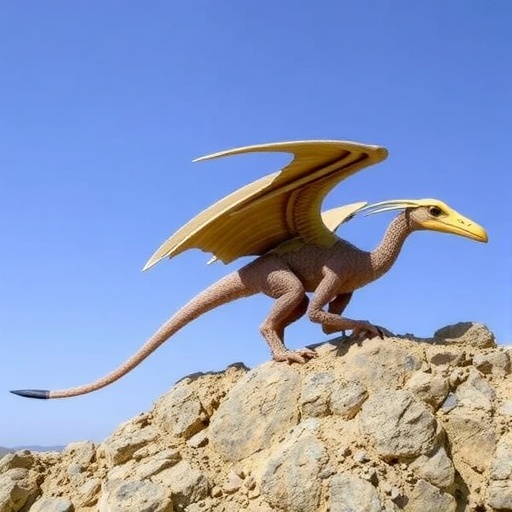
In an extraordinary glimpse into the evolutionary past, scientists have unveiled a remarkable new fossil bird species whose extravagant tail feathers drastically challenge our understanding of early avian display and sexual selection. This extraordinary discovery, published in PLOS One, describes the enantiornithine bird dubbed Plumadraco bankoorum, affectionately known as the “feathered dragon,” which thrived during the early Cretaceous period approximately 121 million years ago. The fossil showcases tail feathers that extend to nearly twice the length of the bird’s body, a feature unparalleled in both scale and proportion among ancient birds.
This new species, roughly the size of a modern American robin, exhibits tail feathers roughly a foot in length, indicating that the evolution of exaggerated ornamental traits in birds traces back far deeper than previously thought. These feathers not only imply a sophisticated mechanism of visual courtship display but also reveal critical aspects of early avian physiology previously inaccessible to paleontology. The significance of Plumadraco lies in its intimate link to sexual selection — the selective pressures exerted by mate choice — which appears to have been a driving evolutionary force well before the asteroid impact that eradicated most dinosaur lineages.
Birds are modern dinosaurs, having survived the cataclysmic events that extinguished their non-avian cousins 66 million years ago, yet the enantiornithines, the group to which Plumadraco belonged, did not survive the mass extinction. This group was among the most diverse and widespread of early birds during the Cretaceous, but they vanished alongside many other species at the end of the period. The Plumadraco fossil, therefore, serves as a window into this lost lineage’s evolutionary biology, particularly their early use of ornamental features in sexual signaling.
Alex Clark, a PhD candidate at the Field Museum and the University of Chicago, led the research team that uncovered the fossil at China’s Shandong Tianyu Museum. The specimen stood out due to its wildly disproportionate tail feathers, suggesting a function beyond mere aerodynamics or thermoregulation. Clark’s deep interest in avian mating displays allowed him to hypothesize that such exaggerated feathers could serve a role analogous to the ornate plumage of contemporary bird species, where males flaunt extensive decorative features to attract females.
Detailed morphological comparisons showed that the tail feathers of Plumadraco possessed unique structural adaptations. Hardened spines formed the feathers’ central shafts, culminating in elegant tapering tips. This construction not only provided rigidity but also implied limited mobility in the tail itself. Nevertheless, muscle remnants in related enantiornithine fossils reveal that these birds could elevate and depress their tail feathers. This movement, Clark suggests, would enable dynamic visual displays—a “flickering” of feather tips enticing potential mates—which parallels courtship rituals of many extant species where males use tail movement to enhance visual signals.
Identifying the sex of fossilized birds remains notoriously challenging due to the scarcity of soft tissue preservation, including reproductive organs. However, the extraordinary tail feather length in Plumadraco strongly suggests sexual dimorphism, with males likely exhibiting elaborate plumes as a display trait to allure females. This inference aligns with observations in modern birds, where such extensive feather elongations are predominantly found in males, underlining the selective pressures of female choice shaping male phenotype.
Chemical analyses using non-destructive handheld mass spectrometry brought further insights into the coloration of Plumadraco’s plumage. The fossilized melanin residues indicate a predominance of dark brown or black hues in its tail feathers. Nevertheless, Clark’s team posits that some iridescence or subtle color highlights could have adorned the feather tips, possibly blue or structurally derived hues that evade pigment detection. This finding echoes the intricate coloration strategies employed by contemporary birds, where structural coloration adds dynamic visual effects without relying on conventional pigments.
These revelations underscore a compelling narrative that sexual selection and extravagant physical ornamentation are ancient evolutionary phenomena intricately woven into the avian lineage. The Plumadraco fossil extends the timeline for the emergence of costly display features, underscoring the persistent role of mate selection in shaping morphology through deep geological time. This fossil serves as a benchmark in paleobiology, indicating that complex behavioral traits influencing appearance were already firmly established over 120 million years ago.
By integrating fossil anatomy with modern comparative biology, this discovery enhances our comprehension of the evolutionary trajectory of birds. It enriches our understanding of how mating systems influenced morphological diversification long before modern bird clades arose. Not only does Plumadraco shed light on the physical attributes of its species, but it also offers invaluable clues about behavioral ecology in prehistoric ecosystems.
The exceptional condition of the Plumadraco fossil, combined with state-of-the-art analytical techniques, enables unprecedented reconstructions of extinct species’ biology. These insights pave the way for future research exploring the interaction between anatomy, ecology, and evolution in early birds and offer a profound perspective on the origins of sexual displays that continue to captivate the natural world today. This finding eloquently demonstrates that the vivid displays seen in modern birds have an ancient patriarch, the faint echo of which resonates across millions of years.
Plumadraco bankoorum epitomizes the complexity and beauty of avian evolution, mirroring phenomena observable in extant species from peacocks to birds-of-paradise. This ornate feathered dinosaur not only rewrites chapters of evolutionary history but also deepens the mystery and allure surrounding birds’ extraordinary adaptations and their spectacular visual signals. As paleontologists continue to unravel secrets from deep time, such discoveries weave a vivid tapestry of life’s dynamic history, emphasizing the timeless interplay between natural selection and mate choice.
Web References:
10.1371/journal.pone.0347641
Cite Scienmag News
Gavin Prescott. (May 27, 2026). Feathered Dragon Reveals Record-Breaking Long Tail Feathers Among Fossil Birds. Scienmag. https://scienmag.com/feathered-dragon-reveals-record-breaking-long-tail-feathers-among-fossil-birds/
Gavin Prescott. "Feathered Dragon Reveals Record-Breaking Long Tail Feathers Among Fossil Birds." Scienmag, 27 May 2026, https://scienmag.com/feathered-dragon-reveals-record-breaking-long-tail-feathers-among-fossil-birds/. Accessed 5 September 2026.
Gavin Prescott. "Feathered Dragon Reveals Record-Breaking Long Tail Feathers Among Fossil Birds." Scienmag. May 27, 2026. https://scienmag.com/feathered-dragon-reveals-record-breaking-long-tail-feathers-among-fossil-birds/


