


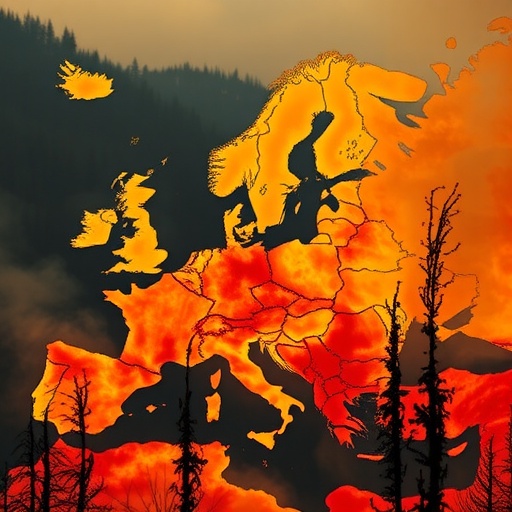
Europe could face a dramatic expansion of wildfire activity by the end of this century as climate change intensifies the hot, dry and windy conditions that allow fires to ignite, spread and overwhelm suppression efforts, according to a new study led by the Potsdam Institute for Climate Impact Research. The researchers estimate that the amount of land burned across Europe each year could rise by approximately 39 percent under a comparatively low-emissions scenario. Under a much higher-emissions pathway, the increase could reach about 192 percent compared with today’s average. The findings suggest that wildfire risk is no longer confined to the continent’s traditionally fire-prone Mediterranean regions. As the climate warms, areas of Western and Central Europe that have historically experienced relatively few large fires could increasingly become exposed to dangerous fire conditions.
The study, published in Global Change Biology, compares projected annual burned area between 2070 and 2100 with a modelled reference period covering 2000 to 2030. The researchers examined two possible climate futures. In the lower-emissions scenario, SSP1-2.6, global warming reaches roughly 1.8 degrees Celsius relative to the pre-industrial period. In the higher-emissions scenario, SSP3-7.0, warming approaches approximately 3.6 degrees Celsius. These scenarios are not simply different temperature forecasts; they represent alternative pathways for population growth, energy use, land management and greenhouse-gas emissions. By linking climate projections with fire behaviour, the study illustrates how decisions made today could influence the geographic scale and intensity of wildfire threats for decades to come.
“Climate change is driving up fire activity across Europe as hot, dry and windy conditions become more severe,” said Maik Billing, a researcher at the Potsdam Institute for Climate Impact Research and lead author of the study. Fire activity depends on more than temperature alone. Heat accelerates evaporation from soils and vegetation, while prolonged rainfall deficits reduce the moisture content of forests, grasslands and agricultural landscapes. Wind can then rapidly transport flames and embers across dry terrain, making fires harder to predict and contain. Together, these factors create what scientists describe as dangerous fire weather: atmospheric and surface conditions that increase the probability of ignition, rapid fire spread and extensive burning.
The projected changes are particularly significant because fire risk can rise sharply when several environmental thresholds are crossed at the same time. Hot air increases the drying power of the atmosphere, allowing it to draw moisture from plants and soils. Dry vegetation becomes more flammable, and a larger share of the landscape can act as fuel. Strong winds intensify combustion by supplying oxygen and carrying burning embers ahead of the main fire front. Under these conditions, a fire that might once have been controlled quickly can develop into a fast-moving event capable of jumping roads, firebreaks and other natural barriers. The models therefore point not merely to more frequent fires, but to a greater likelihood of large fires that burn extensive areas before emergency services can establish control.
The study indicates that even a relatively low-warming future would bring widespread increases in burned area. Under SSP1-2.6, the researchers calculate that Europe could experience about 39 percent more land burned annually by the end of the century than during the reference period. Under SSP3-7.0, the increase rises to around 192 percent. The largest changes are expected around the Mediterranean, where high temperatures and seasonal drought already create severe fire conditions. However, the high-emissions projections also show substantial growth in wildfire activity across Western and Central Europe. This expansion could affect densely populated regions, infrastructure networks and landscapes that have limited experience with large-scale wildfire preparedness.
The findings arrive during another severe wildfire season in Europe. Data from the European Forest Fire Information System indicated that approximately 550,000 hectares had burned across the European Union by 12 August 2026, about two and a half times the average area recorded by that point during the previous 20 years. Fires in France, Spain and Greece have demonstrated how quickly hot, dry and windy weather can stretch firefighting forces beyond their normal capacity. Although individual wildfire seasons are shaped by local weather, vegetation, land use and human activity, climate change is altering the background conditions in which these events occur. A warmer atmosphere increases the likelihood that multiple regions will experience dangerous fire weather simultaneously, complicating the movement of aircraft, crews and equipment between countries.
The researchers also examined how human action could modify the projected outcome. In a second modelling approach developed with contributions from scientists at the Senckenberg Society for Nature Research, the study simulated the effects of improved wildfire prevention, detection and suppression. The results suggest that continued advances in fire management could reduce burned area by as much as 92 percent in a future with approximately 1.8 degrees Celsius of warming. In the higher-warming scenario, effective management could reduce the projected burned area by about 72 percent. These estimates highlight the importance of reducing ignition risks, monitoring landscapes for early signs of fire and deploying trained crews before fires become too large to contain.
Prevention and response measures operate at several stages of the wildfire cycle. Reducing the accumulation of dry vegetation can limit the amount of available fuel, while public education and restrictions on high-risk activities can lower the number of human-caused ignitions. Satellite observations, aircraft and ground-based sensor networks can help identify fires during their earliest stages. Fire crews equipped with reliable communications, protective gear and appropriate vehicles can then attack the fire before it develops a broad and intense front. Coordination between national and regional authorities is also essential, particularly when several fires occur at once. The study’s results indicate that investment in these measures could significantly alter the amount of land ultimately burned, even as climate conditions become more dangerous.
However, the authors warn that the estimated benefits of fire management may be optimistic in the warmest future. Existing models are based partly on the historical relationship between fire conditions and suppression success, but that relationship may weaken as fires become more extreme. When flames generate their own winds, spread through continuous dry vegetation or produce large numbers of airborne embers, conventional containment methods can fail. Firefighting resources may also be overwhelmed if extreme events occur simultaneously across several countries. “If fires become really extreme, our ability to contain them might break down and we do not know yet where this point is,” said Thomas Hickler, a Senckenberg scientist and co-author of the study. Recent record-breaking fires in France, he added, show why past experience cannot simply be projected into a much warmer future.
The researchers stress that stronger fire management cannot replace rapid reductions in greenhouse-gas emissions. Lower emissions would reduce the degree to which heat, drought and atmospheric dryness intensify, helping to limit the expansion of fire-prone conditions. At the same time, communities will need to adapt to the risk that can no longer be avoided. Kirsten Thonicke, a scientist at the Potsdam Institute for Climate Impact Research and co-author of the study, said climate change could eventually push fire conditions beyond the limits of what prevention and suppression systems can handle once fires reach a certain size. The study’s central message is therefore twofold: cutting emissions remains essential to prevent the most severe escalation of wildfire risk, while sustained investment in local preparedness, early warning systems and professional firefighting will be crucial for protecting Europe from the fires already becoming more likely.
News Publication Date: 20-Aug-2026
Web References: https://doi.org/10.1111/gcb.71043
References: Billing, M. et al., “Future projections of burned area in Europe highlight the importance of human action,” Global Change Biology, DOI: 10.1111/gcb.71043.
Cite Scienmag News
Sloane Callahan. (August 20, 2026). Climate change could nearly triple wildfire-affected areas across Europe. Scienmag. https://scienmag.com/climate-change-could-nearly-triple-wildfire-affected-areas-across-europe/
Sloane Callahan. "Climate change could nearly triple wildfire-affected areas across Europe." Scienmag, 20 August 2026, https://scienmag.com/climate-change-could-nearly-triple-wildfire-affected-areas-across-europe/. Accessed 4 September 2026.
Sloane Callahan. "Climate change could nearly triple wildfire-affected areas across Europe." Scienmag. August 20, 2026. https://scienmag.com/climate-change-could-nearly-triple-wildfire-affected-areas-across-europe/


