


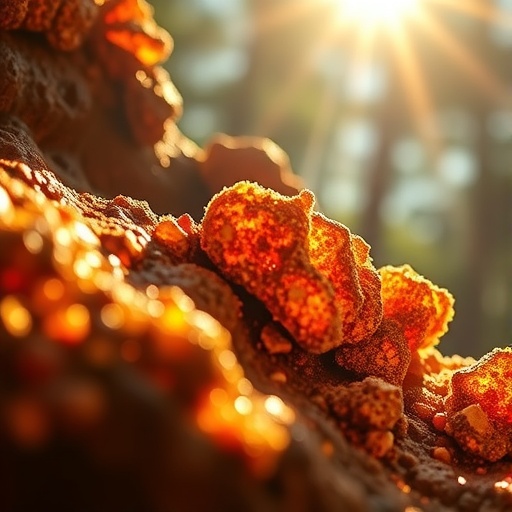
Sunlight may be quietly rewriting the chemistry of Earth’s surface—and iron minerals could be at the center of the transformation. A new review in Nature Reviews Earth & Environment examines how solar radiation changes interactions between iron-bearing minerals and dissolved organic matter, or DOM, across soils, rivers, wetlands, lakes, coastal waters and other exposed environments. These interactions are often described as a natural mechanism for locking organic carbon onto mineral surfaces, potentially slowing decomposition and helping ecosystems retain carbon. But the emerging picture is far more dynamic. Under sunlight, iron minerals and DOM can trigger one another’s breakdown, rearrangement and chemical activation, influencing how carbon moves through the environment and how pollutants are transformed along the way.
Iron minerals are among the most reactive and widespread components of Earth’s surface. In soils and sediments, minerals such as ferrihydrite, goethite, hematite and magnetite can bind organic molecules through adsorption, surface complexation and coprecipitation. These processes may protect some forms of organic carbon from microbial degradation. Yet the mineral surface is not a permanent vault. Solar radiation can alter the oxidation state, structure and reactivity of iron, especially when minerals are in contact with water and organic compounds. Light-driven reactions can dissolve portions of a mineral, convert one iron phase into another or expose new reactive surfaces. As a result, carbon once associated with a solid mineral may be released into the surrounding water, chemically modified or fully mineralized into carbon dioxide.
The key to this sunlight-driven chemistry is the movement of electrons. Iron commonly cycles between ferric iron, Fe(III), and ferrous iron, Fe(II). When iron minerals absorb light, electrons can be promoted into higher-energy states or transferred through mineral defects and surface-bound molecules. DOM can act as both an electron donor and an electron acceptor, depending on its molecular composition and the surrounding conditions. Light-absorbing components of DOM, including aromatic and quinone-like structures, may pass electrons to iron minerals. This can reduce Fe(III) to Fe(II), destabilize mineral structures and accelerate dissolution. In other cases, iron minerals can withdraw electrons from DOM, initiating the breakdown of complex carbon molecules into smaller, more mobile compounds.
The chemistry becomes even more powerful when sunlight produces reactive oxygen species. Photoexcited DOM can transfer energy to oxygen, generating singlet oxygen, superoxide and, through subsequent reactions, hydrogen peroxide and hydroxyl radicals. These short-lived molecules are chemically aggressive: they can attack aromatic carbon structures, cleave larger organic molecules and transform contaminants that would otherwise persist in water or sediment. Iron cycling can amplify these reactions. Fe(II) may react with hydrogen peroxide through Fenton-type chemistry, producing hydroxyl radicals capable of oxidizing a wide range of organic compounds. At the same time, iron minerals can consume, generate or redirect reactive oxygen species, meaning that the same mineral surface may either preserve organic carbon or promote its destruction depending on light intensity, oxygen availability and molecular composition.
This creates a fundamental challenge for carbon-cycle calculations. If researchers treat iron minerals primarily as stabilizers of organic matter, they may overlook conditions in which sunlight reverses that effect. A mineral-bound carbon pool can be stable in darkness but become vulnerable at the surface, where solar radiation penetrates water films, shallow sediments, wet soils and exposed mineral deposits. The result may be a pulse of dissolved carbon, followed by further oxidation or microbial consumption. Some reactions can increase the production of carbon dioxide, while others create smaller organic molecules that remain dissolved and travel downstream. In this way, photochemical activity may connect carbon reservoirs that are often measured separately, linking mineral surfaces, pore waters, rivers, coastal zones and the atmosphere.
The consequences extend beyond carbon itself. Iron minerals and DOM frequently interact with contaminants, including metals, metalloids, pesticides, pharmaceuticals and other industrial chemicals. Organic matter can coat mineral surfaces, change their charge and control whether contaminants are adsorbed or released. Sunlight may then alter the coating or reduce the mineral, weakening the bonds that hold contaminants in place. Alternatively, newly formed iron phases may capture contaminants more efficiently. Reactive oxygen species generated during these reactions can transform pollutants into products that are less toxic, more mobile or, in some cases, even more hazardous than the original compounds. The chemical fate of a contaminant therefore depends not only on its own structure but also on the mineral phase, DOM composition, water chemistry and history of light exposure.
Environmental conditions can determine which pathway dominates. Acidity affects iron solubility and the electrical charge of mineral surfaces. Oxygen availability governs whether reduced iron is rapidly reoxidized and whether reactive oxygen species accumulate. Salinity can compress electrical double layers and alter mineral aggregation, while competing ions may displace organic molecules or contaminants from surfaces. Temperature, water depth, turbidity and the duration of wetting regulate how much solar radiation reaches an iron–DOM interface. Seasonal flooding and drying can expose fresh mineral surfaces, concentrate dissolved compounds and create sharp chemical gradients. In wetlands, riverbanks and estuaries, these transitions can produce especially strong spatial heterogeneity, with intense reactions occurring over millimetres or even thinner surface layers.
The molecular identity of DOM is equally important. DOM is not a single substance but a complex mixture assembled from plant residues, microbial products, soil leachates and aquatic transformations. Large aromatic molecules may absorb sunlight efficiently and generate reactive oxygen species, while simpler compounds may be more readily oxidized or consumed by microorganisms. Functional groups containing oxygen, nitrogen or sulfur can bind iron in different ways, changing mineral dissolution and electron transfer. As DOM is photochemically processed, its composition shifts: some molecules fragment into smaller acids and carbonyl compounds, while others become more resistant to further oxidation. This continual molecular turnover means that an iron mineral may encounter a changing sequence of organic partners rather than one stable coating.
The review argues that resolving this complexity will require researchers to combine field observations with controlled laboratory experiments and advanced analytical tools. Techniques capable of tracking iron oxidation states, mineral phases, molecular-level DOM composition and short-lived reactive species can reveal which reactions occur simultaneously and which are separated in time. Spectroscopic methods, high-resolution mass spectrometry, isotope tracing, microscopy and electrochemical measurements could help connect molecular transformations to changes in carbon fluxes. Field studies are particularly important because laboratory systems often use purified minerals and simplified organic compounds, whereas real environments contain mineral mixtures, microbial communities, fluctuating water levels and repeated cycles of sunlight and darkness. Linking these scales could improve models of carbon budgets and help explain why nearby locations sometimes show sharply different carbon and contaminant behavior.
The broader message is that iron and carbon cycles at Earth’s surface are not governed by darkness alone. Solar radiation can turn mineral–organic associations into rapidly changing reaction zones, where carbon is stored, released, reshaped or oxidized and where contaminants may be immobilized or mobilized. Understanding these processes could improve predictions of carbon emissions from soils, sediments and inland waters, particularly as climate change alters flooding, drought, water clarity and the amount of organic matter entering aquatic systems. It could also inform remediation strategies that use iron minerals to capture pollutants or manage carbon. Rather than treating iron minerals as passive containers for organic matter, scientists may need to view them as sunlight-activated chemical engines—capable of protecting carbon under one set of conditions and accelerating its transformation under another.
Cite Scienmag News
Violet Maxwell. (August 19, 2026). Sunlight Reveals How Iron Minerals Interact with Dissolved Organic Matter. Scienmag. https://scienmag.com/sunlight-reveals-how-iron-minerals-interact-with-dissolved-organic-matter/
Violet Maxwell. "Sunlight Reveals How Iron Minerals Interact with Dissolved Organic Matter." Scienmag, 19 August 2026, https://scienmag.com/sunlight-reveals-how-iron-minerals-interact-with-dissolved-organic-matter/. Accessed 3 September 2026.
Violet Maxwell. "Sunlight Reveals How Iron Minerals Interact with Dissolved Organic Matter." Scienmag. August 19, 2026. https://scienmag.com/sunlight-reveals-how-iron-minerals-interact-with-dissolved-organic-matter/


