


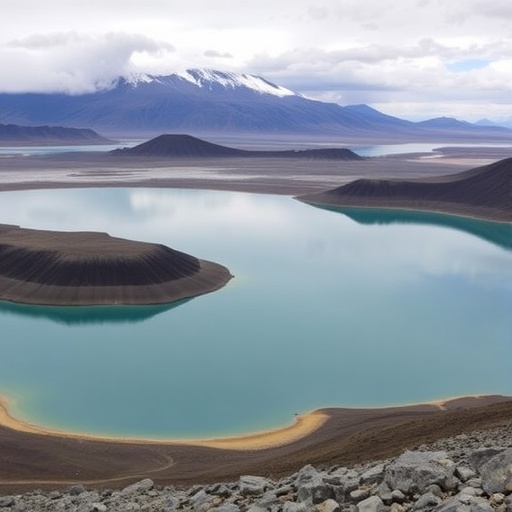
A new study has mapped the deep plumbing system feeding Laguna del Maule, one of Chile’s best-studied supervolcano regions, revealing how magma travels from the crustal reservoir toward the surface. Researchers combine geophysical and modeling approaches to track magma ascent across the crust, offering an unusually detailed look at the mechanisms that can precede volcanic unrest.
The work focuses on “transcrustal” ascent, the journey magma makes through multiple crustal layers. Instead of treating magma movement as a single step, the study characterizes it as a process shaped by changing rock properties with depth, including variations in temperature, density, and mechanical strength.
Using signals that constrain where magma accumulates and how stresses evolve, the team infers that ascent is not purely buoyancy-driven. Elastic and viscoelastic deformation in the crust appears to guide the pathway, while heat and pressure modify surrounding materials. This coupling between magma and the host crust helps explain why some intrusions stall or spread laterally before continuing upward.
A key result is evidence for a conduit-like ascent geometry beneath the caldera area, with magma rising in a manner consistent with segmented or intermittently fed channels. Such a structure can produce complex surface deformation patterns, even when magma flux is relatively low. In other words, the crust can “record” subtle changes in the underground system over time.
The authors also discuss how magma ascent can transfer stress to pre-existing fractures and faults. By loading critical zones, an intrusion may promote permeability changes and localized weakening, allowing magma to exploit transient weaknesses rather than drilling a uniform vertical path.
From a hazard perspective, the findings help connect measurable geophysical observations—such as deformation signals—to physical processes occurring at depth. That link is crucial for interpreting monitoring data from supervolcano provinces, where unrest can persist for years without an eruption.
The study’s 2026 publication in Communications Earth & Environment underscores that monitoring should consider the crust’s rheology and geometry, not just the presence of magma. This perspective may improve how scientists evaluate evolving risk during periods of seismicity and ground deformation.
Overall, the research reframes Laguna del Maule’s underground dynamics as an interacting system: magma ascent, crustal response, and stress redistribution together determine how quickly magma can progress and whether it remains trapped.
If confirmed across other volcanic systems, these insights could sharpen viral public understanding of “what’s happening underground” during unrest—turning abstract deep processes into testable, observation-driven explanations.
Cite Scienmag News
Violet Maxwell. (July 27, 2026). Groundbreaking Findings Show Magma Rising Beneath Laguna del Maule, Chile. Scienmag. https://scienmag.com/groundbreaking-findings-show-magma-rising-beneath-laguna-del-maule-chile/
Violet Maxwell. "Groundbreaking Findings Show Magma Rising Beneath Laguna del Maule, Chile." Scienmag, 27 July 2026, https://scienmag.com/groundbreaking-findings-show-magma-rising-beneath-laguna-del-maule-chile/. Accessed 3 September 2026.
Violet Maxwell. "Groundbreaking Findings Show Magma Rising Beneath Laguna del Maule, Chile." Scienmag. July 27, 2026. https://scienmag.com/groundbreaking-findings-show-magma-rising-beneath-laguna-del-maule-chile/


